Abdominal liposuction is a surgical procedure involving the removal of localised fat deposits using a special cannula. Its main aim is to sculpt the figure, improve body proportions and reduce stubborn fat deposits that have not been reduced through diet or physical activity.
Although the name of the treatment itself may be associated primarily with weight loss, Liposuction is not a method of weight loss. This procedure is primarily used to reshape the contours of a specific part of the body. In the case of the abdomen, it can help reduce localised excess fat and give the figure more harmonious proportions.
However, many questions have arisen regarding the procedure. What exactly does it involve? abdominal liposuction? How long does the recovery take? When can you see the first results, and do they last for years? It is also worth knowing that traditional liposuction It is not the only way to improve the appearance of the abdomen. Advances in aesthetic medicine have led to the development of solutions that allow the body to be contoured without the need for traditional surgery.
Abdominal liposuction - what it is and how it works
Abdominal liposuction It is a surgical procedure designed to reduce fat tissue in a specific area. During the procedure, the doctor uses a thin cannula, which is inserted under the skin through small incisions. Vacuum suction is then used to remove excess fat from the pre-determined area.
The procedure requires a high degree of precision. The doctor should not focus solely on the amount of fat removed, but above all on maintaining the correct body proportions. Excessively aggressive liposuction can lead to unevenness of the skin’s surface, which is why proper planning of the procedure is of the utmost importance for the final result.
When it comes to the abdomen, it is also important to take into account neighbouring areas, such as the waist and the hips. Shaping the transitions between the different areas appropriately can make the result look more natural.
Liposuction as a method of body contouring
It is worth emphasising that Abdominal liposuction is not intended for weight loss. The procedure is not intended to treat excess weight or obesity. Its primary purpose is to remove localised fat deposits in people whose body weight is relatively stable.
That is precisely why liposuction It may be considered by people who, despite leading a healthy lifestyle, still experience a disproportionate accumulation of fat in a specific area. However, this does not mean that the procedure is a substitute for a healthy diet and physical activity. Maintaining a stable body weight remains one of the most important factors in preserving the results of body contouring.
Indications for abdominal liposuction
One of the main reasons for considering the procedure is localised fat deposits on the abdomen. It can occur in both the lower and upper abdomen, as well as around the waist. For some people, fat in this area is particularly resistant to lifestyle changes.
However, eligibility for the procedure is not determined solely by the amount of body fat. During the consultation, the doctor also takes into account the quality of the skin, its elasticity, your general state of health and your expectations regarding the results.
This is particularly important because reducing belly fat It does not always automatically result in a flat and firm stomach. If the skin is significantly stretched or loose, liposuction alone may not solve the problem.
A step-by-step guide to abdominal liposuction
The procedure for abdominal liposuction It depends on the technique chosen, the extent of the procedure and the individual’s body type. However, the entire procedure begins well before the first incision is made.
Consultation and assessment for the procedure
The first stage is a medical consultation. During the appointment, the specialist assesses the distribution of body fat, the condition of the skin and the patient’s general state of health. They also discuss the patient’s expectations and determine whether it is possible to achieve the desired result.
It is during the consultation that the doctor should explain the appropriate scope of the treatment and what results can realistically be expected. The doctor also discusses any contraindications, possible side effects, how to prepare for the procedure, and the recovery process.
Preparation of the treatment area
Before the procedure begins, the doctor carefully identifies the area to be contoured. This is important for maintaining the proportions of the entire figure.
The treatment area is then prepared, and the patient is given the appropriate anaesthesia. The type of anaesthesia depends, amongst other things, on the scope of the planned procedure and the patient’s individual circumstances.
Insertion of the cannula and suction of adipose tissue
In traditional liposuction, the doctor makes small incisions through which a thin cannula is inserted. The fat tissue is then suctioned out using the appropriate technique.
This stage requires particular precision, as the way the cannula is guided affects the subsequent appearance of the skin. The aim is to reduce fat tissue evenly and achieve a smooth, natural contour.
Shaping the abdominal contour
Simply removing fat is not in itself enough to achieve an attractive result. It is important to contour the entire abdominal and waist area appropriately.
The doctor takes into account the body’s natural build, the distribution of body fat and the proportions between the various body parts. As a result, the results of abdominal liposuction they can be more harmonious and better suited to the figure.
The results of abdominal liposuction
The most significant result of the treatment is a reduction in localised fat deposits and an improvement in the contour of the abdomen. The figure may become slimmer and the waist more clearly defined.
However, you should not assess the results immediately after the procedure. In the first few days and weeks, swelling occurs, and bruising and increased tissue sensitivity may develop. These are natural parts of the healing process.
As time goes by, the swelling gradually subsides and the body’s contours become more visible. The final result of abdominal liposuction It therefore requires patience and adherence to the doctor’s advice.
The longevity of the results following liposuction
Fat cells removed during the procedure are not regenerated in the same way. However, this does not mean that any subsequent weight gain will have no effect on your figure.
The remaining fat cells may increase in volume, which is why significant weight gain can alter body proportions. For this reason, maintaining a stable weight is important for sustaining the results.
Liposuction should therefore be regarded as a means of achieving long-term contouring of a specific area, rather than a solution that prevents the subsequent accumulation of body fat.
Abdominal liposuction and excess skin
One of the most important aspects of assessing suitability for the procedure is evaluating the condition of the skin. Liposuction removes fat tissue, but it does not remove excess skin.
If the skin is firm and sufficiently elastic, it can gradually adapt to the new body contour once the volume of adipose tissue has been reduced. However, in cases of significant skin laxity, the result may differ from what is expected.
Excess skin can occur, amongst other things, following significant weight loss, pregnancy or as part of the natural ageing process. In such situations, liposuction alone may not be sufficient to improve the appearance of the abdomen.
Side effects and possible complications of liposuction
Like any surgical procedure, Abdominal liposuction carries a risk of side effects. In the initial period following the procedure, swelling, bruising, pain, a feeling of tightness and temporary sensory disturbances may occur.
In some cases, there may be irregularities in the contour, asymmetry or visible scars at the incision sites. There are also more serious, though rarer, complications associated with surgical procedures, such as infection, bleeding, thrombosis or fluid build-up.
The risks depend, amongst other things, on the extent of the procedure, the patient’s state of health and the technique used. For this reason, the decision to undergo the procedure should always be preceded by a detailed medical consultation.
Recovery following abdominal liposuction
Recovery after liposuction It is an important stage in the whole process. Immediately after the procedure, the body begins the healing process, which may be accompanied by swelling, bruising and a feeling of discomfort.
Depending on the technique used and your doctor’s advice, you may need to wear compression garments. Their purpose is, amongst other things, to reduce swelling and support the healing process.
Returning to one’s daily responsibilities is a matter of individual circumstance. People in jobs that do not require physical exertion may be able to return to work sooner than patients whose work involves a heavy physical strain.
Returning to training should also be done gradually and in accordance with a specialist’s advice. Starting intensive activity too soon may put unnecessary strain on healing tissues.
Abdominal liposuction versus laser liposuction
Advances in the technologies used in aesthetic medicine mean that methods utilising laser energy to improve the appearance of the body are now also available.
However, it is worth distinguishing between conventional liposuction and laser procedures. In a traditional procedure, fat tissue is physically removed using a cannula and negative pressure. Laser liposuction It may, however, refer to various techniques that utilise laser energy, and not all of them involve surgical liposuction.
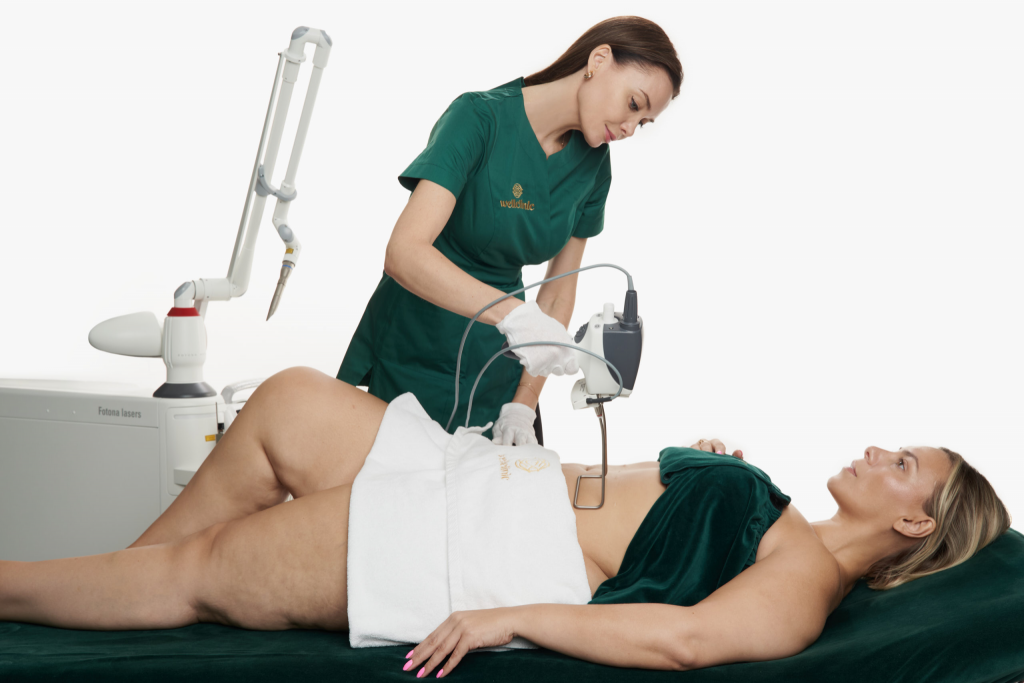
At Wellclinic, the following protocol is used Tight Sculpting, which utilises Fotona laser technology. The procedure is designed to target localised fat deposits and improve the appearance and firmness of the skin, without the need for traditional surgical incisions.
Non-surgical tummy contouring
Not everyone who wants to reduce localised excess body fat is willing to undergo surgery. For some patients, the option of undergoing a procedure without traditional incisions and the associated recovery period is important.
Contemporary non-invasive body shaping methods They enable you to target specific areas of the body using state-of-the-art technology. One of the treatments offered at Wellclinic is Tight Sculpting.
The procedure uses laser energy to target tissues, helping to address localised fat deposits and improve the appearance of the skin. As such, it can be a solution for people who wish to contour their abdomen but are not interested in traditional surgery.
Choosing the right body-shaping method
The choice of the appropriate procedure should always be based on an individual assessment of the patient. It is not only the amount of body fat that matters, but also its distribution, the quality of the skin, its elasticity and the expected result.
If there is a significant amount of localised fat, the doctor may consider a surgical procedure. Where the problem is less severe but there is also a need to improve skin tone, non-invasive methods may be an option.
Therefore pre-treatment medical consultation for body contouring It is a crucial stage in the whole process. It enables us to assess the capabilities of a particular method and tailor the solution to individual needs.
A modern approach to reducing body fat
Abdominal liposuction It is a surgical method for reducing localised fat deposits. Its primary aim is to improve the body’s contours and body modelling, rather than weight loss.
The procedure involves inserting a cannula through small incisions and mechanically removing fat tissue. This can result in a reduction in the circumference of a specific area of the body and an improvement in the proportions of the abdomen and waist.
It is important to bear in mind, however, that traditional liposuction is a surgical procedure and therefore involves a recovery period and the risk of side effects. A proper assessment and medical consultation will help determine whether this is the right method for a particular individual.
If the aim is reducing belly fat, but if you’d also like to avoid traditional surgery, it’s worth discussing the options for non-invasive body contouring during your consultation. Modern technologies, such as Tight Sculpting, offer a different approach to tackling localised fat deposits, without the need for surgical liposuction.
Sources:
- U.S. Food and Drug Administration (FDA) „Non-Invasive Body Contouring Technologies”
https://www.fda.gov/medical-devices/aesthetic-cosmetic-devices/non-invasive-body-contouring-technologies - U.S. Food and Drug Administration (FDA) „Suction Lipoplasty System”
https://www.accessdata.fda.gov/scripts/cdrh/cfdocs/cfPCD/classification.cfm?id=QPB - PubMed „Risks and Complication Rates in Liposuction: A Systematic Review and Meta-Analysis”
https://pubmed.ncbi.nlm.nih.gov/38563572/ - PubMed „Complications of Aesthetic Liposuction Performed in Isolation: A Systematic Literature Review and Meta-Analysis”
https://pubmed.ncbi.nlm.nih.gov/38433796/ - PubMed „Laser-Assisted Liposuction (LAL) Versus Traditional Liposuction: A Systematic Review”
https://pubmed.ncbi.nlm.nih.gov/29362943/