
 Katarzyna Pawłowska

 03.11.2026
Table of contents
A botched facelift may result in an outcome that differs from the patient’s expectations. Excessively tight skin, an unnatural appearance, asymmetrical features or visible scars can make the face look different from what was anticipated before the operation. What can be done in such a situation? The course of action depends primarily on the cause of the problem and the extent of the changes in the tissues.
Not every unsatisfactory change indicates a permanent complication. Immediately after the operation, the face may be swollen, and bruising and temporary asymmetry may also occur. You will need to wait until the healing process is complete to see the final result. However, if any abnormalities persist, it is worth consulting your doctor to determine whether surgical correction will be necessary, or whether less invasive methods of improving the skin’s appearance will suffice.
A botched facelift – symptoms you shouldn’t ignore
Effect face lift It should improve the proportions and firmness of the tissues whilst preserving natural features. Problems arise when, following the operation, the face loses its previous range of facial expressions, the contours become unnatural, or irregularities are visible in the scars.
The most commonly reported problems include:
- excessively taut facial skin, which creates the effect of artificial tension;
- facial asymmetry, particularly around the cheeks, mouth and jawline;
- visible, thickened or healing abnormally scars from a facelift;
- irregularities and depressions in the skin;
- sensory disturbances that persist for longer than would be expected during the typical course of recovery;
- a change to the natural proportions of the face.
A distinction must be made between an unsatisfactory aesthetic result and a medical complication. Worsening pain, fever, redness, discharge from the wound, impaired blood supply to the skin or sudden weakness of the facial muscles require urgent medical attention. You should not attempt to treat such symptoms with cosmetic procedures.
Why can a facelift produce an unnatural result?
The procedure itself is not always the cause of an unsuccessful outcome. The surgical technique, the condition of the tissues prior to surgery, individual healing predispositions and adherence to post-operative instructions all play a role.
One of the problems might be excessive skin tensiony. If the tissues are pulled too tightly, the face may lose the natural softness of its features. The distribution of tension and the extent of intervention in the deeper structures supporting the skin are also important.
The final result is also influenced by healing processes. Some patients develop thickened scars, uneven skin or localised adhesions. Previous cosmetic procedures, as well as the quality and elasticity of the skin, are also significant factors.
It is therefore essential to assess the cause of the problem before choosing a method to improve one’s appearance. A botched facelift Cases involving excessive skin tension require a different approach to visible scars, permanent asymmetry or damage to nerve structures.
How can a botched facelift be corrected? Choosing the right corrective procedure
There is no single procedure that can resolve all problems following a failed operation. The choice of treatment depends on the type of complication, the time that has elapsed since the facelift, and the condition of the tissues.
Corrective surgery following a failed facelift
If the problem is caused by abnormal tissue positioning, significant asymmetry or excessive skin tension, the doctor may suggest correction of a facelift. Depending on the situation, the procedure involves the appropriate release, repositioning or tightening of the tissues.
Follow-up after a previous operation It can be more challenging than the first facelift. There may be scarring and adhesions in the tissues, and their blood supply and elasticity may have changed. For this reason, the decision to undergo a second operation should be made following a thorough consultation with a plastic surgeon.
Laser therapy for improving skin quality
If the problem mainly concerns the skin’s surface, its structure, minor irregularities or signs of photoageing, the doctor may consider laser therapy. Laser energy It triggers a controlled reaction in the tissues, stimulating regenerative processes and collagen remodelling.
Laser treatments They can help improve skin firmness, smoothness and overall quality. However, they are no substitute for surgical correction if the cause of a failed facelift is the incorrect positioning of deeper tissues, nerve damage or significant anatomical deformity.
Micro-needle radiofrequency
Micro-needle radiofrequency It combines micro-needling of the skin with radiofrequency energy. The controlled heating of the tissues stimulates repair processes and the remodelling of collagen fibres.
This method may be considered to improve the firmness, texture and tone of the skin. However, it is not suitable for every patient who has undergone a facelift. The doctor will decide whether it is appropriate after assessing the extent of healing and the condition of the tissues.
Tissue stimulators
Tissue stimulators They support the skin’s natural regenerative processes. Depending on the product used, they can stimulate fibroblast activity and collagen synthesis, which leads to a gradual improvement in tissue density and elasticity.
They are not a treatment for serious post-operative complications. However, they may be used to complement treatment in patients whose main problem is a deterioration in skin quality.
Non-surgical laser facelift – when should you consider it?
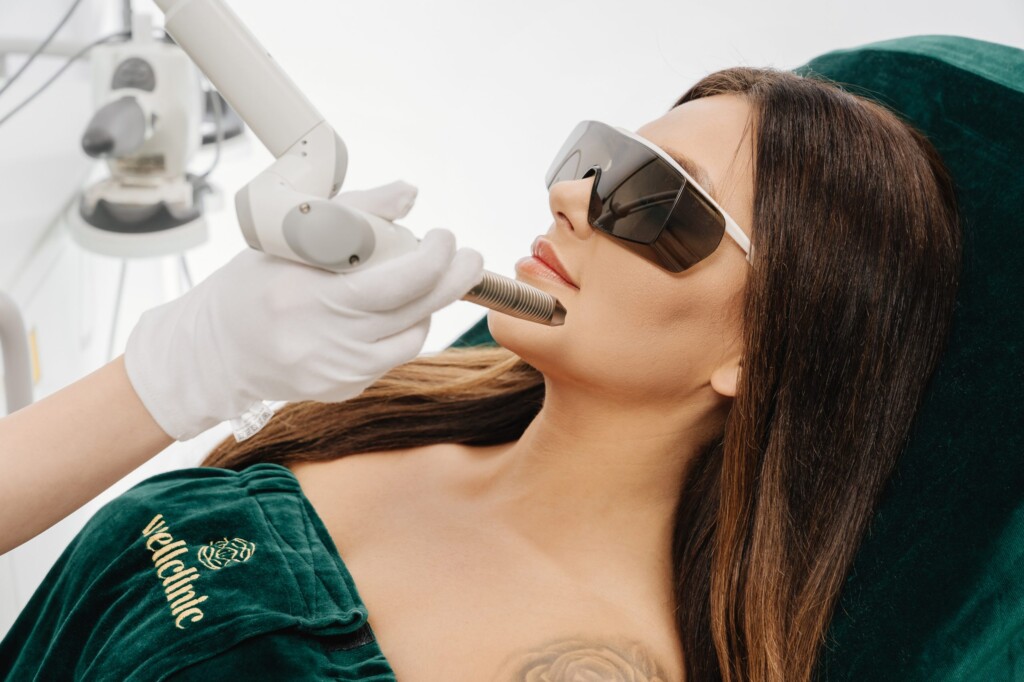
Not every patient who is dissatisfied with the outcome of their operation requires further surgery. If the tissues are correctly positioned and the problem relates primarily to sagging, fine lines or a deterioration in skin texture, one might consider laser face lift.
One of the available methods is 4D endolifting carried out using the platform Fotona Dynamis SP. The treatment uses laser energy to exert a controlled effect on the tissues. Its aim is to improve the skin’s firmness, elasticity and quality, and to stimulate the processes involved in collagen remodelling.
4D endolifting It is not equivalent to a surgical facelift and does not correct all post-operative complications. It may be considered as a method of improving the appearance of the skin in suitably selected patients, provided there are no contraindications to laser treatment.
Before the procedure, it is essential to assess the condition of the skin and tissues. It is particularly important to establish whether the healing process following a previous operation has been completed.
When can a laser treatment be carried out following a surgical facelift?
Completion date laser treatment The recovery period following surgery depends on the extent of the facelift, the course of recovery and the type of procedure planned. There is no single recovery period that is suitable for all patients.
The skin must have healed properly. There should be no active inflammation, unhealed wounds or other concerning lesions. Before starting treatment, the doctor should assess any scars, tissue tension and any sensory disturbances.
Starting intensive treatments too early may place an unnecessary strain on tissues that are in the process of regenerating. Therefore, the decision to laser therapy following a facelift Decisions should be made on a case-by-case basis, preferably after consulting the surgeon performing the operation or a doctor familiar with the procedure.
How can you avoid another unsuccessful anti-ageing treatment?
Following an unsatisfactory outcome from an operation, it is tempting to look for a quick way to improve one’s appearance. However, a further procedure should not be chosen solely on the basis of advertising or the promise of immediate results.
First, you need to determine exactly what needs correcting. Skin with visible scars requires a different approach to tissue with established asymmetry, and a face where the only problem is a loss of firmness requires yet another approach.
Before starting treatment, it is worth:
- consult a doctor with experience in treating complications following cosmetic procedures;
- provide documentation relating to a previous operation and information on the course of recovery;
- discuss the potential effects, limitations and risks of the proposed method;
- ensure that the tissues have healed sufficiently;
- Avoid combining several intensive treatments unless there is a medical reason to do so.
A well-planned treatment programme should take into account the anatomy of the face, the condition of the skin and the patient’s expectations. The aim is not to alter facial features at any cost, but to restore as natural an appearance as possible.
How can you improve the appearance of your face after a botched facelift?
A botched facelift This does not always mean that further surgery is necessary. In some cases, surgical correction may be helpful; in others, the quality of the skin can be improved using laser therapy, microneedle radiofrequency or carefully selected treatments.
The most important thing is to identify the cause of the unsatisfactory result. 4D endolifting, like other non-surgical rejuvenation methods, can improve skin firmness and texture, but it cannot replace treatment for serious post-operative complications.
W At Wellclinic, a consultation takes place before a treatment is selected, during which the condition of the skin is assessed and the suitability of a particular method is evaluated. This allows the treatment plan to be tailored to the actual problem, rather than carrying out yet another treatment without being certain whether it addresses the cause of the unsatisfactory result.
Sources:
1. "The Evolution of Superficial Muscular Aponeurotic System Facelift Techniques: A Comprehensive Systematic Review of Complications and Outcomes."
https://pmc.ncbi.nlm.nih.gov/articles/10819192/
2. PubMed ""Facelift Surgery and Nerve Injury: A Systematic Review and Meta-Analysis".
https://pubmed.ncbi.nlm.nih.gov/40456989/
3. PubMed "A Meta-Analysis of Complication Rates Among Different SMAS Facelift Techniques."
https://pubmed.ncbi.nlm.nih.gov/30768122/
4. PubMed "Radiofrequency Microneedling: A Comprehensive and Critical Review."
https://pubmed.ncbi.nlm.nih.gov/33577211/
5. PubMed "A Scoping Review of Radiofrequency Microneedling: Clinical Application and Outcome Assessment."
https://pubmed.ncbi.nlm.nih.gov/40537669/
6. Limited Incision Facelifts: A Contemporary Review of Approaches and Complications.
https://academic.oup.com/asj/article/44/3/NP218/7405400




 +48 600 100 177