
 Katarzyna Pawłowska
 21.09.2026
 Table of contents
Fotona 4D This is an advanced laser treatment designed to comprehensively improve the quality, firmness and appearance of the facial skin. The technology combines the effects of two types of laser - Er:YAG and Nd:YAG - and four complementary treatment protocols: Endolifting, FRAC3, PIANO and Superfacial.
The multi-level action of the treatment allows you to work simultaneously on the skin’s firmness and tone, as well as its density, texture and complexion. Fotona 4D It can be used in treatments aimed at reducing the appearance of wrinkles, improving facial contours, reducing certain types of discolouration and smoothing the skin’s surface.
This treatment is designed for people looking for non-surgical facelift, who wish to improve the appearance of their skin without undergoing surgery and without the need for fillers.
Fotona 4D - what is this modern laser facelift all about?
Skin ageing It is a multi-factorial process. Over time, the skin’s elasticity and density decrease, wrinkles appear, and the facial contours may gradually lose their definition. At the same time, the structure of the skin’s surface and its tone change.
That is why a comprehensive rejuvenation programme should not focus solely on a single issue. Fotona 4D Laser It utilises several complementary mechanisms that enable it to act on different tissue levels.
Four procedures are used as part of a single course of treatment:
- Endolifting - designed to improve skin firmness and facial contours,
- FRAC3 - which supports skin regeneration and firming,
- PIANO - utilising controlled heating of the deeper layers of the skin,
- Superfacial - a superficial laser peel to improve the appearance and texture of the epidermis.
This combination means that Fotona 4D facial treatment It consists of a multi-stage treatment programme in which the individual procedures complement one another.
Er:YAG and Nd:YAG lasers - why are two wavelengths used?
The Fotona 4D treatment uses two types of laser, which differ in the way they affect the tissues.
Er:YAG laser It is used, amongst other things, in the Endolifting procedure and in the Superfacial protocol. It allows for controlled treatment of specific layers of the skin and epidermis.
Nd:YAG laser 1064 nm It is, however, used in the FRAC3 and PIANO protocols. Its energy enables it to act on deeper layers of tissue and utilise a controlled thermal effect.
Combining these two technologies makes it possible to develop a treatment that targets both the skin’s surface and its deeper structures.
The four stages of the Fotona 4D treatment - Endolifting, FRAC3, PIANO and Superfacial
Each of the four stages of the treatment focuses on a different aspect of improving the skin’s appearance. Combining them enables a comprehensive approach to facial rejuvenation.
Endolifting - improving facial firmness and contour
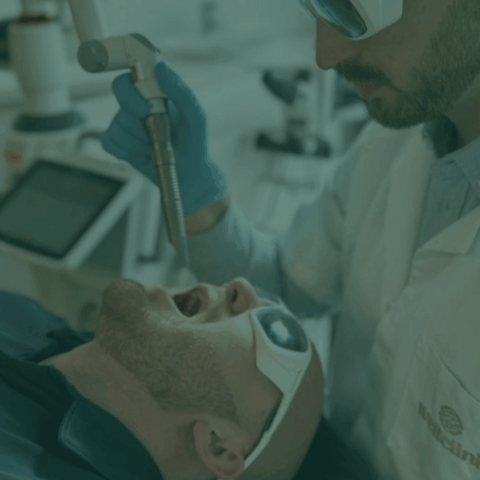
Fotona Endolifting uses non-ablative Er:YAG laser in SMOOTH mode. Laser energy It is applied to the inside of the mouth, including the upper and lower parts of the lips and selected muscle structures.
The treatment allows the tissues beneath the skin’s surface to be targeted without making any incisions. The aim of this part of the therapy is to improve tissue firmness and support facial contouring.
Endolifting is particularly beneficial for visible nasolabial folds, marionette lines and a loss of facial contour definition.
FRAC3 - skin remodelling and tightening
FRAC3 It uses an Nd:YAG laser and targets the deeper layers of the skin.
Laser energy induces controlled thermal effects which stimulate tissue regeneration and remodelling. As part of the treatment, processes associated with the formation of new collagen fibres may be stimulated.
FRAC3 is used to improve:
- skin density,
- firmness,
- voltages,
- skin structures,
- its overall quality.
PIANO - Nd:YAG laser thermolifting
Fotona PIANO This is a treatment protocol that uses a long Nd:YAG laser beam. It works by controlled heating of the deeper layers of the skin.
During the procedure, the tissue temperature may be gradually increased to approximately 42°C, without the need to mechanically damage the surface of the epidermis.
The controlled thermal effect stimulates skin remodelling processes and can help improve skin tone, firmness and density. For this reason, PIANO is often described as Nd:YAG thermolifting.
Superfacial - superficial Er:YAG laser peel
Superfacial It is the final stage of the treatment and uses an Er:YAG laser to deliver controlled energy to the superficial layers of the skin.
The aim is to improve the appearance and texture of the epidermis. The treatment can help to smooth the skin’s surface and reduce the appearance of fine lines, enlarged pores and certain types of discolouration.
After the treatment, the skin may appear smoother, fresher, more even-toned and radiant.
Fotona 4D - what results can be expected after the treatment?
One of the most frequently searched topics is Fotona 4D results. Treatment results vary from person to person and depend, amongst other things, on age, skin condition, the degree of sagging, the parameters used and the number of treatments carried out.
Therapy can help with:
- improved skin tone and firmness,
- increasing its flexibility,
- improved skin density,
- smoothing out fine lines,
- reduction in the appearance of nasolabial folds,
- improving the appearance of the marionette lines,
- improvement of the facial shape and contours,
- smoothing the skin’s texture,
- reduction in the appearance of enlarged pores,
- improved skin tone,
- the reduction of selected discolourations,
- brightens and refreshes the skin.
Fotona 4D for wrinkles and loss of skin firmness
Photona for wrinkles It can be used as part of a comprehensive rejuvenation programme.
The controlled application of laser energy can stimulate skin remodelling processes and support the skin’s natural regenerative mechanisms. As a result, the skin may gradually develop a more uniform texture and improved firmness.
The treatment can be used, amongst other things, for wrinkles around the mouth, fine lines and signs of loss of firmness.
Improving the shape and contours of the face
The loss of a defined facial contour is one of the visible signs of skin ageing. As the skin’s elasticity decreases, the facial contours may become less defined.
Fotona 4D for facial contouring It utilises the multi-level action of Er:YAG and Nd:YAG lasers. Of particular significance here are Endolifting and protocols that make use of a controlled thermal effect.
The aim of the treatment is to improve tissue tone and skin quality, which can result in a more defined facial contour.
Discolouration, enlarged pores and uneven skin texture
Fotona technology It can also be used in treatments aimed at improving the skin’s texture and tone.
Depending on the type of skin condition and individual circumstances, laser treatment may be used, amongst other things, for certain types of discolouration, freckles, acne scars or enlarged pores.
In the case of pigmentary changes, a proper assessment of the skin is essential, as the type and depth of the discolouration are important factors in choosing the appropriate course of action.
Who is the Fotona 4D treatment suitable for?
Fotona 4D It may be considered by people who are noticing the first or more advanced signs of skin ageing and wish to improve the condition of their skin without resorting to surgical methods.
Indications for consultation may include, amongst others:
- loss of skin firmness and elasticity,
- a reduction in skin density,
- fine lines,
- nasolabial folds,
- puppet strings,
- loss of a defined facial contour,
- uneven skin texture,
- enlarged pores,
- discolouration,
- selected acne scars,
- skin that looks grey, tired or lacklustre.
The choice of treatment should always take into account the individual condition of the skin and the patient’s expectations.
What does the Fotona 4D treatment involve, and what is the recovery process like?
Before the treatment is carried out, a consultation takes place during which the condition of the skin, the treatment area and any possible contraindications are assessed.
The treatment itself comprises the successive stages of Fotona 4D therapy. Depending on the parameters used, the patient may feel warmth, a gentle tingling sensation or a more intense sensation of heat on the skin.
Fotona 4D uses non-surgical laser protocols, so the time away from daily activities may be limited. However, temporary redness, a sensation of warmth or increased skin sensitivity may occur after the treatment.
The duration and course of recovery depend on the protocol used, the treatment parameters and the individual skin’s response.
Fotona 4D - safety, contraindications and patient selection
Like any procedure that uses laser energy, Fotona 4D requires appropriate assessment. Before the treatment, you should inform the specialist of your current state of health, any medication you are taking, any skin conditions and any other factors that may be relevant to the safety of the procedure.
The treatment parameters are tailored to each individual. It is also very important to follow the recommendations for skin care before and after the treatment.
Fotona 4D - effectiveness confirmed by scientific research
Laser-based technologies Er:YAG and Nd:YAG are the subject of clinical trials and scientific publications. Among other things, their use in improving skin firmness, reducing wrinkles, tissue remodelling and non-ablative rejuvenation has been analysed.
There are also publications available on therapies that combine the effects of both types of laser, as well as on the mechanisms used in the various protocols.
Objective measurement of skin tension using 3D imaging
A prospective study objectively assessed changes in skin tension in the lower face following treatment using a combination of Er:YAG and Nd:YAG lasers.
The analysis utilised 3D imaging, which allows for a precise assessment of changes within the facial contour. The results were analysed both in the early post-treatment period and during the medium-term follow-up period.
Long-pulse 1064 nm Nd:YAG laser and skin tightening
Clinical trials have investigated the use of a long-pulse Nd:YAG laser with a wavelength of 1064 nm to improve skin firmness and reduce the appearance of wrinkles.
The mechanism is based on the controlled delivery of energy to the tissues and the induction of a thermal effect. This mode of action is in line with the principles of the PIANO protocol, which utilises the controlled heating of the deeper layers of the skin.
Non-ablative, three-dimensional skin rejuvenation
A retrospective study involving 46 patients analysed the effects of non-ablative, three-dimensional skin rejuvenation.
The concept of multi-level action involves targeting different layers of tissue, which enables a comprehensive approach to improving the skin’s firmness, structure and appearance.
Fotona 4D - treatment price and consultation
Price of the Foton 4D It depends on the scope of the treatment, the number of protocols used, the treatment area and the individual treatment plan.
If you’re interested in Fotona 4D, before the procedure, it is worth checking the current price list and the exact scope of the treatment offered by your chosen clinic.
The final treatment plan should be agreed during the consultation. It is at this stage that the condition of the skin can be assessed, the main aim of the treatment determined and the appropriate parameters selected.
Fotona 4D - a comprehensive approach to skin rejuvenation
Fotona 4D It combines the action of Er:YAG and Nd:YAG lasers with four complementary protocols: Endolifting, FRAC3, PIANO and Superfacial.
A treatment programme designed in this way enables a comprehensive approach to improving the skin’s firmness, tone and quality, as well as its texture and complexion. It can be used as part of non-surgical rejuvenation treatments aimed at improving the appearance of the face without the need for a surgical facelift.
If you are considering Fotona 4D, the most important stage is an individual consultation and skin assessment. This enables us to identify the skin’s needs, select the appropriate settings and draw up a treatment plan tailored to the desired outcome.
- Wiley Online Library „Three-Dimensional Imaging of Dynamic Changes Following Nd:YAG/Er:YAG Laser Skin Tightening: A Prospective Study”
https://onlinelibrary.wiley.com/doi/10.1002/lsm.70095 - PubMed „Three-Dimensional Imaging of Dynamic Changes Following Nd:YAG/Er:YAG Laser Skin Tightening: A Prospective Study”
https://pubmed.ncbi.nlm.nih.gov/41472528/ - Wiley Online Library „Long-pulsed 1064 nm Nd:YAG laser treatment for wrinkle reduction and skin laxity: evaluation of new parameters”
https://onlinelibrary.wiley.com/doi/10.1111/ijd.12626 - PubMed „Long-pulsed 1064 nm Nd:YAG laser treatment for wrinkle reduction and skin laxity: evaluation of new parameters”
https://pubmed.ncbi.nlm.nih.gov/25515708/ - SAGE Journals „Long-Pulsed 1064 nm Nd:YAG Laser Treatment for Skin Laxity and Wrinkle Reduction: Evaluation of a New Handpiece and the ‘in Motion’ Setting Technique - A Case Series Study”
https://journals.sagepub.com/doi/10.1089/photob.2023.0024 - PubMed „Non-ablative laser resurfacing using the long-pulse (1064 nm) Nd:YAG laser”
https://pubmed.ncbi.nlm.nih.gov/12873868/ - Fotona „Fotona4D®”
https://www.fotona.com/en/treatments/2045/fotona4d






 +48 600 100 177