
 Katarzyna Pawłowska

 02.11.2026
Table of contents
The skin may look older, even if it does not yet have deep wrinkles. A loss of firmness, a reduction in tissue density, dryness and a decline in elasticity often begin well before any obvious signs of ageing appear. Moisturising alone is not always enough, as the problem may affect deeper skin structures and weaken the skin’s natural regenerative mechanisms.
In such cases, the solution may be tissue biostimulator – a preparation used in aesthetic medicine to stimulate or support regenerative processes. Depending on its composition, it can stimulate collagen production, improve skin structure, support skin hydration and increase tissue firmness. Unlike traditional dermal fillers, biostimulation therapy focuses on the biological remodelling of the skin, rather than solely on replenishing lost volume.
Tissue biostimulators are used in anti-ageing treatments for women and men. They are used in loss of firmness, fine lines, deterioration in skin quality and signs of photoageing. The results develop gradually, as the body needs time to rebuild its supporting fibres and regenerate tissues.
What is a tissue biostimulator and how does it affect the skin?
Tissue biostimulator it's injectable preparation, the purpose of which is to stimulate or support the natural biological processes taking place in the skin. Depending on the substance used, it may affect fibroblasts, synthesis collagen, preconstruction of the extracellular matrix or processes relating to tissue regeneration and hydration.
Of particular importance are fibroblasts, i.e. the cells responsible for producing the components that form the skin’s support structure. Among other things, they produce collagen and elastin, which are responsible for the skin’s strength, resilience and elasticity. As we age, their activity gradually decreases and the structure of the supporting fibres changes.
It is precisely these processes that it is aimed at biostimulation. A suitably chosen product can to support skin renewal, improve its density and quality, and reduce the appearance of certain signs of ageing.
It is worth bearing in mind, however, that not all tissue biostimulators work in exactly the same way. Polynucleotides, polylactic acid or calcium hydroxyapatite They have different properties and mechanisms of action on tissues. Therefore, the choice of treatment should be based on the specific aesthetic concern, rather than solely on the patient’s age.
Types of tissue biostimulants – how do the different products differ?
W aesthetic medicine Several groups of substances with biostimulating properties are used. They differ in their composition, mechanism of action, the speed at which results are achieved, and their scope of application.
Polynucleotides (PN) and PDRN
Polynucleotides These are nucleotide chains used in formulations designed to improve skin quality and promote skin regeneration. PDRN, i.e. polydeoxyribonucleotides, is a related but distinct group of compounds. Both substances are the subject of research into their applications in regenerative dermatology and aesthetic medicine.
Their potential effects include supporting repair processes, improving tissue quality and having a beneficial effect on the condition of the skin. Preparations based on polynucleotides are used, amongst other things, in therapies aimed at fine lines, dryness, loss of elasticity and deterioration in skin texture.
L-polylactic acid (PLLA)
Polylactic acid is a substance used in products with a biostimulating effectm. Once administered to the tissues, it triggers a controlled biological response which stimulates the processes of extracellular matrix remodelling and collagen production.
The effects become apparent gradually. As the tissues are remodelled, their density and firmness may increase, and in certain areas, a restoration of lost volume is also possible.
Calcium hydroxyapatite (CaHA)
Calcium hydroxyapatite It is a substance used both to improve the contours of specific areas of the face and to stimulate collagen production. Its effects depend, amongst other things, on the properties of the preparation, the degree of dilution and the technique used for administration.
When used for the appropriate conditions, it can help improved skin firmness, density and tone, as well as contouring of specific areas.
Polycaprolactone (PCL)
Polycaprolactone is one of the biodegradable polymers used in biostimulants. Its use is associated with stimulating neocollagenesis processes, i.e. the formation of new collagen fibres.
As with other collagen-stimulating treatments, the results develop over time and depend on the product used and the individual response of the tissues.
What skin problems can be improved using tissue biostimulators?
Tissue biostimulators They are used primarily when the aim of the treatment is to improve the quality of the skin, rather than simply to smooth out a single wrinkle.
The most common indications include:
- loss of skin firmness and elasticity,
- a reduction in tissue density,
- fine lines and signs of photoageing,
- dryness and deterioration in skin quality,
- loss of firmness in the cheeks and lower face,
- sagging skin on the neck and décolletage,
- deterioration in the structure of the skin on the hands,
- the need to support regenerative processes.
In the case of severe tissue sagging or In the event of significant volume loss, the biostimulator alone may not produce the expected result. In such situations, a doctor may consider combining biostimulation with other aesthetic medicine treatments.
Tissue biostimulator for the face, neck and décolletage
Face It is one of the most popular areas for treatment. Over time, the skin on the cheeks, around the mouth and on the lower part of the face loses its elasticity. Fine lines appear, and the contours become less defined.
Biostimulation It may help to improve the quality of the skin in these areas, particularly where the main concern is sagging skin and reduced density.
Neck and décolletage require a specific approach. The skin in these areas is relatively thin, is often exposed to UV radiation and shows signs of photoageing more quickly. Depending on the type of treatment, biostimulation can be used to improve its firmness, elasticity and structure.
Biostimulants It is also applied to the hands, where the skin becomes thinner and less firm with age. The choice of substances and application technique depends on the anatomy of the area and the desired result.
What results can you expect from a tissue biostimulator?
The results of the treatment depend primarily on the type of product used, the initial condition of the skin and the body’s individual regenerative capacity.
Possible outcomes include:
- improved skin firmness and elasticity,
- increasing its density,
- smoothing out fine lines,
- improvement in tissue structure and tone,
- a beneficial effect on moisture levels, depending on the product,
- improving the appearance of skin showing signs of ageing.
One should not expect everyone to biostimulator will produce the same result. These products differ in their properties; therefore, some are primarily designed to promote skin regeneration and improve skin quality, whilst others may also enhance the skin’s firmness and volume.
What does a treatment using a tissue biostimulator involve?
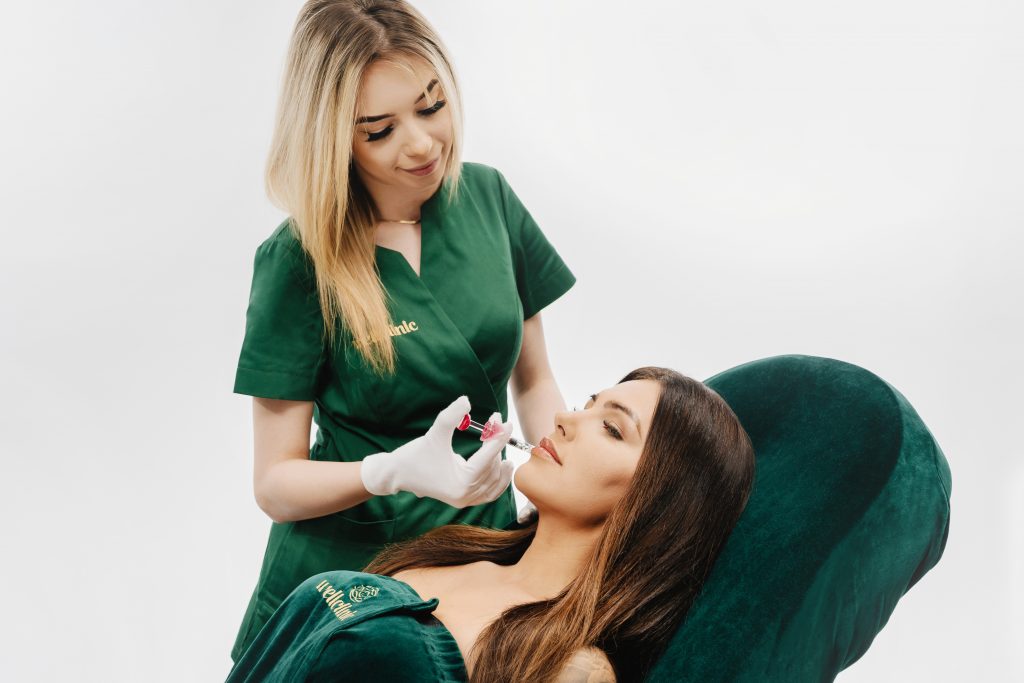
The treatment begins with skin consultations and assessments. The specialist assesses the degree of skin laxity, the quality of the tissue, the distribution of wrinkles and the patient’s expectations. On this basis, they select the product, the injection site and the injection technique.
Before the procedure begins, the skin is properly prepared and disinfected. Depending on the type of product and the technique used, the treatment may be carried out using a fine needle or a cannula.
The product is administered into specific tissue layers, in accordance with its intended use and the manufacturer’s instructions. The entire The procedure usually takes around 30–45 minutest, although the time may vary depending on the treatment area.
Following the procedure, temporary local reactions may occur, such as:
- redness,
- slight swelling,
- tenderness,
- bruises,
- slight raised areas at the injection sites.
Their severity and duration depend on the type of product used and the individual’s skin reaction. The patient is given post-treatment instructions, which must be followed.
How many tissue biostimulator treatments should be carried out?
There is no single treatment plan that suits all treatments and patients. Some treatments involve a single session, whilst others require a series of sessions at specific intervals.
The number of sessions depends on the composition of the biostimulator, the indication, the condition of the skin and the desired result. It is also important whether the treatment is primarily aimed at improving the skin’s quality, or whether it also targets its firmness and volume.
The final plan is drawn up by a specialist during the consultation. You should not increase the frequency of treatments simply to speed up the appearance of results.
How long do the effects of a tissue biostimulator last?
The longevity of the results depends on the substance used and the individual characteristics of the body. Different preparations have varying biodegradation profiles and different effects on tissue remodelling.
Age, skin quality, exposure to UV radiation, lifestyle and the natural ageing process also play a role.
The effects of biostimulation do not halt the ageing process. However, they can improve the condition of the skin and support its structure for a certain period of time. For some treatments, your doctor may recommend maintenance treatments.
Tissue biostimulator versus dermal filler – what’s the difference?
Both types of preparations are used in aesthetic medicine, although their main therapeutic aims are different.
Traditional fillers, most commonly based on cross-linked hyaluronic acid, are primarily used to add volume, contour specific areas and smooth out furrows.
Tissue biostimulators Instead, they are designed to stimulate or support regenerative processes and tissue remodelling. Depending on the type of preparation, they may also affect volume, but this is not their sole or always their primary aim.
This difference is important when planning treatment. If the skin is thin, flaccid and lacking in elasticity, the doctor may consider biostimulation. If, on the other hand, the main problem is a loss of volume in specific areas of the face, the use of a filler or a combination of several methods may prove more appropriate.
Tissue biostimulator – contraindications and safety of the procedure
Although tissue biostimulators They are used in regenerative therapies; the injection procedure requires appropriate medical qualifications.
Situations which may constitute a contraindication or require the procedure to be postponed include, amongst others:
- active infections and inflammation of the skin at the treatment site,
- hypersensitivity to any of the ingredients in the product,
- pregnancy and lactation,
- certain autoimmune diseases,
- blood clotting disorders,
- certain chronic diseases and uncontrolled systemic conditions.
The list of contraindications depends on the specific preparation and its characteristics. Not all restrictions are the same for every substance.
After the procedure, the following may occur side effects associated with the injection, such as swelling, redness, bruising and tenderness. Less commonly, complications may arise that require medical consultation. The practitioner’s experience, knowledge of anatomy and adherence to aseptic principles are crucial to safety.
Before the procedure, you should inform the specialist about any medicines you are taking, any chronic conditions, previous procedures and any allergic reactions you may have had.
Is a tissue biostimulator suitable for everyone?
Not every sign of ageing requires the same type of treatment. For one person, the main concern may be dryness and a loss of elasticity; for another, it may be sagging skin, reduced tissue density or a loss of volume in the cheeks.
Tissue biostimulators may be a good option when the aim is to improving skin quality and supporting its natural regenerative processes. However, they do not replace all aesthetic medicine treatments and do not always provide a lifting effect in cases of severe tissue sagging.
The best results are achieved when the product is chosen to address a specific problem, rather than being treated as a one-size-fits-all anti-ageing solution.
Skin biostimulation – choose regeneration tailored to your needs
Tissue biostimulator may be an important element anti-ageing treatments, particularly when the skin loses its firmness, elasticity and density. Its purpose is not to alter the natural features of the face, but to support the biological processes responsible for the quality and structure of the tissues.
Do not choose a product solely on the basis of its popularity or the opinions of other patients. The same product may produce different results in people with different skin conditions and different aesthetic needs.
Would you like to check whether tissue biostimulator Will this be the right solution for you? Book a consultation at Wellclinic. Our medical team will assess the condition of your skin, identify the cause of the loss of firmness and select a treatment tailored to your needs. Look after the condition of your skin before loss of firmness becomes a major cosmetic concern.
Sources:
- Lampridou S. et al., "The Effectiveness of Polynucleotides in Aesthetic Medicine: A Systematic Review", Journal of Cosmetic Dermatology, 2025.
https://pubmed.ncbi.nlm.nih.gov/39645667/ - Lee K.W.A. et al., "Polynucleotides in Aesthetic Medicine: A Review of Current Practices and Perceived Effectiveness", International Journal of Molecular Sciences, 2024.
https://pubmed.ncbi.nlm.nih.gov/39125793/ - Ferreira A.C.M. et al., "Efficacy, Durability and Safety of Collagen Biostimulators Based on Poly-L-Lactic Acid (PLLA) and Calcium Hydroxyapatite (CaHA) in the Face: A Systematic Review", Aesthetic Plastic Surgery, 2026. https://pubmed.ncbi.nlm.nih.gov/41184662/
- Alhussain A.M. et al.,"Polynucleotides and Polydeoxyribonucleotides for Skin Rejuvenation, Post-operative Scar Prevention and Wound Healing: A Systematic Review of Randomised Clinical Trials", Cureus, 2026. https://pubmed.ncbi.nlm.nih.gov/42572627/




 +48 600 100 177