A moustache above the upper lip. A few dark hairs on the chin. Facial hair that disappears after shaving but reappears after a while. If you regularly struggle with this problem, you know just how much time it can take to keep removing it.
Tweezers, wax, a razor – each of these methods requires repeated use. Sometimes this is accompanied by redness, irritation and ingrown hairs.
Laser depilation of the face may help to alleviate this problem in the long term. However, it will not have the same effect on every woman. The following factors are important: hair colour and thickness, skin condition, as well as any endocrine disruptors.
Is Laser hair removal is permanent? How many sessions are needed? And is there a risk that there will be more hair rather than less?
We explain how it works laser face depilation, what to expect from it, and when it might be worth considering an alternative method.
How does laser facial hair removal work?
The laser uses melanin, which is the pigment found in the hair shaft. It absorbs light energy, which is converted into heat and damages the hair’s structure hair follicle responsible for hair growth.
Why isn’t a single treatment enough? Facial hair doesn’t all grow at the same time. Some of it is in active growth phase, whilst some are in other stages of the cycle. The laser is most effective on hairs in the right phase, which is why the treatments need to be repeated.
The number of sessions depends on the type of hair and the skin’s reaction. It also matters whether the hair growth is linked to hormonal changes.
Why does laser hair removal for the upper lip and chin require a personalised approach?
Facial hair It is particularly sensitive to hormonal changes. In some women, the hair above the upper lip, on the chin or along the jawline is fine and light in colour. In others, it becomes thicker, darker and more noticeable.
Dark hair usually responds better to laser treatment than light, grey or melanin-free hair. The thickness of the hair and the depth at which the hair follicle is located are also important factors.
If your hair growth has suddenly increased, particularly if it is accompanied by irregular periods or other symptoms of hormonal imbalances, it is advisable to consult a doctor. The treatment itself does not address the cause of excessive hair growth.
Prime 3D diode laser – what do you need to know?
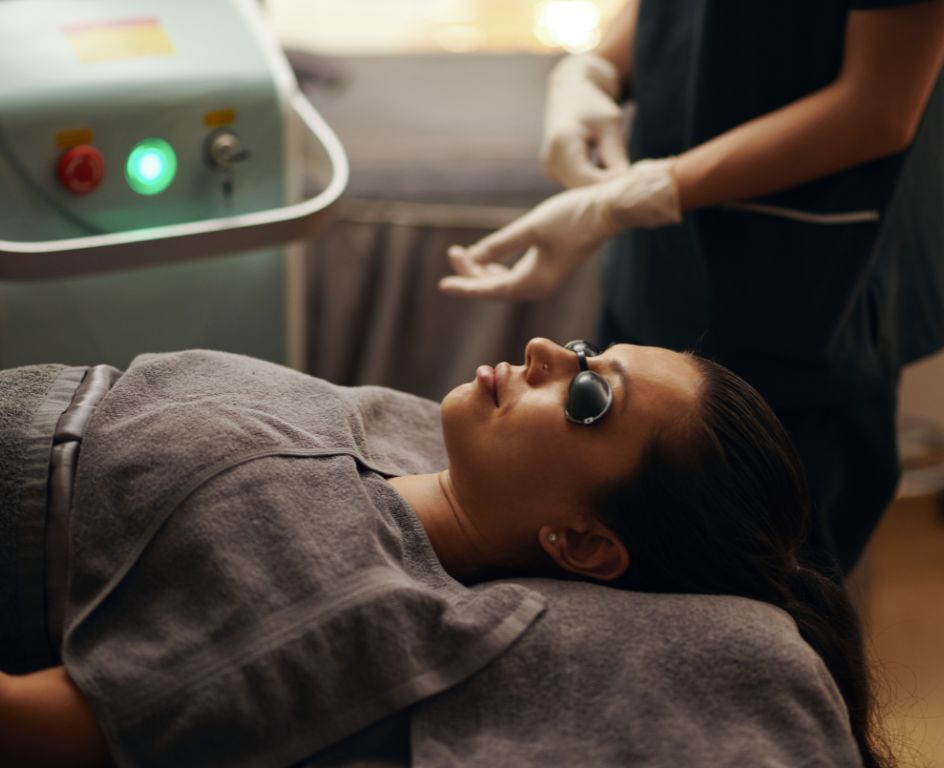
At Wellclinic, you can laser depilation is used Prime 3D laser, which operates at three wavelengths: 755, 808 and 1064 nm. The different wavelengths allow the device to target melanin at different depths, but this does not mean that it will be equally effective on every type of hair.
The best results are usually achieved on dark hair, which contains more melanin. Light, grey and very fine hair may respond less effectively.
Before the procedure, it is also necessary to assess skin phototype, the degree of tanning and any contraindications to laser hair removal. The laser settings are tailored to the individual, rather than solely to the area to be treated.
The head cooling system helps to minimise discomfort during the treatment. However, it does not completely eliminate the risk of irritation or burns, which is why both the correct settings of the device and the experience of the person carrying out the procedure are important.
Laser facial hair removal – facts and myths
Myth 1. Laser hair removal and IPL work in the same way
Both methods use light, but differ in terms of its characteristics. A laser emits light of a specific wavelength, whereas IPL uses a wider spectrum.
In practice, effectiveness depends on the device, the treatment parameters, and the colour and thickness of the hair. The name of the technology alone does not determine the outcome.
Myth 2. Lasers stimulate hair growth
The aim of the treatment is to reduce hair growth. However, rare cases of paradoxical increased hair growth following light-based treatments have been reported, particularly on the face and neck.
If you have a lot of fine hair on your cheeks or jawline, it is worth discussing with the practitioner whether laser treatment is the right choice. When hormone-related excessive hair growth You may also need to see a doctor.
Myth 3. Laser facial hair removal is painful
The sensations you experience depend on your skin’s sensitivity, the treatment area and the device settings. You may feel warmth, a pinching sensation or brief pricks. Cooling the treatment head helps to reduce discomfort, but does not guarantee that you will feel no pain at all.
If you experience severe pain during the treatment, please tell the person carrying out the procedure.
Myth 4. Laser hair removal removes hair permanently
Laser hair removal allows you to achieve long-term hair reduction, but it does not guarantee that all the hair will disappear for good. Some may grow back, and hormonal changes may stimulate the growth of new hair.
Some women need treatments similar to. In the case of facial hair on the chin and above the upper lip, it is particularly important to determine whether the problem has a hormonal cause.
How many facial laser hair removal sessions are needed?
After a course of treatments, you usually have less hair, and some of the hair that grows back becomes finer and less noticeable. This means you don’t need to reach for tweezers or a razor quite so often.
The results do not always remain the same over the years. Hormones play a significant role in the face, which is why some women develop new hair over time. Another session may then be necessary.
Usually, around 5–8 laser hair removal sessions, but this is not a hard and fast rule. With thick, dark hair, the results may differ from those with fine hair, and hormonal imbalances may prolong the treatment.
During the consultation, it is worth agreeing not only on the expected number of sessions, but also on how the results will be assessed and whether any follow-up treatments may be required.
The long-term effects of laser facial hair removal – what should you expect?
After a course of treatments, you usually have less hair, and some of the hair that grows back becomes finer and less noticeable. This means you don’t need to reach for tweezers or a razor quite so often.
The results do not always remain the same over the years. Hormones play a significant role in the face, which is why some women develop new hair over time. Another session may then be necessary.
This is particularly important in the case of laser hair removal for the chin and upper lip. If hair growth is caused by hormonal imbalances, laser hair removal alone may not be sufficient to maintain the results without additional treatment.
Therefore, the long-term effect depends not only on the number of treatments, but also on the cause of the problem and individual predispositions.
Contraindications for facial laser hair removal – when should the treatment be postponed?
Before the treatment, please inform the specialist about any medicines you are taking, any skin conditions you have and any recent exposure to the sun. In some cases, it may be necessary to postpone the hair removal treatment or to arrange a further consultation.
Such situations include pregnancy, a recent tan or the use of a self-tanning product, taking medicines or preparations that may increase sensitivity to light, as well as active cold sores, an infection or skin damage at the treatment site. Certain skin conditions and medical conditions require an individual assessment before treatment begins.
Do not stop taking your medication on your own initiative. If you are unsure whether a particular medicine is contraindicated, discuss this with your doctor before your appointment.
Skin care following facial laser hair removal
After hair removal, the skin may be red and slightly swollen. These symptoms are usually temporary, but for a few days it is advisable to avoid anything that might aggravate the irritation.
Use SPF 50+ sun cream and limit your direct exposure to the sun. Choose gentle moisturisers that support the skin’s protective barrier. Put aside intensive exfoliants and irritating active ingredients until the time recommended by a specialist.
Also keep an eye on your skin’s reaction. If you develop blisters, severe pain or increasing swelling, contact your doctor.
After the treatment, please follow the advice given during your appointment. Your skin’s needs may vary depending on the parameters used and your reaction to the laser.
Laser facial hair removal at Wellclinic – book a consultation
If you regularly remove hair from your chin or above your upper lip, and the results only last a few days, it’s worth checking whether laser face depilation will be suitable for you.
During your consultation at Wellclinic, you can discuss your hair type, skin condition, any potential contraindications and the expected course of treatment. It is also a good opportunity to determine whether you only need laser treatments, or whether it would be worth investigating whether the problem might have a hormonal cause.
Book a consultation at Wellclinic and find out which hair-reduction options are suitable for your skin.