
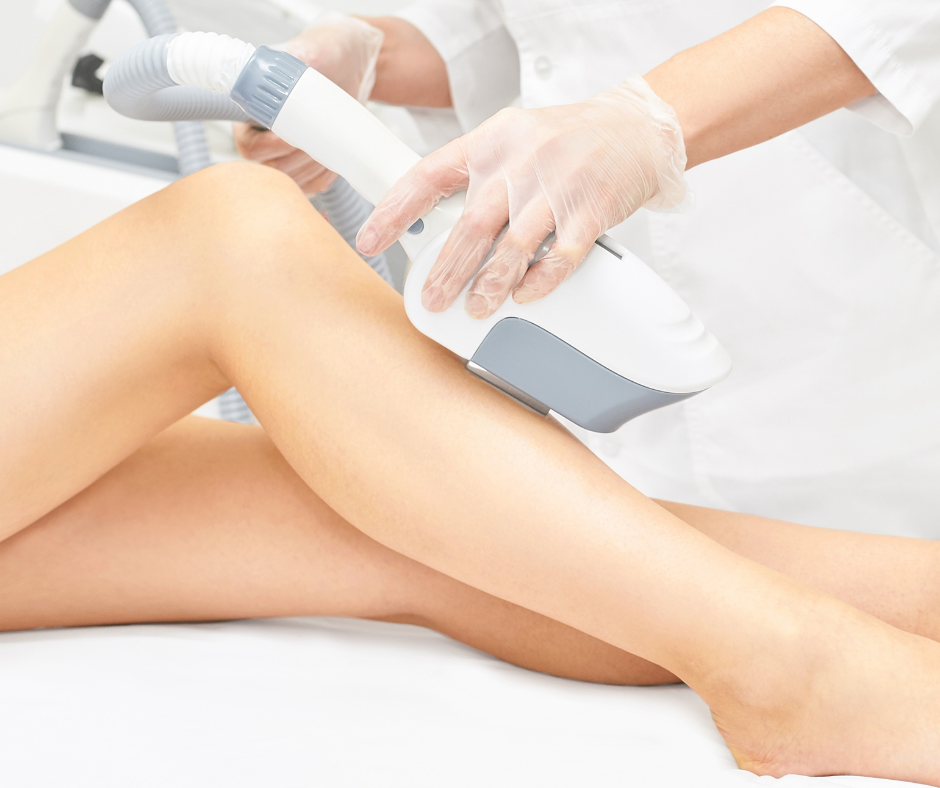
Laser depilation of the legs This is a method of long-term hair reduction using laser light energy. The treatment can cover the whole legs or selected areas, such as the calves or thighs. The laser energy targets the hair follicles, gradually reducing hair growth. The procedure can be carried out on both women and men.
You can find more information about the method in the description laser depilation.
Laser depilation of the legs It utilises the phenomenon of selective photothermolysis. The energy from the laser light is absorbed by the melanin in the hair shaft and then converted into heat. This results in a controlled thermal effect on the hair follicle and the structures responsible for hair growth.
The laser is most effective on hair that is in anagen phase, i.e. the active growth phase. As individual hairs are at different stages of the growth cycle at any one time, achieving a satisfactory reduction in hair growth requires a series of treatments. The number of sessions and the intervals between them are determined on an individual basis, taking into account factors such as hair colour and thickness, skin phototype and the rate of hair regrowth.
At Wellclinic, you can laser depilation of the legs is used Laser Prime 3D. The device allows the treatment parameters to be tailored to the individual characteristics of the skin and hair, and enables treatment of larger areas of the body. Comfort during the procedure is enhanced by In Motion technology, which allows the head to glide smoothly over the skin and delivers energy evenly to the area being treated.
Another key component of the device is TEC Thermo Electric Cooling. The cooling system helps to lower the skin’s temperature whilst laser energy is being emitted, thereby enhancing treatment comfort and minimising thermal sensations.
Effects laser depilation of the legs The results become apparent gradually with each subsequent treatment. Hair growth is reduced, and regrowing hair may become finer, weaker and less noticeable. For people who experience irritation or ingrown hairs from shaving, reducing the frequency of razor use can further improve the comfort and appearance of the skin.
Want to find out more? See also: Laser hair removal - how it works, preparation and results of the treatment
Warsaw ∙ Gdansk ∙ Krakow
Please fill in the contact form and our team will get in touch with you to arrange a convenient time for your appointment.
Show more search results
Show more search results