
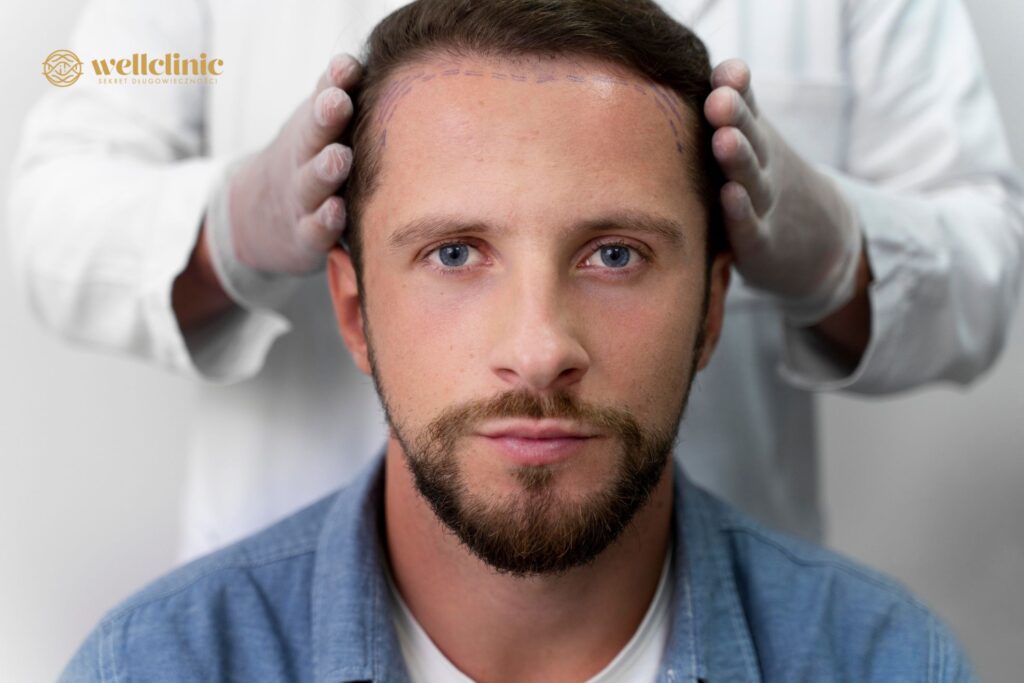
Hair that is starting to thin out today may become even less dense in a few months’ time. And that is precisely why, in the case of progressive hair loss, time does not always work in your favour. The longer you wait to identify the cause of the problem, the larger the area may become that will subsequently require treatment of alopecia.
Hair transplantation Nor does it produce immediate results. The procedure itself may take several hours, but it takes many months to see visible results. During this time, the transplanted follicles go through the various stages of their cycle, and the hair gradually grows back and becomes thicker.
That is why the question „How long does a hair transplant take?” should not be limited to the time spent at the clinic. It is equally important that, When can you see the results of a hair transplant?, how long the whole process takes, and whether a hair transplant is actually the best solution for a particular type of hair loss.
How long does a hair transplant take?
Hair transplantation time It depends primarily on the number of hair follicular units transplanted, the size of the area requiring densification, and the technique used.
Depending on the extent of the procedure, it may take several hours, or - if a large number of grafts are required - a significant part of the day. It involves harvesting follicular units from the donor area, preparing them and precisely implanting them in the area requiring densification.
However, the duration of the procedure is not the most important factor. It is equally important to plan the hairline carefully, position the grafts correctly and maintain the natural direction of hair growth.
When can you see the results of a hair transplant?
The results of a hair transplant do not appear straight away. New hair growth is a biological process and depends on the hair’s natural cycle.
Transplanted hair follicles need time to go through the various stages hair growth phases. Therefore, the first few months following the procedure should not be regarded as a definitive indicator of the outcome.
The first few weeks after the transplant
Immediately after the procedure, the scalp needs time to recover. Redness, swelling, scabs and temporary changes to the appearance of the area where the transplant was carried out may occur.
During the first few weeks, temporary hair shaft shedding may also occur from the transplanted grafts. This is referred to as sudden loss. This does not automatically mean that the hair follicles are lost - the transplanted follicles may remain in the skin and begin another growth cycle.
However, if hair loss is severe, persists or spreads to other areas of the scalp, it is advisable to consult a specialist.
3-4 months - when does hair start to grow after a transplant?
The first new hairs may appear around the third or fourth month. Initially, they are usually fine, delicate and less noticeable.
This is the point at which you may begin to notice the first changes in the area where the graft was placed. However, this does not mean that the process is complete.
Hair transplant after 6 months
Hair transplant after 6 months This usually allows you to notice a more pronounced change in hair density. The hair becomes more visible and its structure gradually improves.
However, the growth process is still ongoing. Over the coming months, your hair may become thicker and denser, so the results seen after six months may not be the final outcome.
9-12 months - when can the results be assessed?
For a more comprehensive assessment of the effect hair transplant It usually takes around 9-12 months. However, the rate of growth varies from person to person, and for some people the process may take longer.
It is only after this period that it is possible to assess more accurately the density achieved, the appearance of the hairline and the quality of the transplanted hair’s growth.
Does hair fall out after a hair transplant?
Yes. Hair loss following a hair transplant may be a temporary stage of the process.
After the procedure, the hair shafts may fall out, whilst the follicles remain in the skin. They then go through a series of stages the hair growth cycle, before growth picks up again.
However, this does not mean that every instance of hair loss following a transplant should be ignored. If there is any doubt as to its nature, a specialist’s assessment is required.
What factors influence the results of a hair transplant?
The result depends on a number of factors. Among other things, the following are significant:
- the number and quality of the residential units acquired,
- the condition of the donor area,
- the cause and stage of hair loss,
- how to plan the hairline,
- the technique for carrying out the procedure,
- individual hair growth rate,
- post-transplant care.
It is also important that A hair transplant does not automatically halt the process of hair loss. Transplanted hair follicles may be more resistant to the factors responsible for androgenetic alopecia, but hair outside the transplanted area may still thin over time.
It is therefore worth identifying the cause of the problem and assessing the condition of the scalp and hair follicles before making a decision. In the case of progressive hair loss A transplant is not always the best first step.
Is it possible to treat hair loss without a hair transplant?
Not every case of hair thinning requires a hair transplant. Depending on the cause of the problem, it is possible to use treatments aimed at reducing hair loss and supporting the functioning of the hair follicles.
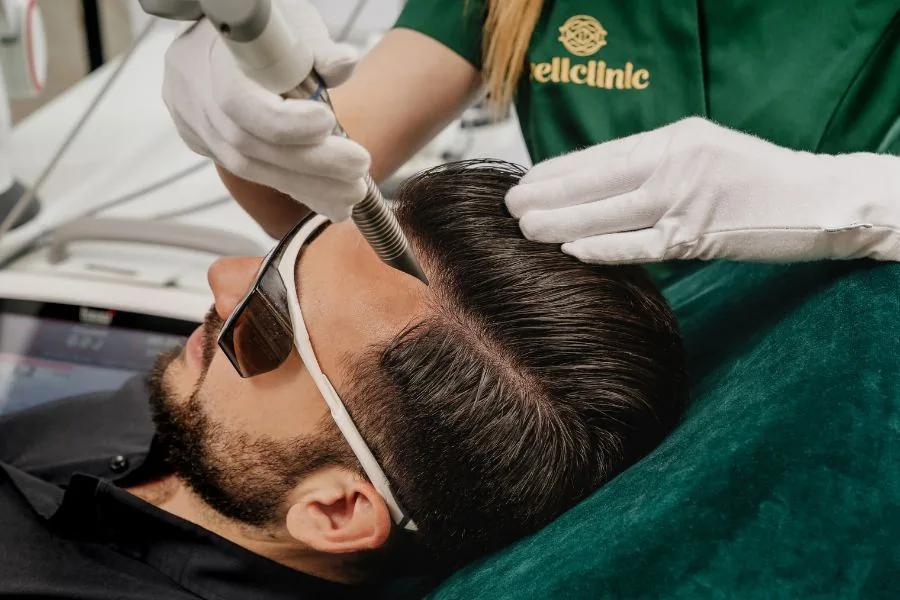
At Wellclinic, the treatments offered include, amongst others, combined therapies laser therapy i tissue biostimulator. Their aim is to support the health of the scalp and the processes involved in hair growth and thickening.
Targeted therapies na treatment of alopecia They may be considered as a stand-alone treatment in suitably selected cases or as part of a broader treatment plan. At Wellclinic, we also use hair regeneration, tailored to the cause and severity of the problem.
However, there is no single method that is suitable for every patient. The most important thing is to determine, Why does hair fall out? and whether the hair follicles still have the potential to continue growing.
Hair transplant - how long does the whole process take?
If you’re asking „How long does a hair transplant take?”, a distinction must be made between the time taken for the procedure itself and the time needed for the results to become apparent.
The procedure itself can take anywhere from a few hours to most of the day, depending on its scope. It usually takes a few months for the first new hairs to appear, whilst a more comprehensive assessment of the results may only be possible after around 9-12 months.
And this is where the most important question arises: Do you really need a hair transplant, or can your hair follicles still be effectively stimulated?
The sooner the cause of hair loss is identified, the more options you can consider. It is therefore worth not waiting until the problem spreads to an increasingly larger area of the scalp.
If you notice your hair is gradually thinning, book a consultation with our specialist. An assessment of the condition of your scalp and hair will help determine which course of treatment is most suitable for you.
Sources:
1. PubMed „Hair Transplantation: State of the Art”
https://pubmed.ncbi.nlm.nih.gov/40354670/
2. PubMed „Hair Transplant: Patient Eligibility, Medical Optimisation and Surgical Considerations”
https://pubmed.ncbi.nlm.nih.gov/40660483/
3. PubMed „Enhancing Graft Survival Rates in Follicular Unit Excision: A Chinese Expert Consensus on Perioperative Procedures”
https://pubmed.ncbi.nlm.nih.gov/40489742/
4. PubMed „The use of the follicular unit extraction technique in the treatment of male androgenetic alopecia”
https://pubmed.ncbi.nlm.nih.gov/39543552/
5. PubMed „An Analysis of Risk Factors for Temporary Effluvium at the Recipient Site Following Follicular Unit Excision: A Single-Centre Retrospective Study”
https://pubmed.ncbi.nlm.nih.gov/37816944/
6. PubMed „Management of androgenic alopecia: a systematic review of the literature”
https://pubmed.ncbi.nlm.nih.gov/38852607/