
 Katarzyna Pawłowska

 17.11.2026
Facial ageing does not begin or end with wrinkles. Over time, ocheeks fall, the furrows deepen, the jawline changes, a the skin loses its firmness. Is surgery the only way to make your face look younger again? Not necessarily.
Modern aesthetic medicine i plastic surgery offer various rejuvenation options. One of these is deep facelift, known as Deep Plane Facelift. It is a surgical technique that allows surgeons to work on the deeper structures of the face, rather than simply tightening the skin.
However, not everyone wants to undergo surgery. Anaesthesia, incisions, scars, recovery and the risk of complications mean that some patients seek less radical solutions. For them, an alternative may be a comprehensive approach to rejuvenation without a surgical facelift, such as our proprietary protocol Quantum Face.
Both methods have different scopes of application and address different needs. The choice depends primarily on the severity of the condition and the patient’s expectations.
Table of contents
Why does the face lose its youthful appearance?
The ageing process It affects many structures. The quality of the skin changes, the levels of collagen and elastin decrease, fat pads become displaced, and the tissues gradually lose their support.
As a result the cheeks may sag, nasolabial folds become more noticeable, a the oval shape of the face becomes less pronounced as before. There are also facial wrinkles, sagging skin on the neck i changes around the eyes.
That is why skin tightening alone is not always enough to improve the appearance of the whole face. In many cases, the problem also affects deeper structures.
It is precisely on these that the focus lies deep facelift.
Deep facelift – what is a Deep Plane Facelift?
Just a few decades ago, a facelift was primarily associated with tightening the skin and removing excess skin. Modern surgical techniques take many more anatomical structures into account.
One of them is Deep Plane Facelift, i.e. deep facelift. During the operation, the surgeon works in a plane situated beneath the layer SMAS - the facial myofascial system. It releases specific ligaments that support the tissues, and then reposition the deeper structures into a more favourable position.
This helps to correct sagging cheeks, improve the contour of the jawline and reduce the appearance of certain wrinkles. Excess skin may be removed, but this is not the only part of the operation.
The essence of this technique lies in working on the deeper structures of the face, rather than simply tightening the skin.
What results can you expect from a deep facelift?
Deep Plane Facelift It is a method intended primarily for people with noticeable sagging of the tissues and a loss of facial contour. It can bring about a visible improvement in the mid and lower parts of the face.
The outcome depends on the patient’s anatomy, the condition of the tissues, their biological age and the surgical technique used. The results may last for many years, but the operation does not halt the ageing process.
It is also important that deep facelift It remains a major surgical procedure. It requires specialist expertise, appropriate anaesthesia and time for recovery.
Surgical facelift – what should you know before the operation?
The decision on surgical facial rejuvenation requires consideration not only of the possible outcomes, but also of the course of treatment and potential complications.
Deep facelift involves incisions, tissue dissection and a recovery period. Following the operation, swelling, bruising, haematomas, infections, healing complications, visible scars or temporary sensory disturbances may occur. More serious complications, including damage to the facial nerves, may occur less frequently.
This does not mean that surgery is a bad decision. For suitably selected patients, it can be an effective method of correcting advanced lesions. It is important to bear in mind, however, that this is not a minor cosmetic procedure, but a surgical intervention requiring an informed decision.
Not everyone wants to go through such a process. Nor does everyone need such a drastic correction.
Quantum Face – facial rejuvenation without a surgical facelift
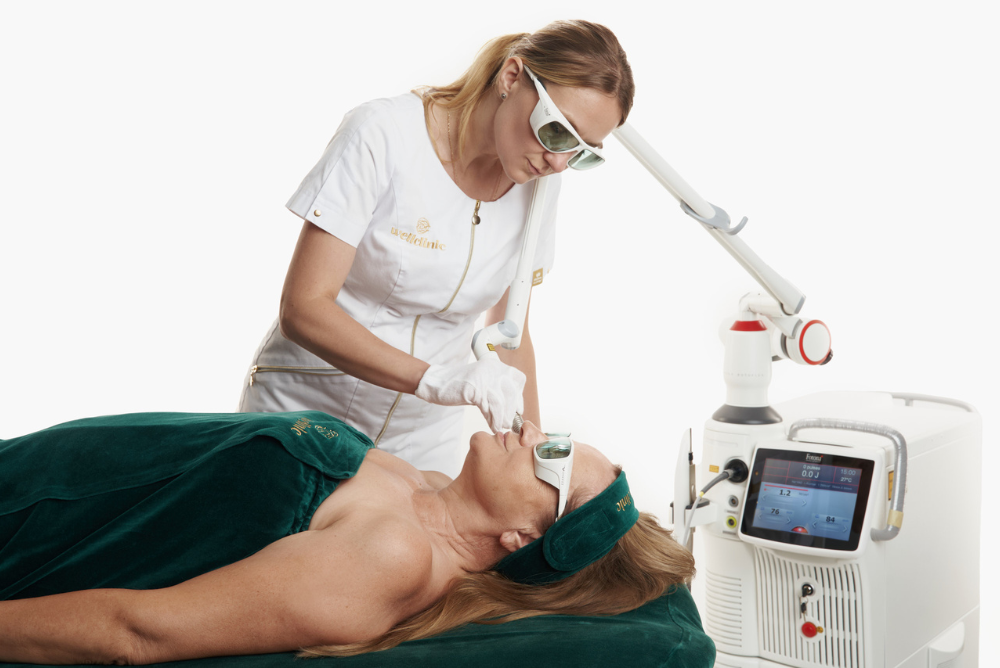
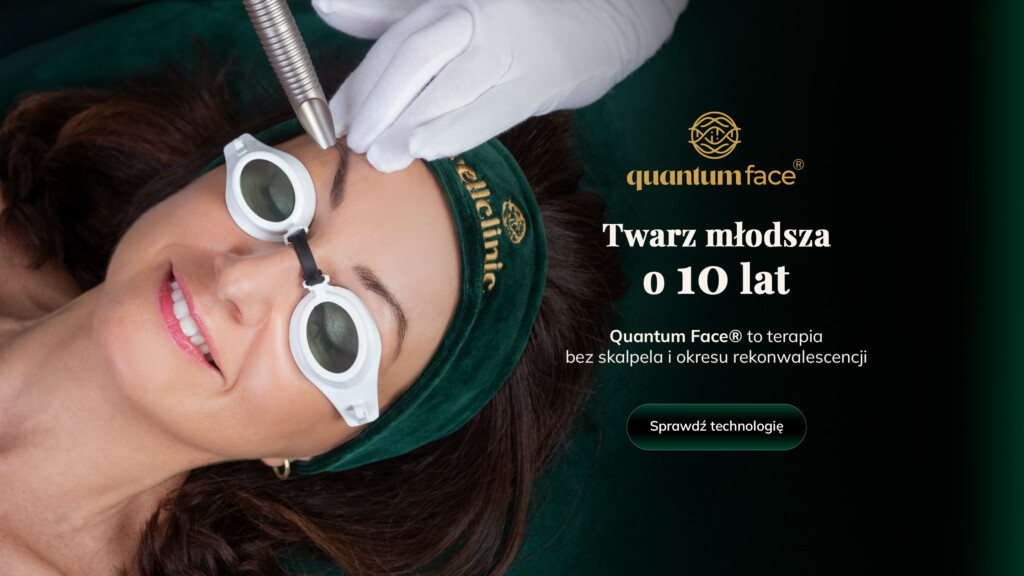
For people who want to improve the appearance of their face but are not planning to have surgery, Wellclinic has developed its own protocol Quantum Face.
This is a five-stage programme combining laser technologies, biotechnology and selected aesthetic medicine procedures. Its aim is improvement in skin quality and firmness, refreshing the eye area, Treating expression lines and improving facial contours.
Quantum Face It does not require surgical incisions or the surgical repositioning of tissues. However, this does not mean there is a complete absence of intervention – certain stages involve injection procedures and therefore require appropriate qualifications and consideration of any contraindications.
This is an option for people who want to look younger without undergoing a surgical facelift.
The five stages of Quantum Face
The protocol covers five complementary areas:
- Pre-Activation - preparing the skin and improving its condition.
- Quantum Beam - laser therapy combined with exosome biotechnology.
- Oculum - revitalisation of the eye area.
- Neuro Balance - treatment of expression lines using a neuromodulator.
- Contour Lift - improved skin firmness and contouring of the lower face.
The treatment is preceded by a skin assessment using 3D imaging and multispectral analysis. This allows for the evaluation of, amongst other things, wrinkles, discolouration, skin texture i signs of sun damage. The scope of the proceedings is tailored to her needs.
Quantum Face versus Deep Plane Facelift – how do these methods differ?
Although both methods are designed to improve the appearance of the face, their mechanisms of action are completely different.
Deep facelift involves the surgical release and repositioning of tissues. It allows for the correction of advanced sagging of the cheeks and other facial structures. However, it involves surgery, anaesthesia and a period of recovery.
Quantum Face It focuses on improving skin quality, firmness, the appearance of the eye area, facial expressions and facial contours. It does not require surgery, but does not allow for the same degree of repositioning of deep tissues as a surgical facelift.
| Deep facelift | Quantum Face |
|---|---|
| Surgical method | Non-surgical protocol |
| Working on the deep facial structures | Focusing on skin quality, facial expressions and contours |
| It requires incisions and anaesthesia | It does not require an operation or surgical incisions |
| It is associated with the recovery period | It does not require the usual post-operative recovery period |
| Designed, amongst other things, for people with advanced tissue sagging | It may be suitable for certain signs of ageing and loss of firmness |
There is no single method that suits everyone. Where there is a significant excess of skin and advanced tissue sagging, non-surgical methods may not achieve the desired results. Conversely, where the changes are less advanced, the patient may not require surgery.
Who should consider Quantum Face?
Quantum Face It may be suitable for people who notice a loss of skin firmness, a less defined facial contour, expression lines, deepening furrows or signs of tiredness around the eyes.
It is particularly worth considering this method if:
- you don’t want to have the operation,
- you are worried about the anaesthetic, the incisions and the recovery period,
- do you want to improve the quality and firmness of your skin,
- do you want to look after several areas of your face at the same time,
- You prefer a gradual approach to anti-ageing.
The final decision should be based on consultation. The specialist assesses the facial anatomy, the severity of the condition, the condition of the skin, the patient’s expectations and any contraindications. In some cases, it may turn out that a different procedure would be a better option.
Two paths, one goal – a face that looks natural
Modern rejuvenation It is not limited to a single method. Deep facelift enables the surgeon to correct the position of the tissues, whilst Quantum Face allows you to work on selected signsanti-ageing without surgery.
The most important thing is to tailor the method to the actual needs of the face, rather than choosing the most advanced treatment.
If you don’t want to opt for a surgical facelift but would like to improve the appearance of your skin, the area around your eyes and the contours of your face, discover what Quantum Face has to offer.
Book a consultation at WellClinic and discover the possibilities of non-surgical rejuvenation. Find out if Quantum Face treatment meets your skin’s needs and your expectations.
Sources:
1. Polish Dermatological Society (2022) - Lasers in Dermatology. Recommendations of the Polish Dermatological Society.
https://www.termedia.pl/Zastosowanie-laserow-w-dermatologii-Rekomendacje-Polskiego-Towarzystwa-Dermatologicznego-Czesc-1-Lasery-w-dermatochirurgii.html
2. Kosmos – Issues in the Biological Sciences (2023) - What can aesthetic medicine do to rejuvenate the skin?
https://kosmos.ptpk.org/index.php/Kosmos/article/view/2971
3. Polish Society of Aesthetic Medicine and Anti-Ageing - Cosmetic surgery on the face.
https://www.ptmeiaa.pl/wp-content/uploads/2022/02/2021_4_21_Monografia_low.pdf
4. Advances in Engineering and Education (2025) - The regenerative potential of exosomes in the treatment of ageing skin.
https://pzie.kwspz.pl/wp-content/uploads/PZiE_2025_1_wydanie-specjalne_09.pdf
5. Agnieszka Surgiel-Gemza (2025) - Laser therapy in aesthetic medicine and cosmetology, PZWL.
Book a consultation




 +48 600 100 177