
 Katarzyna Pawłowska
 17.11.2026
Coffee It is one of the most popular drinks in the world. It invigorates and supports concentration and may affect the pace metabolism. It is therefore no surprise that it often comes up in the context of slimming. But does this mean that people who want to lose weight should drink more of it? Not necessarily. Caffeine It does indeed affect the metabolism, but its effect on calorie burning is considerably smaller than the adverts for weight-loss supplements suggest.
Table of contents
What does the research say about coffee and body weight?
Results observational studies suggest a link between regular coffee consumption and lower levels of body fat and a smaller increase body weight.
- Analysis of data from the US NHANES study (2020), involving 5,696 people, showed that women who drink 2–3 cups of coffee a day had around 3–4 per cent less body fat than women who did not drink coffee. The measurement was carried out using the DXA, which allows for a more accurate assessment of body composition than just BMI. A weaker correlation was observed in men.
- A meta-analysis by Lee et al. from 2019 she pointed out that every additional cup of coffee drunk during the day was associated with a slightly lower the risk of obesity. This correlation was more pronounced amongst men.
- A long-term study involving over 50,000 people (Lopez-Garcia et al., 2006) The study showed that participants who increased their coffee consumption gained slightly less weight than the others. The difference, however, was small, amounting to around 0.3–0.5 kg over 12 years.
It is worth bearing in mind that observational studies do not allow us to definitively determine the cause of the observed correlations. People who drink regularly black coffee may lead a different lifestyle to those who choose sweetened drinks. It cannot therefore be concluded that drinking coffee alone leads to weight loss.
How does caffeine affect the metabolism?
Caffeine It affects the body in several ways. It can increase energy expenditure, influence the use of fat as an energy source and improve exercise capacity. However, not all of these mechanisms translate directly into visible weight loss.
1. Thermogenesis, or an increase in energy expenditure
Caffeine stimulates the nervous system and may temporarily increase the body’s heat production, and thus the amount of calories burnt. It is estimated that the increase in energy expenditure may be around 3–5 per cent for several hours after consumption. In practice, this means a relatively small additional amount of energy is burnt. Furthermore, with regular caffeine intake, the body gradually becomes accustomed to its effects, which may cause the effect to diminish.
2. Lipolysis, or the release of fatty acids
Caffeine may stimulate the process lipolysis, in which the fat stored in fat cells is broken down into fatty acids. These can then be used by the body as energy source, particularly during physical activity. However, the release of fatty acids alone does not automatically lead to a loss of body fat – their subsequent utilisation is also important.
3. Improved performance during training
One of the best-documented effects of caffeine is its impact on exercise capacity. A reception for around 3–6 mg of caffeine per kilogram of body weight, usually 30–60 minutes before training, may reduce feelings of tiredness and improve muscle endurance and strength.
This effect has been confirmed, amongst other things, in a 2021 statement by the International Society of Sports Nutrition. Thanks to improved exercise tolerance, it is possible to train for longer or at a higher intensity, which potentially increases the total energy expenditure.
4. Effect on appetite
Coffee may temporarily reduce a feeling of hunger and reduce the urge to eat. However, this effect is not experienced by everyone. Research findings on the effect of caffeine on appetite remain inconclusive; therefore, coffee should not be regarded as an effective way of controlling hunger.
5. Polyphenols – additional properties of coffee
Coffee contains not only caffeine, but also polyphenols, which are natural plant compounds with antioxidant properties. They help protect cells from oxidative stress and support the body’s natural defences.
Polyphenols They may also play a role in maintaining a healthy metabolism and regulating blood sugar levels. Their presence means that coffee has more benefits than just being a stimulant. However, this does not mean that simply drinking it leads to weight loss.
How much caffeine is there in coffee and other popular drinks?
Contents caffeine It depends on the type of beans, the brewing method, the serving size and the preparation method used. The approximate values are as follows:
| Drink | Approximate caffeine content |
|---|---|
| Espresso (30 ml) | 60–80 mg |
| Filter coffee or coffee from a coffee machine (235 ml) | 80–120 mg |
| Instant coffee (235 ml) | 60–80 mg |
| Cold brew (235 ml) | 100–150 mg |
| Decaffeinated coffee | 2–5 mg |
| Black tea (235 ml) | 40–60 mg |
| Yerba mate (235 ml) | 30–80 mg |
In accordance with the recommendations the European Food Safety Authority (EFSA) Healthy adults can consume up to 400 mg of caffeine a day. A single dose should not exceed 200 mg. For pregnant women, the recommended maximum level is 200 mg per day.
It is also worth taking into account other sources of caffeine, such as tea, energy drinks and pre-workout supplements.
Arabica or Robusta – which coffee is better when trying to lose weight?
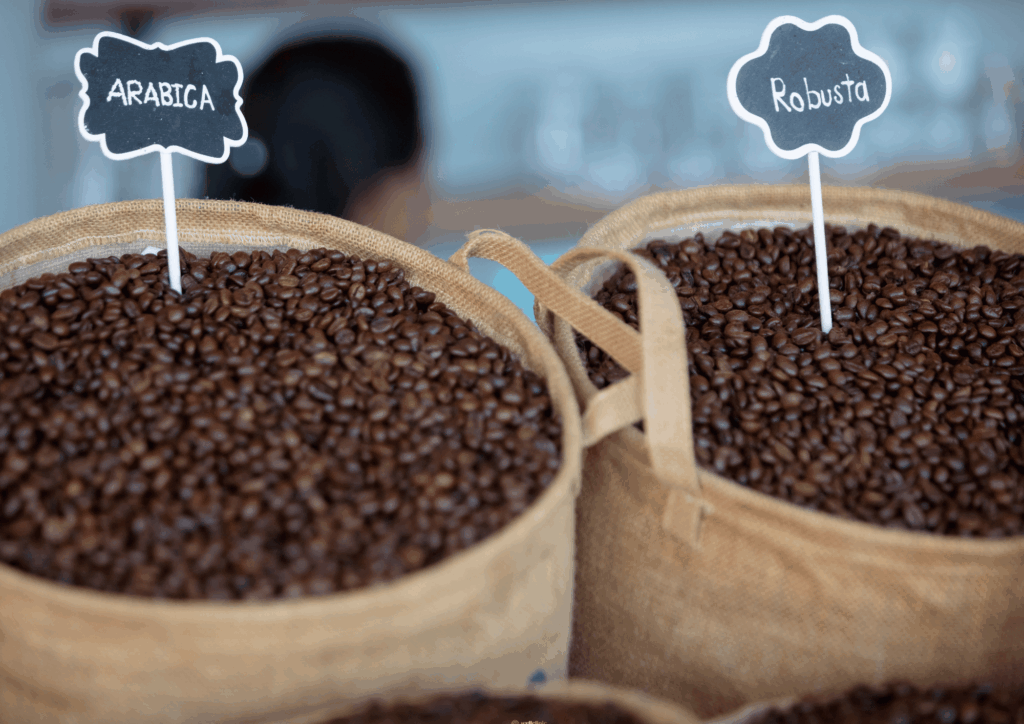
The choice of beans is important, primarily because of their caffeine content. Arabica usually contains around 1–1.5 per cent, whilst Robusta contains as much as 2–2.7 per cent. The second variety therefore has a stronger stimulating effect and may temporarily increase energy expenditure to a greater extent. Robusta It is also characterised by a higher content of certain natural compounds with antioxidant properties.
However, this does not mean that it is more effective for weight loss. Both varieties provide valuable bioactive compounds, and research to date does not conclusively confirm that choosing Robusta over Arabica leads to greater fat loss. If you prefer a milder flavour and a lower caffeine content, choose Arabica. Robusta, on the other hand, is ideal for those who prefer a stronger coffee.
Coffee and calories – what should you watch out for when trying to lose weight?
In the context of weight reduction It is not only the amount of coffee you drink that matters, but also how it is prepared. Black coffee without additives, it provides only about 2–5 kcal per cup, which is why it can form part of a weight-loss diet.
The situation is different for drinks containing milk, cream, sugar or flavoured syrups. Such ingredients can significantly increase calorie content of coffee:
- Milk - approximately 30–60 kcal,
- Cream - approximately 50–100 kcal,
- A teaspoon of sugar - approximately 20 kcal,
- A portion of flavoured syrup - approximately 50–80 kcal.
Large latte with syrup and whipped cream It can provide as much as 300–450 kcal, which is equivalent to a full meal. The extra energy from such drinks can easily increase your daily calorie balance and make it more difficult to maintain energy deficit.
If you opt for sweetened milky coffees several times a day, it’s worth factoring them into your meal plan. Even small, regularly consumed extra calories can make a difference to your overall weight loss.
Is it worth drinking coffee whilst trying to lose weight?
Coffee can be part of a healthy lifestyle and indirectly support the process weight reduction. However, it is not a slimming aid, and its effect on the metabolism remains relatively minor.
Key findings:
- Caffeine may slightly speed up the metabolism and help burn fat, but its effect is minimal and it is no substitute for a well-balanced diet.
- The most noticeable benefit is an improvement in physical fitness. Caffeine may make it easier to do more intense and longer workouts.
- The body develops a tolerance to caffeine. Its effects may be less pronounced in people who regularly drink large amounts of coffee.
- 2–3 cups of black coffee a day may constitute a reasonable amount for a healthy adult, provided that total caffeine intake remains within the recommended limits.
- Coffee additives do make a difference. Sweetened lattes, syrups and cream can contain a significant number of calories, which are worth taking into account in your daily energy intake.
- You don’t need to start drinking coffee to lose weight. Green tea, black tea and yerba mate can also be sources of caffeine and polyphenols.
Ultimately, success depends on weight reduction is determined, first and foremost, by a suitably chosen caloric deficit, regular physical activity and consistency in your daily habits. Coffee can complement these, but it can never replace the basic principles of healthy weight loss
Sources:
1. PubMed – Tabrizi R. et al. (2019): The Effects of Caffeine Intake on Weight Loss: A Systematic Review and Dose-Response Meta-Analysis of Randomised Controlled Trials.
https://pubmed.ncbi.nlm.nih.gov/30335479/
2. PubMed – Dulloo A.G. et al. (1989): Normal Caffeine Intake: Its Effect on Thermogenesis and Daily Energy Expenditure.
https://pubmed.ncbi.nlm.nih.gov/2912010/
3. International Society of Sports Nutrition – Guest N.S. et al. (2021): Caffeine and Exercise Performance. https://jissn.biomedcentral.com/articles/10.1186/s12970-020-00383-4
4. PubMed – Lopez-Garcia E. et al. (2006): Changes in Caffeine Intake and Long-Term Weight Change in Men and Women. https://doi.org/10.1093/ajcn/83.3.674
5. European Food Safety Authority (EFSA) – NDA Panel (2015): Scientific Opinion on the Safety of Caffeine. https://doi.org/10.2903/j.efsa.2015.4102
6. National Centre for Nutrition Education (NCEŻ), National Institute of Public Health – PZH-PIB: Facts and myths about drinking coffee, part 1.
https://ncez.pzh.gov.pl/abc-zywienia/fakty-i-mity-na-temat-picia-kawy-cz-1/
7. Warsaw Medical University – A. Grodzka et al. (2021): A scientific publication concerning, amongst other things, the link between caffeine and obesity.
Publication – Bulletin of the Faculty of Pharmacy, Medical University of Warsaw (PDF)








 +48 600 100 177