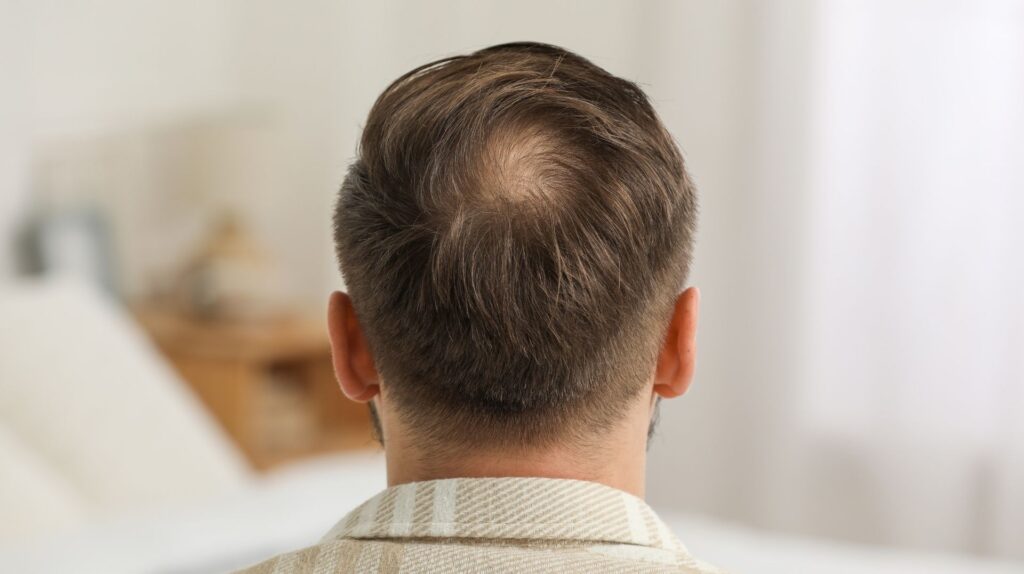
Androgenetic alopecia This is the most common cause of gradual hair loss. It affects both men and women and is a chronic condition. It is caused by androgens and genetic predisposition.
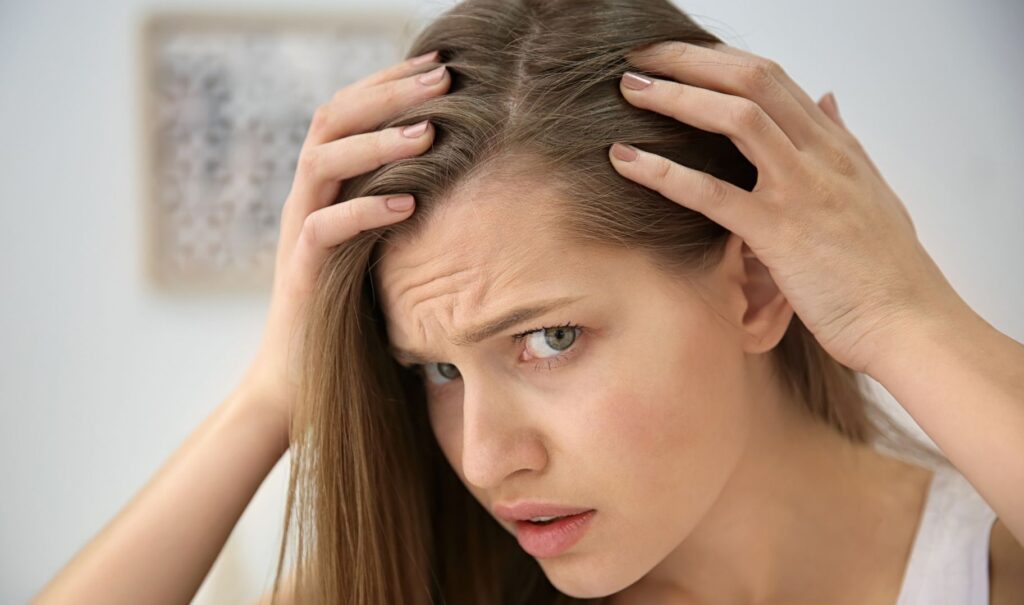
In men, the first symptoms are usually corners and thinning hair in the area parietal. In women, the process is different – the hair gradually thins in the central part of the scalp, whilst the hair on the sides and back remains forehead lines.
The main party responsible for this process is dihydrotestosterone (DHT), which weakens hair follicles and shortens the hair’s life cycle. Over time, the hair becomes thinner, shorter and less firmly anchored in the skin.
As hair loss progresses, this leads to miniaturisation of hair follicles – Terminal hair gradually transforms into increasingly finer strands, until it eventually disappears.
Treatment of alopecia is primarily about slowing down this process and providing support hair follicles in regaining activity, which may lead to an improvement hair density and quality.
The progression of androgenetic alopecia and the importance of time
The process is not sudden. It develops slowly, often over many years. Initially, the changes are subtle and are limited to a deterioration in hair quality; it is only later that visible hair loss occurs.
It is important that hair follicles do not disappear straight away. They are going through a phase of decline and a gradual reduction in activity. During this period, there is still the potential for them to be reactivated, which is important for the effectiveness of the treatment.
The longer the process takes, the higher the proportion of inactive follicles and the poorer the response to treatment.
Differential diagnosis of alopecia
Not all types of hair loss follow the same mechanism.
Telogenetic alopecia It is usually sudden in nature and is the body’s response to stress, infection, nutritional deficiencies or hormonal imbalances. In this case, a large number of hairs enter the shedding phase, but the hair follicle structures remain intact.
Alopecia areata is caused by an autoimmune mechanism and leads to focal hair loss in clearly demarcated areas.
Androgenetic alopecia is a chronic process, influenced by androgens and genetics, in which a key role is played by miniaturisation of hair follicles.
Fotona Hair Restoration – treatment for androgenetic alopecia
Fotona Hair Restoration This is a treatment programme used in treatment for androgenetic alopecia and other types of hair thinning.
In clinical practice, it combines the effects of a medical laser with the use of tissue biosimulators. The combination of these methods is designed to improve the condition of the scalp and support its function hair follicles.
The use of this technology enables results comparable to those achieved with more invasive treatment methods, whilst avoiding any recovery period. In many cases, improvements in hair quality and density are seen more quickly than with conventional supportive treatments.
Laser treatment of androgenetic alopecia
The therapy makes use of a laser platform Fotona Dynamis SP PRO, used in aesthetic medicine and dermatology.
The programme’s effectiveness Fotona Hair Restoration This has been confirmed in clinical observations, which reported an increase in hair density of up to around 86 per cent, depending on the initial condition of the scalp and the stage of the condition.
Laser therapy works by improving microcirculation, stimulating the skin’s regenerative processes and supporting its functioning hair follicles, which may slow down the process of miniaturisation.
The course of treatment for androgenetic alopecia
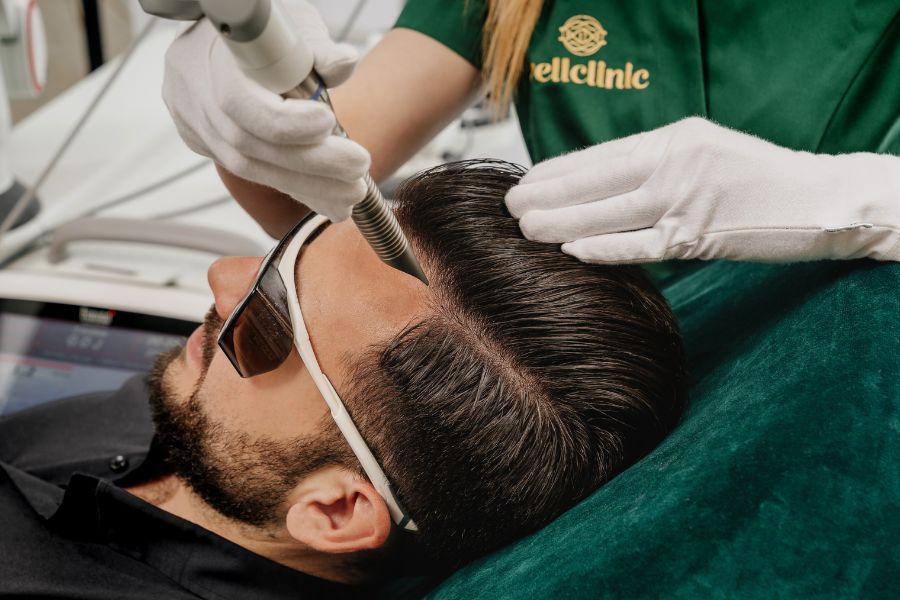
Treatment Fotona Hair Restoration It usually lasts between 10 and 20 minutes. Depending on the stage of the disease androgenetic alopecia A course of around six treatments, carried out at intervals of approximately two weeks, is recommended.
The procedure is non-invasive and painless. It does not require any recovery time, which sets it apart from surgical methods such as hair transplants, which involve a procedure lasting several hours and a recovery period.
After the treatment, the patient can resume their daily activities without any restrictions. The treatment is supportive in nature and aims both to improve the quality of the hair and to slow down further hair loss. androgenetic alopecia, particularly in areas where hair follicles remained active.
Would you like to find out more about hair loss treatment at Wellclinic? Make an appointment for a consultation – our specialists will put together a personalised treatment plan, tailored specifically to your needs. Treatments laser treatment for hair loss We carry out these procedures at our clinics in Warsaw, Gdansk i Krakow.
Sources:
- PubMed „Evidence-based (S3) guideline for the treatment of androgenetic alopecia in women and men"
https://pubmed.ncbi.nlm.nih.gov/29178529/ - PubMed „Comparative effectiveness of low-level laser therapy for androgenetic alopecia in adults: a systematic review and meta-analysis of randomised controlled trials"
https://pubmed.ncbi.nlm.nih.gov/30706177/ - PubMed „Low-Level Laser and LED Therapy for Alopecia: A Systematic Review and Meta-Analysis"
https://pubmed.ncbi.nlm.nih.gov/39404126/ - PubMed „Low-level laser therapy as a treatment for androgenetic alopecia"
https://pubmed.ncbi.nlm.nih.gov/27114071/ - PubMed „Low-level laser therapy for the treatment of androgenetic alopecia: a review"
https://pubmed.ncbi.nlm.nih.gov/29270707/ - American Academy of Dermatology (AAD) „Hair loss: Diagnosis and treatment"
https://www.aad.org/public/diseases/hair-loss/treatment/diagnosis-treat - Cleveland Clinic „Male Pattern Baldness (Androgenic Alopecia): Stages, Treatment"
https://my.clevelandclinic.org/health/diseases/24515-male-pattern-baldness-androgenic-alopecia