
 Katarzyna Pawłowska

 03.11.2026
You may exercise regularly, watch what you eat and maintain a healthy weight, yet still struggle with body fat around your stomach and waist. These areas of the body can be particularly resistant to change. This doesn’t always mean you’re doing something wrong. The appearance of your tummy is also influenced by genetics, age, your hormonal balance, the distribution of body fat and the elasticity of your skin.
Abdominal and waist liposuction It is primarily associated with the surgical removal of localised pockets of fat. However, this is not the only method for improving body contour. Depending on the problem, one might also consider laser lipolysis, cryolipolysis, radiofrequency or non-invasive body contouring using technology TightSculpting™.
The various methods differ in their mechanism of action, level of invasiveness and the range of possible outcomes. Not every method removes the same amount of fat. Nor does every method address the issue of sagging skin. Find out how the available solutions differ and how to choose the right one for your body shape.
Table of contents
Abdominal and waist liposuction – what does the procedure involve?
Abdominal and waist liposuction This is a surgical procedure involving the removal of excess subcutaneous fat from selected areas of the body. The doctor inserts a thin cannula under the skin, through which the fat tissue is suctioned out. Depending on the technique and extent of the procedure, it is carried out under local or general anaesthesia.
The main aim of liposuction is reduction of localised fat deposits and improvement in body proportions. The treatment may target the abdomen, the sides of the waist, the hips or other areas where excess fat accumulates.
However, it is important to bear in mind that Liposuction is not a treatment for obesity, nor is it a means of achieving significant weight loss. The best candidates are usually people whose weight is relatively stable, but who have a problem with localised fat deposits. A doctor determines eligibility after assessing the patient’s health, body type and skin elasticity.
Surgical liposuction versus non-invasive methods
Although terms such as laser liposuction, although the terms ‘lipolysis’ and ‘body contouring’ are sometimes used interchangeably, they do not mean the same thing.
In traditional surgical liposuction, fat tissue is mechanically removed from the body using a cannula. This is an invasive procedure which requires appropriate anaesthesia and involves a period of recovery.
Laser lipolysis It uses laser energy to target adipose tissue. Depending on the technique used, it may be a minimally invasive procedure requiring the insertion of an optical fibre under the skin. It should not be confused with non-invasive laser treatments.
In turn TightSculpting™ It is a non-invasive technology that uses Nd and Er lasers to treat tissue and improve the appearance of the treated area. It does not involve surgical liposuction.
These differences are important when choosing a treatment. Non-invasive body contouring cannot replace surgical liposuction in people with a significant excess of body fat. On the other hand, surgery is not always necessary if the problem involves minor, localised irregularities or reduced skin elasticity.
TightSculpting™ – laser contouring of the abdomen and waist
TightSculpting™ It is a non-invasive technology used for body contouring, improving skin firmness and targeting localised fat deposits. The treatment utilises the Fotona laser system, which combines the effects of two wavelengths: Nd:YAG i Er:YAG.
Nd:YAG laser enables treatment of deeper tissues, whilst Er:YAG It is used to treat the more superficial layers of the skin. The combination of these technologies makes it possible to address both localised fat deposits and reduced skin firmness.
When it comes to the abdomen and waist, it is not only the amount of body fat that matters, but also the condition of the skin. Following weight loss, pregnancy or as we age, the skin may lose its elasticity and become less firm. Therefore, methods focused solely on fat reduction do not always address all the needs of this area.
TightSculpting™ is not surgical liposuction. It does not involve the mechanical removal of fat tissue and is not intended for the reduction of large amounts of fat. It may be considered as a non-invasive method of body contouring for selected areas in suitably qualified individuals.
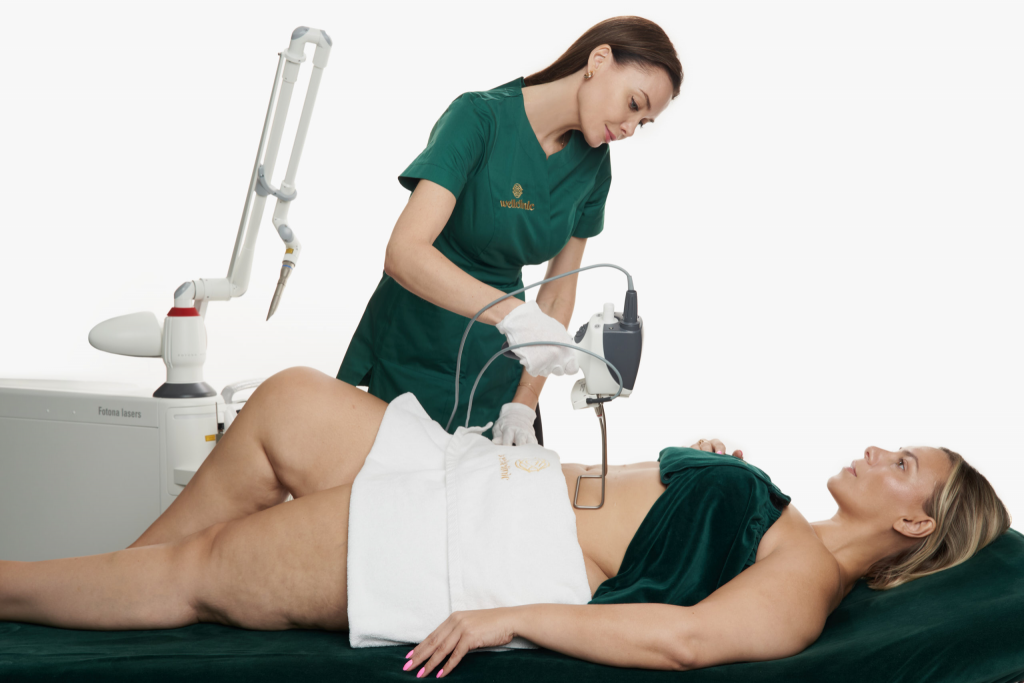
Er:YAG lasers and Er:YAG in body contouring
TightSculpting™ technology utilises two laser wavelengths, which differ in the way they affect the tissues.
Nd:YAG It is a neodymium-YAG laser that uses a light beam with a wavelength of 1064 nm. It is used in various medical and aesthetic procedures. In TightSculpting™ technology is responsible for affecting deeper tissues.
Er:YAG It is an erbium-YAG laser with a wavelength of 2940 nm. Among other things, it is used in procedures designed to improve the quality and structure of the skin. In TightSculpting™ technology, it supports treatments aimed at improving skin firmness and the appearance of the skin’s surface.
Other methods of reducing body fat and sculpting the abdomen
Surgical liposuction is not the only option to consider for localised fat deposits. The available technologies differ in how they work. Some focus on reducing fat, whilst others are primarily aimed at improving skin firmness.
Laser lipolysis – effects on adipose tissue
Laser lipolysis It uses laser energy to target fat cells. Depending on the technique, this may involve inserting an optical fibre under the skin; therefore, not every procedure described in this way can be considered non-invasive.
The method can be used to contour specific areas of the body, including the abdomen, hips and thighs. Compared with traditional liposuction, the extent of the procedure may be less extensive, but this does not mean there are no risks or that the results will be identical.
Laser lipolysis should not be confused with TightSculpting™. These are different technologies, even though both use laser energy.
Cryolipolysis – fat reduction through cooling
Cryolipolysis It utilises controlled cooling of adipose tissue. The low temperature causes damage to some fat cells, which are then gradually eliminated by the body. The treatment can be applied to specific areas of the body, including the abdomen and the sides of the waist.
The results appear gradually, and their extent depends on the individual’s response and the area treated. Cryolipolysis is not a weight-loss method, nor is it the equivalent of surgical liposuction.
It is also worth being aware of the possible side effects. In addition to temporary pain, redness or swelling, a rare complication known as paradoxical adipose tissue hyperplasia has been reported. This involves an increase in tissue volume at the site that has been cooled.
Radiofrequency – improving abdominal skin firmness
Radiofrequency (RF) It uses radiofrequency energy to heat tissue in a controlled manner. Depending on the type of device, the settings and the technique used, the treatment can support skin remodelling processes, including the synthesis of collagen and elastin.
Radiofrequency is used, amongst other things, in procedures aimed at improved firmness, elasticity and tone of the skin. It may be considered when the problem is abdominal laxity, rather than simply excess body fat.
However, not all RF technologies work in the same way. Some devices are primarily designed to improve skin quality, whilst others can be used in body contouring treatments. It is therefore important to check the specific application of a particular device before the treatment.
HIFU - focused ultrasound
HIFU It utilises focused ultrasound energy, which penetrates to a specific depth within the tissues and produces a controlled thermal effect. The technology is used in selected procedures aimed at improving skin firmness.
However, one should not assume that everyone HIFU treatment It is designed for abdominal contouring. Its use depends on the specific device, treatment head, parameters and treatment area.
Injectable lipolysis – a preparation administered into adipose tissue
Injection lipolysis involves administering the preparation into adipose tissue in order to cause damage to fat cells. Whether this method can be used depends on the composition of the preparation, its authorisation and the indications specified by the manufacturer.
Swelling, pain, redness and bruising may occur following the procedure. This is not a one-size-fits-all method for reducing abdominal fat. A doctor should decide whether to use this method after assessing the treatment area and the patient’s state of health.
A comparison of methods for modelling the abdomen and waist
| Method | Main objective | Nature of the procedure |
|---|---|---|
| Surgical liposuction | Mechanical removal of adipose tissue | Invasive |
| Laser lipolysis | The effect of laser treatment on fat cells | Depending on the technique: minimally invasive |
| TightSculpting™ | Body contouring and improving skin firmness | Non-invasive |
| Cryolipolysis | The effect of cooling on adipose tissue | Non-invasive |
| Radiofrequency | Tissue heating and improved skin firmness | Depending on the technology |
| HIFU | The focused effect of ultrasound on tissues | Non-invasive |
| Injection lipolysis | The effect of the preparation on fat cells | Injection |
There is no single method that suits everyone. Surgical liposuction allows a larger amount of fat tissue to be removed, whilst non-invasive procedures are designed for more limited body contouring or to improve skin firmness. Their effectiveness cannot be compared without taking into account the indications, the specific device and the patient’s initial condition.
What results can be achieved through abdominal and waist contouring?
The results depend on the method used, the initial condition of the skin, the amount of body fat and the individual’s response.
Once the appropriate procedure has been selected, you can expect:
- improving the contour of the abdomen and waist;
- to minimise the visibility of localised unevenness;
- improving skin firmness and elasticity;
- smoothing the skin’s surface;
- a more flattering appearance of the chosen part of the body.
However, body-contouring treatments should not be regarded as a means of losing weight. They are no substitute for weight loss, physical activity or a properly balanced diet. Nor do they guarantee a specific reduction in waist circumference.
Who is abdominal and waist liposuction suitable for?
Classic abdominal and waist liposuction It may be considered by people with localised fat deposits that cannot be reduced despite maintaining a stable body weight. Eligibility is determined by a doctor following an assessment of the patient’s health, the distribution of body fat, skin elasticity and the patient’s expectations.
Non-invasive laser contouring may be an alternative for people who do not require surgical removal of large amounts of fat, but who wish to improve the contour of a specific area of the body and enhance skin firmness.
It is worth bearing in mind that a protruding tummy is not always caused by excess subcutaneous fat. It may also be linked to bloating, weak abdominal muscles, diastasis recti, a hernia or a build-up of visceral fat. Treatments designed to contour subcutaneous tissue do not resolve all of these issues.
Contraindications for abdominal contouring treatments
Every treatment requires prior assessment. Contraindications depend on the method used and the patient’s state of health.
In the case of laser procedures, contraindications may include, amongst others, pregnancy, active infections and skin inflammation in the treatment area, certain chronic conditions, healing disorders, and selected medical conditions that increase the risk of complications. Medications being taken and previous treatments in the area in question may also be relevant.
Prior to surgical liposuction, it is also necessary to assess the surgical risks, including any underlying medical conditions, coagulation disorders, medications being taken and general health.
The final decision on whether the procedure can be carried out is made by the doctor after taking the patient’s medical history and examining them.
Is liposuction of the abdomen and waist painful?
The sensations experienced depend on the type of procedure. Traditional surgical liposuction is carried out under anaesthesia, but pain, swelling, bruising and tenderness may occur after the procedure. The recovery period depends on the extent of the procedure and the individual healing process.
During a non-invasive the TightSculpting™ treatment The patient may feel warmth and intense heating of the skin. The intensity of these sensations depends on individual sensitivity and the device’s settings. It should not be assumed that every procedure is completely painless.
After laser treatment Temporary redness, tenderness or swelling may occur. The specialist will provide advice on aftercare and what to do following the treatment.
How long do the results of abdominal contouring last?
The longevity of the results depends on the method used. In the case of surgical liposuction, the fat cells that are removed do not regrow in the same number, although the remaining cells may increase in volume. Significant fluctuations in body weight may therefore alter the achieved body contour.
In the case of non-invasive laser treatment, the results depend on the tissues’ response and should not be equated with the permanent removal of fat cells. The appearance of the abdomen is also influenced by age, hormonal changes, body weight and natural ageing processes.
To maintain these results, you need to maintain a stable weight, take regular exercise and follow healthy eating habits.
Abdominal and waist liposuction at Wellclinic – choosing the right method
Not every tummy requires liposuction. Sometimes the problem is localised fat deposits; at other times, it is a loss of skin firmness; or it may be a combination of several factors. That is why, before choosing a procedure, it is important to determine what is actually affecting the appearance of the figure.
Wellclinic offers the following technology TightSculpting™, which uses Nd:YAG and Er:YAG lasers for non-invasive body contouring of specific areas. During a consultation, it is possible to assess whether this method meets the patient’s needs and whether there are any indications for its use.
Don’t choose a treatment simply because it promises a rapid reduction in waist circumference. First, identify the cause of the problem, and only then choose the appropriate method. Book a consultation at Wellclinic and find out whether TightSculpting™ is the right solution for your figure.
Sources:
1. PubMed: Wolska J., Hassan H., Non-invasive lipolysis modalities in aesthetic medicine, 2023.
https://pubmed.ncbi.nlm.nih.gov/37431699/
2. PubMed: Kumar V. et al., ‘Effectiveness of HIFU Therapy for Nonsurgical Facial and Body Contouring’, 2023.
https://pubmed.ncbi.nlm.nih.gov/36730550/
3. PubMed: Ingargiola M. J. et al., Cryolipolysis for fat reduction and body contouring, 2015.
https://pubmed.ncbi.nlm.nih.gov/26017594/
4. Fotona: TightSculpting®
https://www.fotona.com/
Book a consultation




 +48 600 100 177