
 Katarzyna Pawłowska
 07.09.2026
 Table of contents
You can exercise regularly. Watch what you eat. Do everything by the book. And yet your tummy, hips or thighs may still not look the way you want them to. That’s when the question arises: what to do about localised fat deposits, which doesn’t respond to diet and exercise?
There are several methods to choose from. Cryolipolysis, injection lipolysis, as well as laser lipolysis and other forms laser fat reduction. However, they differ in terms of how they work, the level of comfort they offer, and what the recovery period is like after the procedure.
Find out how these really differ from one another. body treatments. Not all fat disappears as you lose weight
Weight reduction it does not proceed evenly.
For some people, their waist circumference decreases more quickly. For others, the thighs, hips or lower abdomen are the last areas to change. That is why, even if a person’s weight is within the normal range, there may still be localised accumulation of adipose tissue.
And it is precisely in such situations that body modelling.
It’s not about losing weight all over. It’s about targeting a specific area that’s more resistant to change.
Cryolipolysis – fat under the control of low temperatures
Cryolipolysis uses controlled cooling body fat. The principle behind it is to affect fat cells by lowering their temperature, and then for the body to gradually eliminate them.
It sounds simple.
The procedure itself does not require any incisions, but involves a distinctive sensation of suction and cooling in the area being treated. After the procedure, temporary local reactions may occur, such as redness, swelling, tenderness or numbness.
You also have to wait for the results. The process takes place gradually, so the results do not appear immediately after leaving the clinic.
Injection lipolysis – when needles are the problem
Injection lipolysis It works differently. The active ingredient is administered directly into the tissue via an injection.
This allows for localised treatment, but at the same time involves contact with a needle and the possibility of reactions typical of injection procedures.
Swelling, bruising, tenderness or soreness may occur at the injection site, amongst other things. Depending on the area and the desired result, it may also be necessary to repeat the procedure.
For some people, it is this stage that poses the biggest problem.
They want to sculpt their figure, but they don’t want needles, bruising or a recovery period during which they have to take care of the treated area.
Cryolipolysis, injectable lipolysis or laser lipolysis – which should you choose?
Cryolipolysis, injection lipolysis i laser lipolysis They operate on completely different principles.
Cryolipolysis is based on controlled cooling body fat.
Injection lipolysis involves the direct delivery of the active substance to the tissue.
In turn laser lipolysis It uses laser energy to target a specific area and can also help improve skin firmness.
The difference also relates to comfort after the procedure.
With injection-based methods, reactions at the injection site are to be expected. With cryolipolysis, temporary swelling, tenderness or numbness may occur. Laser fat reduction It can, however, be carried out without incisions and allow for a quick return to everyday activities, depending on the technology used.
Therefore, the choice of method should not be reduced solely to the question: „Which one reduces fat?”
It’s also worth asking: How does it work, what does it require, and what happens to the skin?
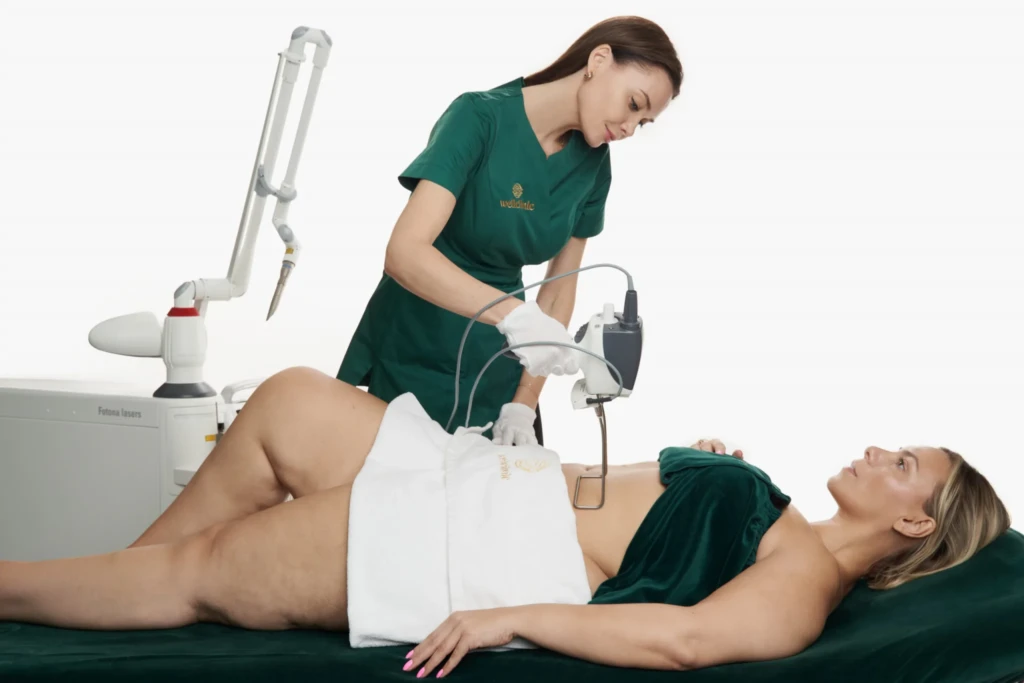
Laser fat reduction – how does it work?
This is precisely where laser fat reduction.
Wellclinic uses laser technology which combines targeted treatment with adipose tissue whilst also helping to improve skin firmness. That’s an important difference.
It’s not just about reducing body fat. When body shaping What also matters is how the skin looks after the reduction. The technology can target a specific area of the body, helping to reduce localised fat deposits and improve skin firmness and appearance.
No needles. No incisions. No scalpel.
When might a laser be a good option?
Laser fat reduction may be considered by those who are keen on localised body contouring, but they do not want to use methods that involve needles, incisions or a long recovery period.
This may be particularly important for people in work who do not want to disrupt their daily routine.
At the same time, it is important to bear in mind that weight-loss treatments and body contouring are no substitute for a healthy diet or physical activity. Treatments of this kind are primarily aimed at localised reduction in body fat, rather than treating excess weight or obesity.
Don’t choose a method based on its name alone
„Fat freezing”. „Lipolysis”. „Laser”.
The names alone do not tell you much about what to expect during and after the procedure.
What matters is the mechanism of action, the area being treated, and the amount body fat, skin condition and the desired result.
It is therefore advisable to consult a specialist before starting treatment and to assess which method will be suitable for the specific case.
Do you want to get in shape without taking a back seat in life?
If, despite following a diet and exercising, you still see areas you’d like to tone, you don’t have to choose a method at random. In Wellclinic during a consultation The area to be treated, the condition of the skin and expectations regarding the results are assessed. On this basis, a suitable solution can be selected.
Sources
- PubMed „Cryolipolysis and associated health outcomes, adverse events, and satisfaction: A systematic review and meta-analysis”
https://pubmed.ncbi.nlm.nih.gov/40211915/ - PubMed „Non-invasive lipolysis techniques in aesthetic medicine”
https://pubmed.ncbi.nlm.nih.gov/37431699/ - PubMed „Cryolipolysis for fat reduction and body contouring: safety and efficacy of current treatment approaches”
https://pubmed.ncbi.nlm.nih.gov/26017594/ - PubMed „A review of non-invasive body contouring devices for fat reduction, skin tightening and muscle definition”
https://pubmed.ncbi.nlm.nih.gov/31168833/ - FDA „Non-Invasive Body Contouring Technologies”
https://www.fda.gov/medical-devices/aesthetic-cosmetic-devices/non-invasive-body-contouring-technologies - PubMed „Non-invasive subcutaneous fat reduction: a review”
https://pubmed.ncbi.nlm.nih.gov/25664493/ - PubMed „A review of research into cryolipolysis technology”
https://pubmed.ncbi.nlm.nih.gov/37988713/



 +48 600 100 177