
 Katarzyna Pawłowska

 03.11.2026
Table of contents
You can get eight hours’ sleep, look after your skin and look well-rested. And yet your eyes may still betray your tiredness. The cause isn’t always to be found in the dark circles under the eyes. Sometimes the problem lies deeper – in the hollow between the lower eyelid and the cheek, which casts a shadow and alters the appearance of the whole face.
And this is precisely where many people go wrong. They reach for yet another cream, try to lighten their skin, or cover the hollow with concealer. Yet none of these methods will restore the lost tissue volume.
Filling the tear trough with hyaluronic acid 1TP4 may help to smooth out this hollow and restore a more harmonious transition between the lower eyelid and the cheek. However, it is not a treatment suitable for everyone. The area around the eyes requires precision, and an ill-chosen method may have the opposite effect to that intended.
Find out what it’s all about tear trough filler treatment, when it is justified and why, before administration hyaluronic acid for under the eyes The most important thing is to assess this area correctly.
What is the ‘tear trough’ and what causes the hollows under the eyes?
Valley of tears This is an elongated groove running from the inner corner of the eye towards the cheek. In some people, it is visible from a young age and is due to the individual structure of the face. In others, it becomes more pronounced as they get older.
Several factors influence the appearance of this area. As time goes by, changes occur in the distribution of body fat, a reduction in tissue volume and gradual loss of skin elasticity. Genetic factors, the structure of the eye socket and the position of the ligaments supporting the tissues are also significant.
As a result, a more distinct line appears between the lower eyelid and the cheek. The shadow cast on the face can further emphasise this hollow and make the eyes look tired.
However, dark circles under the eyes do not always indicate a loss of volume. They may also be caused by thin skin, visible blood vessels, dark circles under the eyes, swelling or adipose hernias. In such situations filling the tear trough with hyaluronic acid may not produce the desired result.
Filling the tear troughs with hyaluronic acid – what does the procedure involve?
Filling the tear trough with hyaluronic acid involves administering the preparation in the infraorbital region to restore local volume loss and 1TP4 reduce the hollow appearance. The doctor selects the type of preparation, the quantity and the method of administration to the patient’s anatomical structure.
Hyaluronic acid It is a substance that occurs naturally in the body, including in the skin and connective tissue. It binds water, thereby affecting the volume and properties of tissues. In preparations used for aesthetic treatments, it takes the form of a gel with specific properties.
However, not just any filler can be used around the eyes. The skin of the lower eyelid is thin, and the course of the blood vessels and the arrangement of the anatomical structures mean that this is an area requiring particular care. The product must be carefully selected for this area, and the amount used should be as small as possible.
The aim of the treatment is not to completely fill the area under the eyes, but to achieve the natural transition between the lower eyelid and the cheek. Using too much of the product may lead to unevenness or persistent swelling.
What are the results of tear trough filler treatment?
The outcome of the treatment depends primarily on the cause of the depression, the product used and the individual characteristics of the tissues. In suitably selected patients filling the tear valley may result in:
- reduced visibility hollows beneath the lower eyelid,
- a smoother transition between the area around the eye and the cheek,
- optical limitation dark circles under the eyes resulting from a loss of volume,
- a more rested appearance,
- a subtle improvement in the proportions of the central part of the face.
The result is usually visible immediately after the treatment, but the following may occur immediately after the procedure: swelling, redness or bruising. The final appearance of the area under the eyes should be assessed once the initial post-treatment reactions have subsided.
It is worth remembering that Hyaluronic acid does not eliminate all the causes of dark circles under the eyes. It will not eliminate discolouration, remove fat deposits or always improve the firmness of sagging skin.
Who is a good candidate for tear trough filler treatment?
The treatment may be suitable for people whose visible hollows under the eyes are primarily caused by local volume deficit. This applies both to certain younger patients with a genetically determined anatomical structure in this region and to people in whom The Valley of Tears has deepened with age.
However, this is not a one-size-fits-all solution for every cosmetic issue under the eyes. Particular caution is required for people who are prone to puffiness under the eyes, lymphatic congestion, pronounced bags under the eyes or sagging skin. The administration of hyaluronic acid in such cases may exacerbate certain imperfections.
During the consultation, the doctor should assess, amongst other things:
- depth and course Valley of Tears,
- the amount of fat tissue in the lower eyelid area,
- skin tension and thickness,
- the occurrence of oedema and lipomata,
- previous treatments using hyaluronic acid-based dermal fillers,
- general state of health and any medication being taken.
Only on this basis can it be determined whether filling the tear trough with hyaluronic acid will be the right solution.
The tear trough filler procedure
The treatment should be preceded by a medical consultation. During the consultation, the specialist finds out about the patient’s expectations, gathers information about their state of health, previous procedures and any reactions to products used in aesthetic medicine. They then assess the anatomy of the eye region and determines whether there are indications for the administration of a filler.
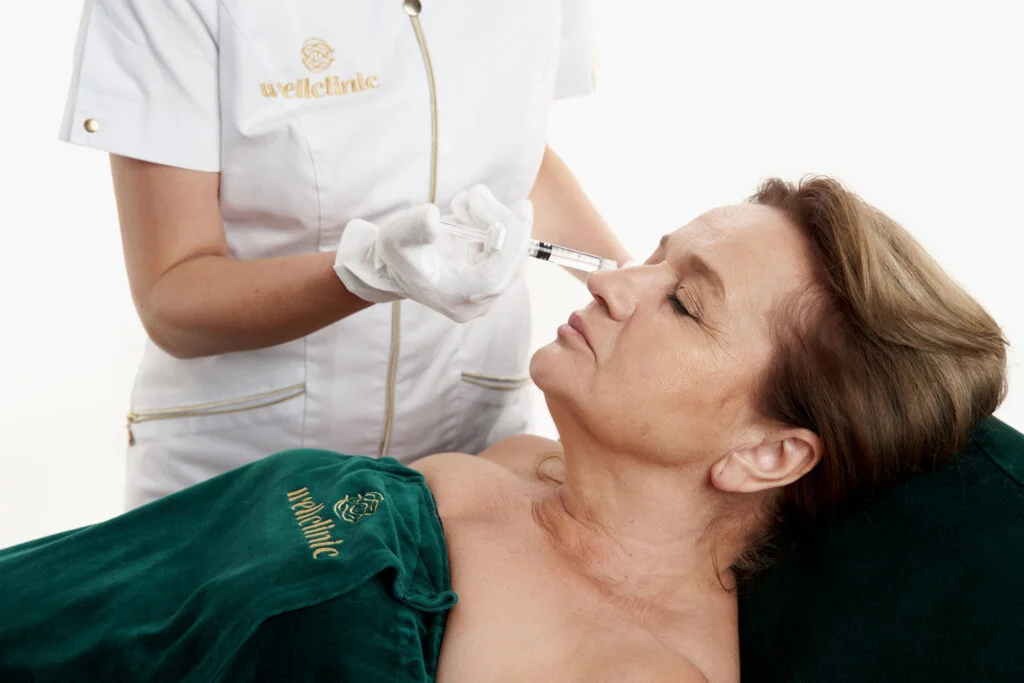
If a patient is deemed suitable for the procedure, the doctor selects the appropriate product and injection technique. Hyaluronic acid can be administered using a fine needle or a cannula, i.e. a blunt-tipped injection device. The choice of method depends on the patient’s anatomy, the intended injection site and the doctor’s experience.
During the procedure, the product is injected into precisely defined layers of tissue. In this area, precision, control over the amount of product administered and avoiding overcorrection are key.
The duration of the treatment depends on the scope of the procedure and the technique used. Once it is complete, the doctor will explain post-treatment recommendations regarding what to do during the recovery period.
How long do the results of tear trough filler last?
The effects of filling the tear trough with hyaluronic acid They are not permanent. The product gradually biodegrades, and the duration of the results depends, amongst other things, on the type of filler, the amount used, the properties of the tissues and the individual’s metabolism.
It cannot therefore be guaranteed that the effect will last for a specific number of months in every individual. In the case of filling the area under the eyes It is also important to note that traces of the product may remain visible or detectable for longer than would be suggested by the stated duration of the effect alone.
Any further administration of the product should be preceded by a medical check-up. It is not always necessary or advisable to carry out a further correction. Too frequent volume replenishment may increase the risk of product accumulation and persistent swelling.
Possible side effects and contraindications
The area under the eyes is particularly challenging due to its thin skin, delicate tissue structure and the presence of blood vessels. Therefore, filling the tear trough with hyaluronic acid It should only be carried out following a thorough assessment and by a suitably qualified doctor.
After the procedure, temporary reactions may occur, such as:
- swelling and redness,
- bruises and bruising at the injection site,
- tenderness or slight discomfort,
- texture and the feel of the product,
- asymmetry requiring monitoring.
The following may also appear in this area the Tyndall effect, i.e. a bluish or greyish discolouration of the skin caused by the product being applied too close to the surface. In some people, this occurs persistent swelling, particularly if there has been a previous tendency to retain fluid.
More serious complications may occur in rare cases, including infection, tissue damage or occlusion of a blood vessel. In the case of fillers administered to the face, visual disturbances have also been reported, and in extreme cases, loss of vision. Sudden, unusual pain, paleness or bruising of the skin, and particularly any visual disturbances following an injection, require immediate medical attention.
Contraindications or situations requiring the procedure to be postponed include, amongst others, active infections and inflammation at the planned injection site, certain systemic diseases, pregnancy and breastfeeding, and hypersensitivity to the product’s ingredients. The final decision is made by the doctor on the basis of the patient’s medical history and examination.
Hyaluronic acid, polynucleotides and HIFU – how do these methods differ?
Not every issue around the eyes requires volume restoration. Therefore, during a consultation, various methods of improving the appearance of this area can be considered. Hyaluronic acid, polynucleotides and HIFU They work in different ways and are not interchangeable.
Hyaluronic acid It is primarily used to correct depressions resulting from volume deficit. Its purpose is to improve the contour and 1TP4soften the transition between the lower eyelid and the cheek.
Polynucleotides these are products used in treatments aimed at improved skin quality. They do not act as a traditional filler and are not intended for the direct restoration of deep volume loss. They may be considered for skin requiring improvement in its condition, but their use around the eyes also requires an individual assessment.
HIFU, a technology that utilises focused, high-intensity ultrasound, is used in procedures aimed at improved tissue tone. It does not fill in tear troughs and does not replace hyaluronic acid in cases of significant volume loss.
The choice of method should be based on the diagnosis of the problem, rather than on the location of the imperfection alone. A different approach is required for anatomical recess, another skin flaccidity, and yet others may have oedema or lipomas.
Filling the valley of tears at Wellclinic
Tired-looking eyes do not always require more product. Sometimes the best decision is to skip the filler. That is why, when it comes to the area under the eyes, it is so important to correctly assess the anatomy and the cause of the problem.
At Wellclinic, aesthetic medicine treatments are preceded by a consultation, during which a specialist assesses the patient’s needs and the suitability of the chosen method. If the problem stems from volume loss, the doctor may consider filling the tear trough with hyaluronic acid. If the main causes are oedema, sagging skin or fat hernias, they may suggest an alternative course of treatment or advise against the injection.
Don’t try to guess which method will suit your skin. Don’t choose a treatment based solely on photos showing the results on other people. Start with a consultation. During your appointment at Wellclinic, a specialist will assess the area under your eyes, explain the treatment options and help you determine whether filling the tear valley is justified in your case.
Find out more about the tear trough filler treatment at Wellclinic i book a consultation. Take the first step towards a more rested appearance – consciously, with the right expertise and without making random decisions.
Sources
- Liu X. et al., ‘The Efficacy and Safety of Hyaluronic Acid Injection in Tear Trough Deformity: A Systematic Review and Meta-analysis’, Aesthetic Plastic Surgery, 2024.
https://pubmed.ncbi.nlm.nih.gov/37684413/ - Rao B. W. et al., ‘Tear Trough Filler Techniques Utilising Hyaluronic Acid: A Systematic Review’, *Plastic and Reconstructive Surgery*, 2022.
https://pubmed.ncbi.nlm.nih.gov/35259144/ - Trinh L. N. et al., ‘Delayed Complications following Dermal Filler for Tear Trough Augmentation: A Systematic Review’, Facial Plastic Surgery, 2022.
https://pubmed.ncbi.nlm.nih.gov/34666405/ - Anido J. et al., ‘Recommendations for the Treatment of Tear Trough Deformity with Cross-linked Hyaluronic Acid Filler’, Journal of Cosmetic Dermatology, 2021.
https://pubmed.ncbi.nlm.nih.gov/32844581/ - Trinh L. N. et al., ‘Dermal Fillers for Tear Trough Rejuvenation: A Systematic Review’, Facial Plastic Surgery, 2022. https://pubmed.ncbi.nlm.nih.gov/34192769/
- Beleznay K. et al., ‘Global Aesthetics Consensus: Avoidance and Management of Complications from Hyaluronic Acid Fillers’, *Plastic and Reconstructive Surgery*, 2016. https://pmc.ncbi.nlm.nih.gov/articles/PMC5242216/









 +48 600 100 177