
 Katarzyna Pawłowska

 22.10.2026
Table of contents
You can have well-cared-for skin and still look tired. Puffy cheeks, a tense jaw, a heavier facial contour and a loss of radiance are not always caused solely by wrinkles. Muscle tension, microcirculation and fluid retention in the tissues also play a role.
That is precisely why the Kobido massage is a facial treatment, which appeals to people who want to improve the appearance of their face without needles or surgery. It is a Japanese massage technique combining rapid manual movements, kneading, rubbing, acupressure and elements of lymphatic drainage.
Can it really work like natural facelift? What happens to the skin during a massage, and is there any research to support its effectiveness?
The answer is more interesting than the promise of instant rejuvenation.
Kobido – where does this Japanese facial massage come from?
Kobido is associated with the Japanese tradition of facial care. In popular accounts, its history is linked to the 15th century and the ancient beauty rituals of the Japanese court. However, it is worth exercising caution: the available scientific literature does not provide sufficient evidence to accurately reconstruct the history of this particular technique or to confirm all the stories about its origins.
The tradition of manual facial care itself is much older and has been practised in various cultures. Massage, applying pressure to specific points and tissue-manipulation techniques were used for both skincare and relaxation purposes.
Kobido stands out for the way it combines techniques. The massage therapist moves from gentle, fluid movements to rapid, rhythmic strokes and more intense manual work. As a result, the treatment is not merely a gentle stroking of the skin. It may also involve working on muscle tension and tissues in the cheeks, forehead, temples and jaw.
Speed of movement isn’t everything
Kobido is sometimes referred to as a face-lifting massage, but the rhythm and intensity of the movements alone do not determine the outcome. What matters is a knowledge of anatomy, the direction in which the techniques are performed, the pressure applied, and the ability to adapt the massage to the condition of the skin.
Working too hard by hand does not necessarily lead to a better result. Skin that is couperose, sensitive or prone to irritation may require a much gentler approach.
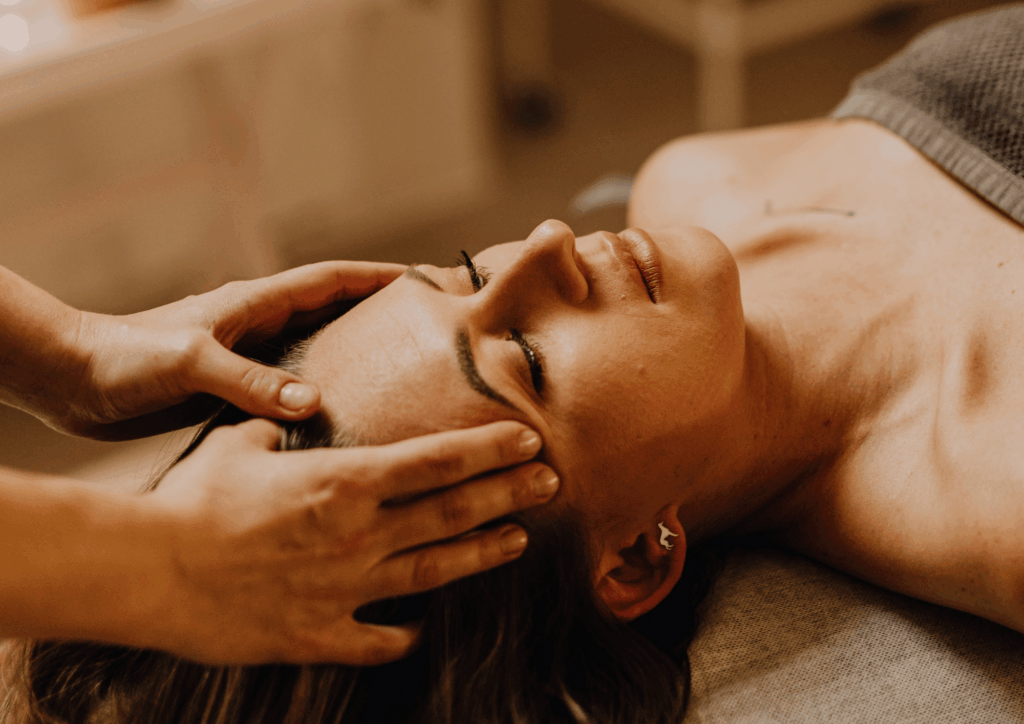
What happens to the face during a Kobido massage?
The face is not a static surface. It contains muscles responsible for facial expressions, fatty tissue, blood vessels, lymphatic vessels and supportive structures, which together influence the appearance of the facial features.
Massage primarily has a mechanical effect. Depending on the techniques used, it can affect local blood flow, muscle tone and the movement of fluids within the tissues.
What does this mean in practice?
- Less swelling. Drainage techniques can help promote lymphatic drainage, which may make facial swelling less noticeable.
- A more rested appearance. Stimulating local blood circulation may temporarily improve skin tone.
- Relaxing tense muscles. Massaging the jaw, temples and forehead can help you feel relaxed.
- Optical contour enhancement. If swelling or tissue tension affects the appearance of the face, the contours may appear more defined after a massage.
- Temporary smoothing. The skin may appear smoother and more radiant, although this does not imply a permanent change in its structure.
It is worth distinguishing these effects from the actual removal of excess skin, the restoration of lost volume or the permanent lifting of sagging tissues. Massage does not work in the same way as surgery or a procedure aesthetic medicine.
Kobido massage and scientific research – what has actually been proven?
Facial massage It has been attracting the interest of researchers for years. The problem is that the procedure’s popularity and positive patient feedback do not necessarily equate to strong clinical evidence.
There is insufficient scientific evidence to conclusively confirm that the mere Kobido massage provides a long-lasting facelift, reduces deep wrinkles or stimulates the production of collagen to a degree comparable to medical procedures. However, there are studies on other forms of facial massage which provide a better understanding of the possible mechanisms by which it works.
A 2018 study – the effect of massage on blood flow
In the publication Akane Miyaji and co-authors, published in the journal Complementary Therapies in Medicine In 2018, a study was carried out to assess the effect of roller massage on blood flow to the skin of the face.
Twelve people took part in the short-term part of the study. A five-minute cheek massage increased local blood flow, and the effect persisted for at least 10 minutes. In a separate part of the study, involving 14 people who used the roller daily for five weeks, an improvement in the vessels’ response to the cieplny stimulus was observed.
What does this mean? Massage can affect local circulation and the response of blood vessels. However, this does not automatically mean that every type of massage, including Kobido, will produce the same results.
A 2022 study – can massage alter the position of tissues?
In 2022, a pilot study was published in which computed tomography was used to assess changes in the cheeks following a facial massage.
Only five healthy people aged between 29 and 37 took part. For two weeks, they performed self-massage on their faces twice a day.
The researchers observed slight changes in the position of selected cheek structures and in the height of the superficial musculo-fascial system, referred to by the abbreviation SMAS.
This is an interesting observation, as it shows that mechanical stimulation of the face may be associated with measurable changes in imaging. However, it is important to bear in mind the very small sample size, the short observation period and the fact that the study concerned self-massage rather than a specific Kobido protocol.
The 2025 systematic review – what do we still not know?
In 2025, in the journal Aesthetic Surgery Journal Open Forum A systematic review has been published on non-surgical, mechanical methods of improving facial appearance, such as facial muscle exercises and manual massage.
The authors analysed 12 studies involving a total of 321 women aged between 30 and 70. Some of the studies reported improvements in selected appearance parameters, including the cheeks, jawline and eye area.
At the same time, the studies differed in their methodology, involved small groups and did not allow for a clear determination of the effectiveness of all the methods analysed. The authors emphasised the need for more well-designed studies.
The review covered various techniques for mechanically enhancing facial appearance, rather than just Kobido massage.
What do these studies tell us?
The available results indicate that facial massage It may affect local blood flow, tissue tension and certain measurable parameters relating to appearance. However, they do not allow Kobido to be regarded as a method with a proven, long-lasting lifting effect.
This does not detract from the value of massage. It simply allows us to realistically assess its potential and align our expectations with what can be achieved without medical intervention.
Does Kobido really work as a natural facelift?
Term „natural facelift” It accurately reflects the way in which the treatment is promoted, but it needs some explanation.
After a massage, the face may look more rested and the contours may appear more defined. This is particularly the case when its appearance is affected by temporary swelling or muscle tension. However, this result is not the same as a permanent lifting of the tissues.
It is not only the outer layers of the skin that change with age. The amount of collagen i elastins, there is a loss of fat tissue volume, and the facial support structures gradually change. Massage does not reverse all these processes.
If the problem is deep furrows, noticeable sagging or a loss of volume in the cheeks, Kobido can form part of a skincare routine, but it should not be presented as a standalone method capable of solving each of these problems.

What effects can you notice after a Kobido massage?
Results depend on facial structure, skin condition, the presence of swelling, the intensity of the treatments and the individual’s response.
After a single session, you may notice:
- a reduced sensation of tension in the facial muscles;
- temporary reduction in swelling;
- improved skin tone and radiance;
- a more rested appearance;
- temporary smoothing of the skin’s surface.
Regular sessions For some people, they may be a way of maintaining these results and establishing a relaxing skincare routine. However, there is insufficient evidence to determine a universal number of treatments that would guarantee a lasting improvement in facial contours.
It is also worth bearing in mind that redness immediately after a massage may be due to increased blood flow. This is not in itself evidence of new collagen production or lasting skin rejuvenation.
Kobido and wrinkles, facial contours and jaw tension
Not every cosmetic issue has the same cause. Therefore, the results of a massage will depend on what is actually affecting the appearance of the face.
Expression lines. Massage can help to relax tense areas around the forehead or jaw, but it does not eliminate deep-set wrinkles in the same way as treatments that target the specific mechanisms behind their formation.
A drooping oval face. If puffiness is making your facial contours appear heavier, reducing this puffiness may improve your facial proportions. However, if there is a significant excess of skin or a loss of tissue support, the effect will be limited.
Tension in the masseter muscles. Gentle manual therapy can help you feel more relaxed. However, if you experience pain, teeth grinding or temporomandibular joint problems, you may need a proper diagnosis rather than just a cosmetic massage.
Dull skin. A temporary boost to blood circulation may improve the skin’s appearance immediately after the treatment. Long-term improvement in skin quality also requires proper skincare, sun protection and taking the skin’s individual needs into account.
When is it better to avoid a massage?
Although Kobido Although it is a non-invasive method, this does not mean that it will be suitable for everyone and in every situation.
A massage should be postponed or you should seek advice before having one if you have any active infections, skin damage, severe inflammation, painful skin conditions or recent facial injuries. Caution is also advised following recent cosmetic procedures, as the tissues need time to regenerate.
In cases of active rosacea, severe vascular fragility, coagulation disorders or anticoagulant therapy, the course of treatment should be determined on a case-by-case basis. In such situations, intensive techniques may not be advisable.
Before the treatment, it is advisable to inform the massage therapist of any medical conditions, medication you are taking and any recent facial treatments.
Which method works better than Kobido massage?
| Problem | A method worth considering |
|---|---|
| Temporary swelling and muscle tension | Kobido massage or drainage techniques |
| Sagging and loss of skin firmness | Micro-needle radiofrequency or selected skin-tightening procedures |
| Discolouration and uneven skin texture | Laser therapy tailored to the type of changes |
| Deepening expression lines | Botulinum toxin, if there are medical indications |
| Loss of volume in the cheeks and temples | Individual assessment of suitability for use hyaluronic acid or other methods of volume correction |
| Dryness and deterioration in skin quality | Proper care, and in certain cases mesotherapy or other moisturising treatments |
| Selected cases of tissue laxity | Assessment of indications for HIFU or other procedures to improve skin tone |
This list does not imply that all methods should be combined. Sometimes a single, well-chosen procedure is sufficient, whilst at other times the best solution will be to combine several methods that address different issues. The final plan should be based on an assessment and consultation.
What aesthetic medicine treatments are alternatives to Kobido?
Kobid MassageIt can improve the appearance of the face and help reduce the visibility of temporary puffiness, but it will not solve every problem associated with skin ageing. If you’re looking to improve firmness, reduce wrinkles, even out skin tone or restore lost volume, it’s worth considering other facial treatments.
Micro-needle radiofrequency It supports skin regeneration and can improve skin firmness, whilst laser therapy helps to reduce certain types of discolouration, fine lines and skin irregularities.
Tissue stimulators It is used to improve skin quality, and hyaluronic acid can help restore volume in specific areas of the face. In turn, botulinum toxin restricts the activity of certain facial muscles, thereby reducing the appearance of some wrinkles, and HIFU uses focused ultrasound to help improve tissue firmness in appropriately selected cases.
If your skin is dry and lacks radiance, you might also consider mesotherapy, the effect of which depends on the preparation used.
Each of these methods works differently from Kobido massage and addresses specific skin needs. It is therefore advisable to consult a specialist before choosing a treatment; they will assess the condition of the skin, rule out any contraindications and help you select a treatment tailored to your desired results.
Conscious skincare rather than empty promises
Kobido connects the Japanese tradition of massage using manual facial techniques. It can promote relaxation, improve local blood circulation, help reduce temporary swelling and improve the appearance of the skin without the need for invasive procedures.
Research into facial massage provides some interesting insights, but it still does not conclusively confirm that Kobido alone has a lasting lifting effect. It is worth bearing this in mind before deciding to undergo a course of treatments.
If you want to improve the appearance of your face, consider whether it is puffiness, muscle tension, wrinkles or a loss of skin firmness that bothers you the most. In At Wellclinic, you can discuss your needs and discuss the options best suited to your skin condition and the desired result.
Sources:
1. Miyaji A., Sugimori K., Hayashi N. (2018).
"Short- and long-term effects of using a facial massage roller on blood flow and vascular reactivity in the facial skin. "
https://doi.org/10.1016/j.ctim.2018.09.009
2. Okuda I. et al. (2022).
"Objective analysis of the effectiveness of facial massage using cutting-edge computed tomography technology: A preliminary pilot study. "
https://doi.org/10.1111/srt.13152
3. Seraj S. S. et al. (2025).
"Efficacy of Conservative Techniques for Mechanical Facial Rejuvenation: A Systematic Review."
https://doi.org/10.1093/asjof/ojaf144
4. Van Borsel, J. et al. (2014). The effectiveness of facial exercises for facial rejuvenation: a systematic review. https://doi.org/10.1177/1090820X13514583



 +48 600 100 177