
 Katarzyna Pawłowska
 05.09.2022
 Table of contents
You’re losing weight, the scales are going down, your clothes are getting looser, but your tummy still doesn’t look the way you want it to?
It’s a common problem.
This doesn’t always mean that someone is doing something wrong. The body doesn’t burn fat evenly. For one person, it’s the love handles that take the longest to go; for another, it’s the lower abdomen, thighs or arms. You can have a healthy weight, exercise and watch what you eat, and still have one area that clearly stands out from the rest of your figure.
In such situations, body-contouring treatments come into play. One of these is laser lipolysis.
However, it is worth knowing exactly what this procedure involves. After all, the term „laser liposuction” may suggest far more than the procedure actually offers.
1. You can be slim and still have excess body fat
Your weight doesn’t tell the whole story about your figure.
Adipose tissue can accumulate in specific areas and be particularly resistant to diet or exercise. This applies, amongst other areas, to the abdomen, love handles, thighs and arms.
That is why losing any more weight does not always make sense.
If your weight is normal and the problem is confined to one specific area, rather than going on yet another diet, you might consider a treatment that targets that area specifically.
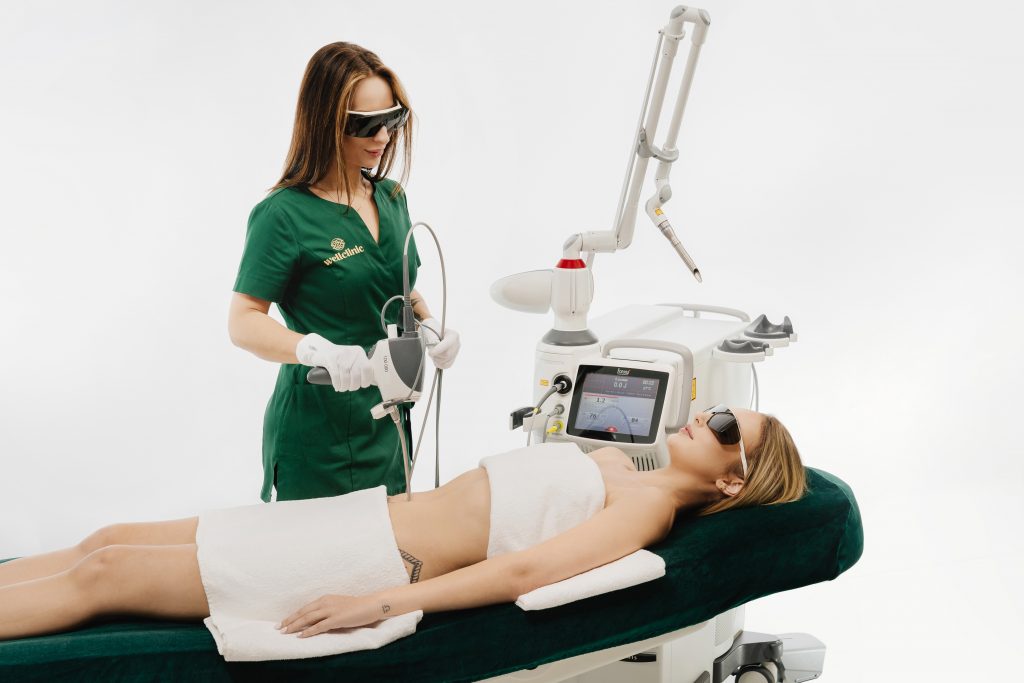
2. Laser lipolysis is not a weight-loss treatment
That is an important distinction.
Laser lipolysis is not intended to treat obesity or to reduce significant body weight. It is not a substitute for physical activity and a healthy diet.
Its aim is to improve the appearance of the figure in specific areas.
A patient may therefore be of a healthy weight but still be unhappy with the appearance of a particular part of their body. It is in such situations that body-contouring procedures may be considered.
Of course, this requires prior consultation and an assessment of whether the method in question is actually suitable for the problem.
3. Not all „laser lipolysis” treatments are the same
It’s easy to get confused here.
There are various terms used in the market: laser weight loss, laser lipolysis, laser fat reduction, laser body contouring or laser liposuction. These do not always refer to the same procedure.
Traditional liposuction is a surgical procedure. During the procedure, fat tissue is mechanically removed from the body.
In the case of non-invasive laser lipolysis, the laser energy is delivered through the skin, without the need for a surgical incision.
The difference is fundamental. That is why, before the treatment, it is worth checking carefully what procedure the clinic is offering and how the technology used works.
4. Laser treatment can also improve the quality of the skin
Wellclinic uses TightSculpting™ technology, which utilises the Fotona Dynamis SP platform.
The procedure consists of two stages.
The first uses an Nd:YAG laser. Energy is delivered to deeper tissues, and its thermal effect is intended to support processes associated with the reduction of locally accumulated fat and the improvement of tissue firmness.
The second stage is carried out using an Er:YAG laser. One of its aims is to improve skin firmness and appearance.
This is important because simply reducing the volume of body fat is not always enough to achieve a satisfactory body shape.
Your skin needs to look good, too.
5. Centimetres can change more quickly than kilograms
If the aim is to shape your figure, weight isn’t always the best benchmark.
Imagine two people of the same body weight. One has a more evenly distributed body fat, whilst the other accumulates more of it around the abdomen.
You’ll see the same number on the scales.
In the mirror - a completely different figure.
Therefore, when assessing the results of body-contouring treatments, consideration is given not only to body weight but also to body measurements, proportions and the appearance of the skin in a specific area.
6. Cellulite and body fat are not the same problem
Many people lump these two issues together.
One shouldn’t.
Cellulite can also occur in slim women. Conversely, having more body fat does not necessarily mean you will have noticeable cellulite.
So, if someone wants to „get rid of cellulite”, this does not always mean that they need a treatment to reduce body fat.
In tTightSculpting™ technology It is possible to improve the appearance of the skin at the same time, but the extent of the possible results always depends on the initial condition of the tissues.
First, we need to establish what we’re dealing with.
7. The same abdomen may require two different treatments
This is one of the things that is rarely mentioned before the procedure.
For some people, the main problem will be localised fat deposits.
Another one has sagging skin.
In yet another case, both problems will occur at the same time.
From the outside, it may look similar. The behaviour, however, is not necessarily the same.
That is why the consultation is so important here. The doctor assesses the treatment area, the condition of the skin, your general state of health and any contraindications. Only then can a decision be made as to whether laser lipolysis is the right treatment for you.
8. You don’t always need lots of treatments
The number of sessions should not be determined according to a single formula for all patients.
Factors that are important include, amongst others, the size of the area, the amount of body fat, the condition of the skin and the desired result.
For some people, a smaller number of treatments may be sufficient. For others, the doctor may recommend a course of treatment.
It is impossible to honestly promise everyone the same result after one, two or four appointments.
Every patient’s body reacts slightly differently.
9. The full effect is not visible on the day of the treatment
This is another common mistake when assessing results.
The patient can see the change immediately after the procedure and tries to imagine what their body will look like in a few weeks’ time.
It doesn’t always make sense.
Tissues need time to respond and regenerate. Therefore, the final assessment of the results is carried out at a later date, in accordance with the doctor’s instructions.
It is also worth bearing in mind that many factors influence the appearance of the body. Body weight, diet, physical activity, skin quality and individual predispositions continue to play a role after the procedure.
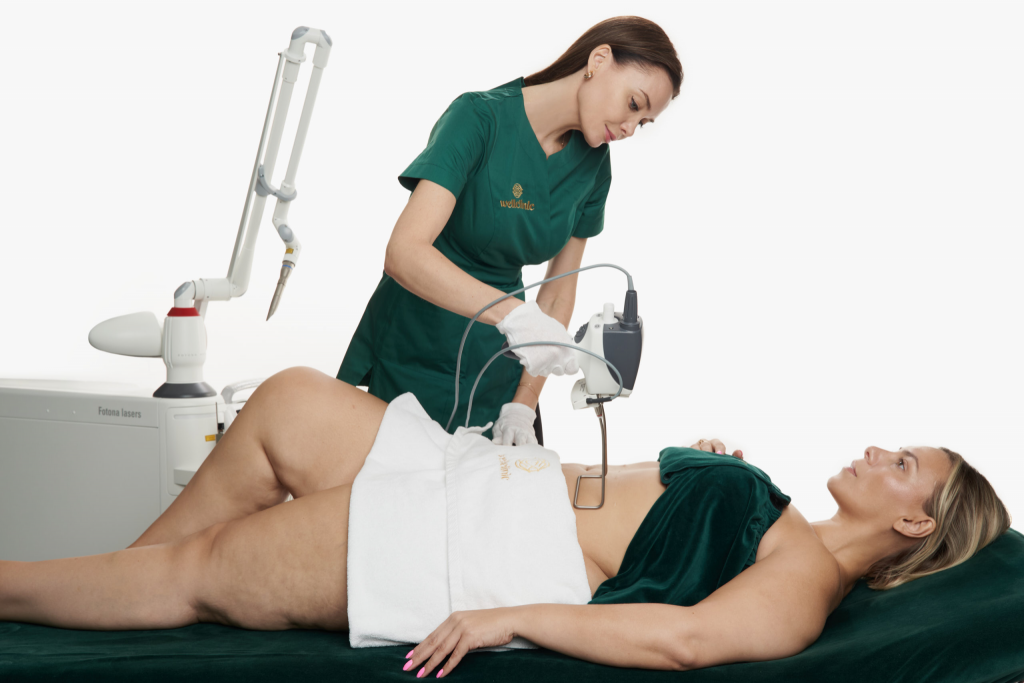
10. The most important question is not: „Which laser should I choose?”
It goes:
„What exactly do I want to improve?”
If the problem is a small amount of localised fat, you may wish to consider a treatment targeted at that area.
If the main problem is sagging skin, a different approach may be required.
And if both problems are present, the doctor may suggest a treatment plan that addresses more than one aspect.
That’s why a good plan doesn’t start with the device.
It begins with an assessment of the patient.
TightSculpting™ at Wellclinic
TightSculpting™ utilises two lasers: the Nd:YAG and the Er:YAG.
In the first stage of the treatment, Nd:YAG laser energy is delivered to the deeper tissues. The Er:YAG laser is then used, with the aim of improving the appearance and firmness of the skin.
The entire procedure is carried out without making any surgical incisions in the skin.
Before the procedure, the doctor conducts a consultation and checks for any contraindications. They also assess whether the problem is actually caused by a localised build-up of fat.
That’s important.
Because if the problem is mainly due to sagging skin, simply reducing body fat won’t solve everything.
Stomach, love handles, thighs or arms?
Laser lipolysis can be used to contour various areas of the body where there is localised fat accumulation.
Most commonly, patients report:
- abdomen,
- sides,
- thighs,
- shoulders,
- specific areas of the body that are difficult to change through diet and exercise alone.
However, this does not mean that each of these areas will require the same approach.
Sometimes it’s enough to target localised fat deposits. Sometimes the skin turns out to be the bigger problem. And sometimes a combination of several methods is needed.
Is laser lipolysis right for you?
It is not worth starting by assuming that a particular treatment will definitely be suitable.
First, you need to find out what is causing the problem.
During the consultation, the doctor can assess the area you wish to treat, the condition of your skin, your body fat levels and any contraindications to the procedure.
Only then can we answer the most important question: does laser lipolysis actually make sense in this case?
If you want to check whether TightSculpting™ technology may be suitable for your body shape, book a consultation at Wellclinic. During your appointment, the doctor will assess your situation and suggest a course of treatment tailored to the condition of your tissues and your desired outcome.
Sources:
- FDA - "Non-Invasive Body Contouring Technologies"
https://www.fda.gov/medical-devices/aesthetic-cosmetic-devices/non-invasive-body-contouring-technologies - Fotona - TightSculpting™:
https://www.fotona.com/en/treatments/2249/tightsculpting - "Efficacy and safety of long-pulse 1064 and 2940 nm lasers in non-invasive lipolysis and skin tightening"
https://pmc.ncbi.nlm.nih.gov/articles/PMC7065637/ - American Society of Plastic Surgeons - "Liposuction"
https://www.plasticsurgery.org/cosmetic-procedures/liposuction - American Society of Plastic Surgeons – Non-surgical Fat Reduction
https://www.plasticsurgery.org/cosmetic-procedures/nonsurgical-fat-reduction - Abe et al. – European Journal of Clinical Nutrition
https://www.nature.com/articles/s41430-021-00942-1 - Cellulite: An Update on Pathogenesis and Management
https://pubmed.ncbi.nlm.nih.gov/37977679/




 +48 600 100 177