Just a few years ago, discussions about weight loss and aesthetic medicine usually centred on reducing body fat and body contouring. Today, another question is being raised more and more often: What happens to the skin when body weight decreases significantly?
The popularity of medicines used to treat obesity, such as Ozempic and Mounjaro, has made significant weight loss a realistic goal for many patients. However, as the body shape changes, so too do the proportions of the body’s tissues. Skin that was previously stretched by a larger body volume may not regain its firmness at the same rate. On the face, in turn, the loss of subcutaneous fat may be particularly noticeable.
That is precisely why skin after weight loss It is becoming an increasingly common topic of consultation in aesthetic medicine. The problem does not always present in the same way and does not always require the same methods. A flabby tummy requires a different approach to the skin on the arms, and yet another to the face, which has lost some of its volume following weight loss.
Ozempic and Mounjaro – why are they changing the way we think about our appearance after losing weight?
Ozempic contains semaglutide, whereas Mounjaro – tirzepatide. These medicines are used to treat metabolic disorders and, in suitably selected patients, can lead to significant weight loss.
From the perspective of aesthetic medicine, what matters is not so much which medicine was used, but rather how tissues change as a result of weight loss. When the body loses a significant amount of body fat, the skin has to adapt to the reduced volume.
With a small amount of weight loss, the body usually copes well with this change. However, following a more significant reduction in body weight, the skin may become less taut, and its surface does not always match the body’s new proportions. The situation is slightly different on the face, as a reduction in body fat affects its natural volume and contours.
This does not mean that Is skin laxity a direct side effect of Ozempic or Mounjaro?. This is primarily due to changes in body weight and the associated loss of tissue volume. Age, genetic predisposition, skin elasticity, the extent of the reduction and the length of time the skin was stretched also play a role.
Skin after weight loss – how does its appearance change?
Skin after weight loss It may look different not only because it is looser. The way the tissues beneath its surface are arranged also changes.
With significant weight loss, the skin may lose some of its elasticity. This can then lead to loss of skin firmness, and in more advanced cases, an excess of it as well. The problem is most often visible in those areas where there was previously a greater amount of adipose tissue.
On the face, the situation is more complex. A lower amount of body fat leads to a change in the volume of the cheeks, temples and lower face. As a result, the skin may appear less taut, even if its structure itself has not deteriorated significantly.
The face after weight loss – loss of volume and changes in contour
The face is often the first to show that body weight has changed significantly. Subcutaneous fat gives the face its volume and affects the proportions between different areas.
After losing weight the cheeks may become less plump, the temples may appear more sunken, and the jawline may be more pronounced. In some cases, more noticeable furrows or wrinkles may also appear.
However, this effect does not always mean that the skin is actually very loose. Sometimes the main change is loss of facial volume following weight loss. This is an important distinction, as improving the appearance of the skin and restoring volume are two different objectives.
It is therefore worth assessing the face holistically following weight loss. It is not only the surface of the skin that matters, but also the way in which the proportions of the tissues have changed.

How can I improve the firmness of my facial skin after losing weight?
Losing weight can change not only the appearance of your skin, but also facial volume. A lower body fat percentage can make the cheeks, temples or the central part of the face appear more sunken. In such situations, it may be helpful to facial volumetrics, i.e. restoring volume in areas where it has been lost. The aim is to improve the proportions of the face without restoring it to its pre-weight-loss appearance.
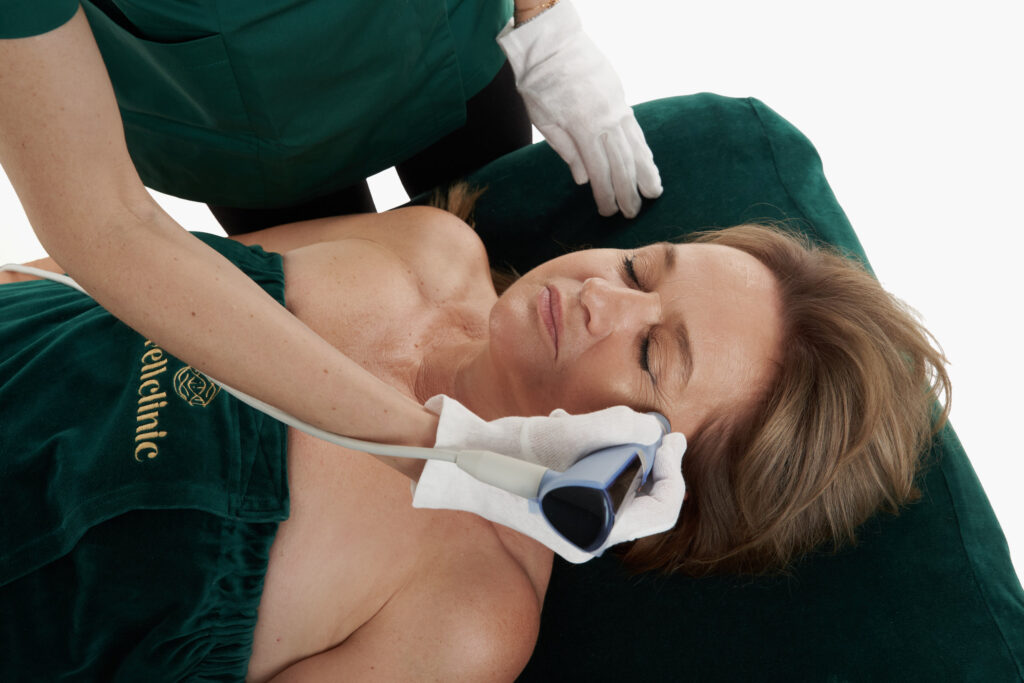
If, after losing weight, the skin on your face has become less firm, it is worth focusing on improving its firmness and quality as well. To this end, the following methods are used, amongst others: tissue biostimulators, which support the skin’s natural processes. If you are experiencing a loss of firmness, you might also consider radiofrequency. Choosing the right method depends primarily on the condition of the skin and the area that needs improvement.
Your face after losing weight doesn’t have to look the same as it did before you lost the weight. Often, the aim is simply to improve its firmness, add volume where needed, and maintain a natural look.
Sagging skin after weight loss – where does it most commonly appear?
On the body, the problem is usually easier to pinpoint. Sagging skin after weight loss It most commonly appears on the stomach, arms, thighs, around the waist and on the buttocks. However, this does not mean that everyone will be left with excess skin after losing weight.
The extent of weight loss is a key factor. The skin will react differently after losing a few kilograms than it will after losing several dozen kilograms. Age and the skin’s natural ability to regenerate are also important factors.
In the case of a slight loss of skin tone, the skin may, over time, partially adapt to its new proportions. However, if the loss of elasticity is more significant, weight loss alone will not be enough to restore the skin to its previous tone.
How can you firm up your skin after losing weight?
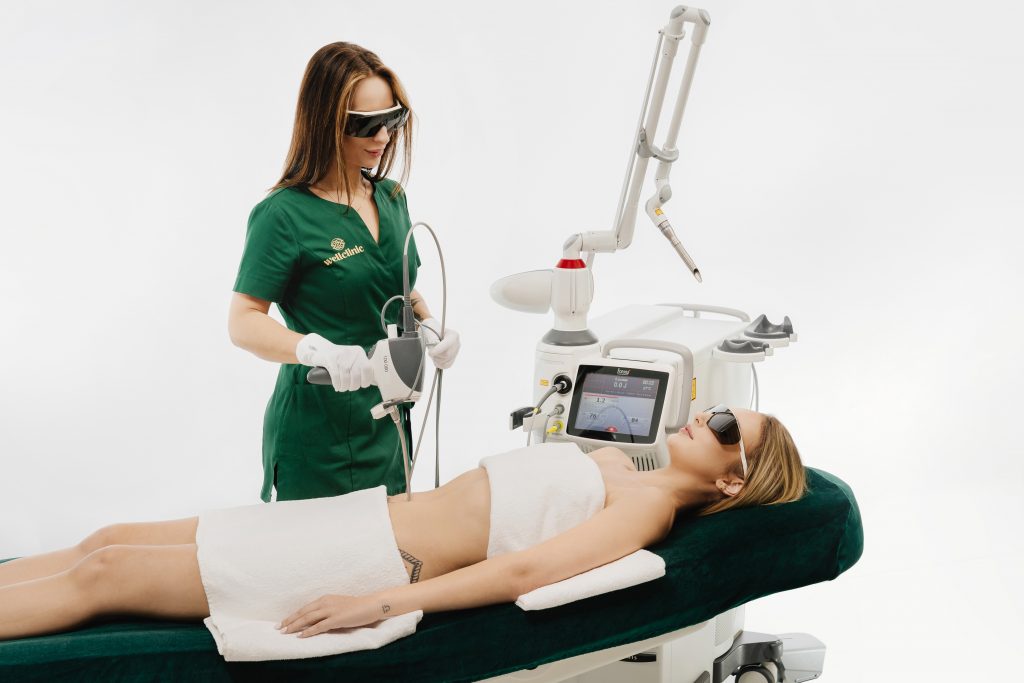
However, following significant weight loss, the situation may be more complex. If there is still localised fat accumulation in the targeted area, whilst the skin has lost its firmness, the following may also be considered: laser liposuction. Its aim is to remove excess fat whilst simultaneously treating the tissues in the area undergoing the procedure. It is therefore not a method intended for further weight loss, but a solution used in appropriately selected cases where the problem concerns both body contour and skin quality.
In practice, it is precisely this combination of issues that is one of the reasons why, after losing weight, a single treatment is not always sufficient. The first step is to assess whether the main challenge is skin flaccidity, a loss of skin tone, localised excess fat, or a combination of these factors.
Toning the skin after losing weight It should address the actual problem. If the skin is, above all, less firm, it is worth focusing on methods that support its remodelling, rather than concentrating once again on reducing body fat.
Depending on the area and the condition of the skin, treatments such as radiofrequency procedures are used. Monopolar RF can be used to improve skin firmness and quality, whilst microneedle radiofrequency combines microneedling with RF energy.
Skin treatments after weight loss – what can be improved?
Skin treatments following weight loss They do not have a single, universal aim. In the case of the face, the aim may be to improve the quality of the skin and restore some of the lost firmness. On the body, the main aim is usually to improve the firmness and appearance of areas where the skin has become looser.
This is also the time to reconsider how we think about treatments. Once a patient has reached their target weight, further procedures for the reduction of body fat may not necessarily be the best solution. The problem may no longer lie in the amount of body fat, but in the quality and firmness of the skin.
Correct assessment helps to avoid a situation where one attempts to remove tissue that, in reality, is no longer present in excess.
Combination therapies following weight loss
Changes following weight loss often affect several structures at the same time. The skin may be less taut, the tissues may have reduced volume, and the contour of the area in question may look different to how it did before the weight loss.
In such situations, the following work well combination therapies, in which the various procedures address the different needs of the tissues.
On the face, a combination of treatments may be aimed at improving the skin’s condition and firmness. On the body, however, the priority may be skin firming after weight loss and to improve the appearance of areas affected by sagging.
Does the skin always need treatment after losing weight?
It is worth giving your body time to stabilise its weight. Only then can you assess which changes have actually become permanent and require further action.
The situation is different in cases of significant weight loss, where there is a marked excess of skin. In such cases, non-surgical treatments may not be sufficient to achieve the desired result.
When should you seek advice about your skin after losing weight?
A consultation may be a good option if, following weight loss, you have developed obvious sagging of the skin, changes to the facial contours, loss of volume or excess loose skin.
When carrying out an assessment, it is important to establish exactly what has changed following the reduction. Is the problem the skin, the subcutaneous tissue, facial volume, or perhaps a combination of several factors? Only by answering this question can one decide whether firming, improving skin quality, restoring volume or a combination of treatments is required.
Ozempic, Mounjaro and the new reality of aesthetic medicine
The popularity of therapies designed to support weight loss has also changed patients’ expectations. These days, achieving a lower weight is often the start of the next stage, rather than the end of the whole process.
Aesthetic medicine is increasingly catering to the needs of people who have lost weight, rather than those who are only just setting out to lose weight. Rather than further reduction, there is a need to improve the quality of the skin, its firmness and the proportions of the face and figure.
Skin after weight loss may require a completely different approach to that used for the skin prior to reduction. The face requires, first and foremost, an assessment of changes in volume and skin quality, whilst the body requires an assessment of the degree of laxity and any excess tissue.
What next?
If, after losing weight, you notice changes to the contours of the face, loss of firmness or sagging skin on the body, it is worth starting by properly assessing the problem, rather than choosing a treatment solely on the basis of its name.
Book a consultation and find out which treatment is best suited to your skin following weight loss. During the consultation, we will assess the condition of your skin, the composition of your tissues and the areas requiring improvement, and then recommend a tailor-made treatment plan.
Sources:
- Oxford Academic „Nonsurgical Aesthetic Treatment of the Face and Neck in Patients Undergoing Weight Loss with GLP-1 Receptor Agonists: Considerations Based on Clinical Experience”
https://academic.oup.com/asjopenforum/article/8/1/ojag011/8423737 - PubMed „Nonsurgical Aesthetic Treatment of the Face and Neck in Patients Undergoing Weight Loss with GLP-1 Receptor Agonists: Considerations Based on Clinical Experience”
https://pubmed.ncbi.nlm.nih.gov/41768029/ - PubMed „GLP-1-Induced Weight Loss and the Face: Anatomical Mechanisms and Rationale for Collagen-Stimulating and Volumising Aesthetic Treatments”
https://pubmed.ncbi.nlm.nih.gov/42210888/ - PubMed „Aesthetic Concerns and Nonsurgical Treatment Trends in Patients With GLP-1 Agonist-Associated Weight Loss”
https://pubmed.ncbi.nlm.nih.gov/42210883/ - PubMed „Effects of GLP-1 Receptor Agonists on Skin Quality: A Comprehensive Literature Review”
https://pubmed.ncbi.nlm.nih.gov/42162206/