You can lose weight, exercise regularly and still have fat on your back. Your weight is dropping, your figure is becoming slimmer, and yet the folds around your shoulder blades, under your bra or on your lower back remain visible. This is particularly frustrating when exercise and diet are producing results in other parts of the body. The problem is that the body doesn’t burn fat evenly, and it’s impossible to pinpoint the exact area from which it should disappear first.
Therefore, further weight loss does not always solve the problem of a single, stubborn area of the body. Localised fat deposits may persist despite a healthy weight and an active lifestyle, disrupting the body’s proportions. In such situations, it is worth considering methods aimed at body sculpting and fat reduction.
Causes of back fat - where do those folds come from?
One of the most common reasons for the accumulation of excess body fat It is a long-term surplus of energy consumed through food relative to the energy expended. This does not, however, mean that everyone with folds of fat on their back leads an unhealthy lifestyle.
Among other things, the following may be relevant genetics, which affects distribution of body fat. In one person excess fat It will be most noticeable on the stomach for some people, whilst for others it will be on the hips, thighs or back. Body composition also changes with age, and maintaining adequate muscle mass may require more regular exercise.
At appearance of the back Posture also plays a role. Weak muscles and prolonged sitting can cause the shoulders to hunch forward and alter the proportions of the figure. Whilst these do not directly cause the build-up of body fat, they can lead to folds on the back are becoming more noticeable.
Fat under the bra and around the shoulder blades
A common problem among women is folds that appear where the bra presses against the skin. They may also occur in the vicinity of armpit, spatulas i sides of the torso. Their visibility depends not only on body fat mass, but also on body shape, skin elasticity and the distribution of subcutaneous tissue.
That is why the very weight reduction does not always result in a uniform change in the appearance of all parts of the body.
Are exercises for back fat effective?
Regular physical activity is one of the key elements fat reduction. It’s worth combining endurance training with resistance exercises, which help build muscle and improve your body shape.
Exercises such as rowing, lat pulldowns, pull-ups and various other exercises that target the back muscles can strengthen the back. However, they do not cause localised fat burning in that specific area.
This is an important distinction: Back exercises strengthen the muscles, but do not guarantee localised fat loss. During weight loss, the body draws on energy reserves stored in various parts of the body, and the order in which these are used varies from person to person.
Regular exercise, on the other hand, can improve muscle tone and posture, making your back look more proportionate.
Diet and reducing body fat on the back
If the cause is an increase in body fat Although there is an excess supply of energy, the key to weight loss remains a properly planned diet. However, there is no diet that causes burning fat exclusively from the back.
Gradual fat reduction It may reduce its levels throughout the body. It is also important to ensure an adequate intake of protein, vegetables, whole grains and other essential nutrients, and to limit the consumption of highly processed foods.
It may also be helpful to monitor changes in body measurements and body composition, rather than just body weight. Two people of the same weight may have completely different body fat percentage and muscle mass.
When are diet and exercise not enough?
It sometimes happens that, despite weight reduction Certain areas remain more resistant to change. This may also apply to the back, the sides of the torso or the area under the bra.
In such a situation, one might consider support procedures reduction of locally accumulated body fat. They are not a substitute for a healthy diet or physical activity, nor are they a treatment for being overweight or obese. Their primary aim is to improve body proportions in people whose body weight is relatively stable.
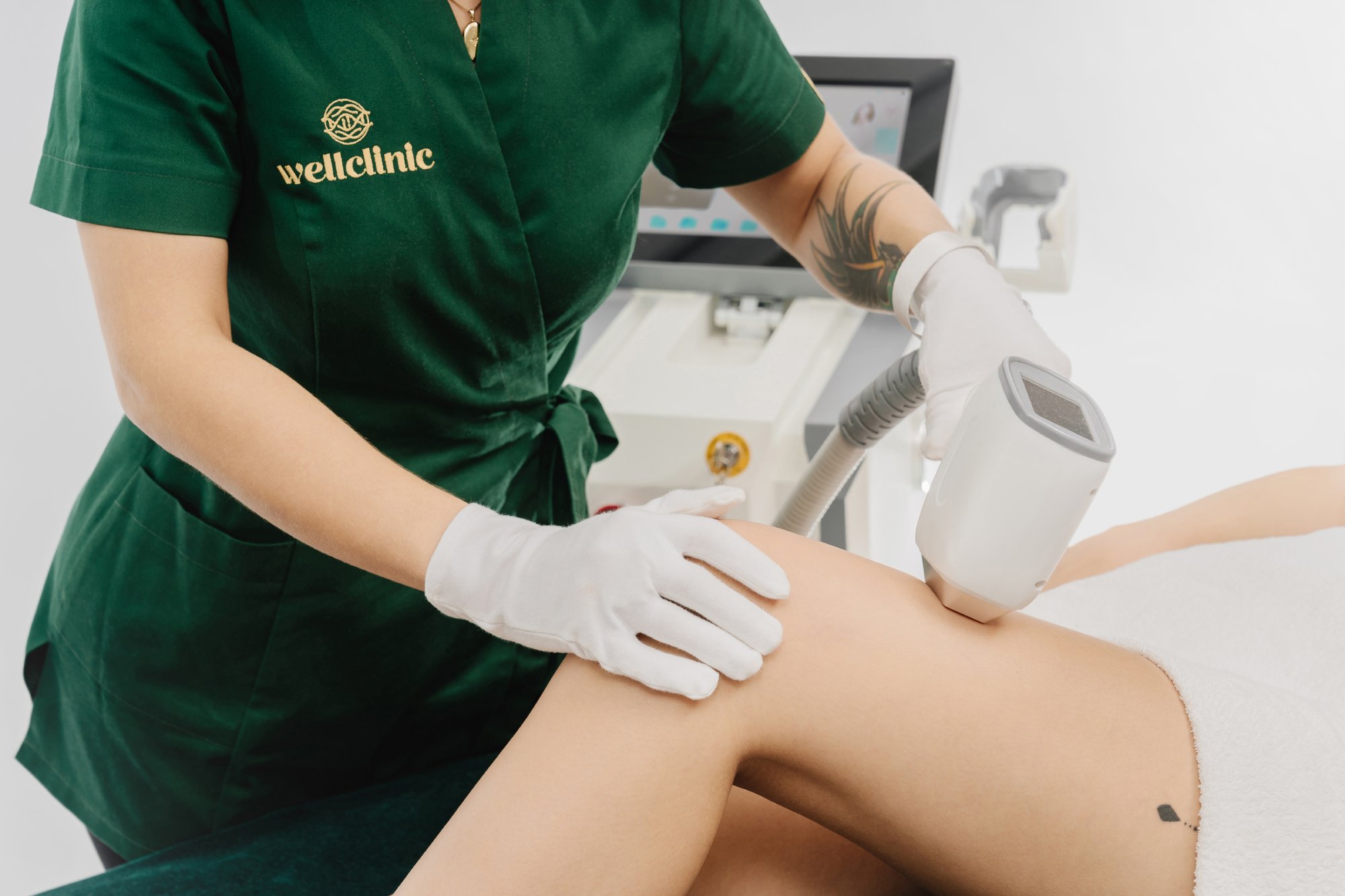
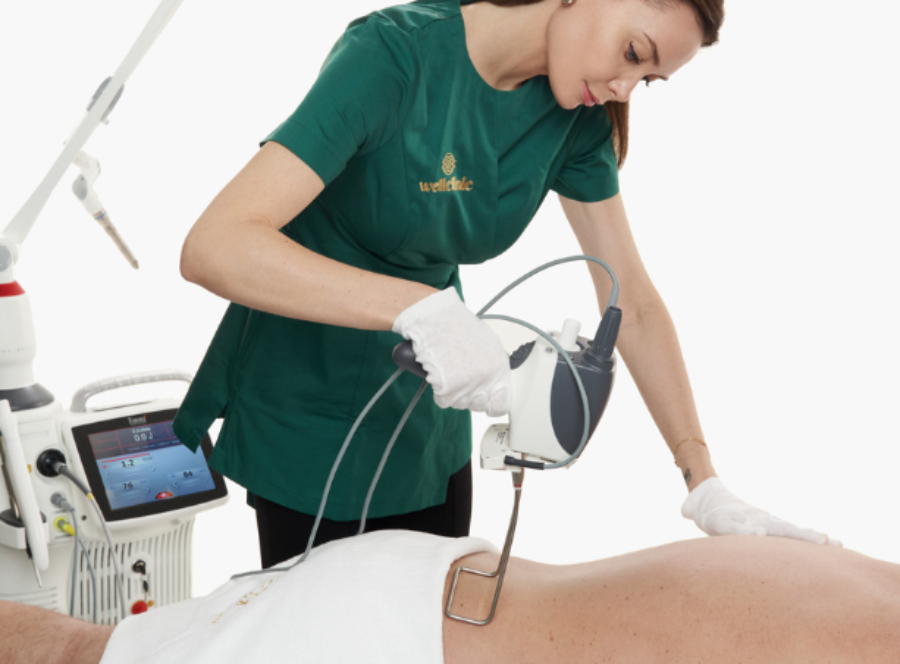
One of the methods used for this purpose is laser lipolysis, which uses laser energy to affect adipose tissue. Depending on the technology used, the procedures may also be designed to improve skin firmness.
Tight Sculpting laser lipolysis and back fat
At Wellclinic, the following is used for body contouring: Tight Sculpting laser lipolysis. The treatment combines effects aimed at adipose tissue, which affects skin firmness, which is why it may be considered for areas where there is a slight excess of body fat and where, at the same time, we wish to improve the appearance of the skin.
The technology can be used on various parts of the body, and whether the procedure can be carried out in a specific area depends on the individual’s anatomy and eligibility.
Body Sculpt HI-EMT and body contouring
Body Sculpt HI-EMT This is a method designed to provide intensive muscle stimulation, which can complement activities related to body modelling. During the procedure, the muscles undergo intense contractions, which allows the treatment to be targeted at a specific part of the body.
In the case of a problem such as fat on the back, however, it is important to assess the area correctly. Muscle stimulation alone is no substitute for weight loss, but it can form part of a broader plan to improve body proportions. Further information on this method can be found under the entry Body Sculpt HI-EMT.
Is it possible to get rid of back fat without liposuction?
Yes. Surgical liposuction is not the only way to body modelling. There are also procedures available that utilise various types of energy, which target adipose tissue or the surrounding area.
The choice of method depends, amongst other things, on body fat mass, its distribution, skin quality and the expected outcome. In the case of small, localised fat deposits, the approach may be completely different to that used for large amounts of adipose tissue. Therefore, before the procedure, it is worth assessing not only the thickness of the skinfold itself, but also firmness and elasticity of the skin.
In certain cases, support procedures may also be considered weight loss without a scalpel, which aim to improve body proportions without the need for surgery.
Back fat and sagging skin
Not every a pleat at the back is solely the result of excess fat. The condition of the skin also affects its appearance. Following significant weight loss, the skin may not always adapt to the body’s new shape.
In such cases, simply reducing body fat may not produce the desired result. It is also important that improved skin firmness, which is why it is worth taking both issues into account when planning treatment.
Depending on your needs, you may wish to consider treatments that use radiofrequency, which is used, amongst other things, in treatments aimed at improving skin quality and firmness.
Can a massage remove fat from the back?
Massage can improve comfort, promote the flow of fluids in the tissues and temporarily improve the appearance of the skin, but does not remove fat cells and does not replace weight reduction nor treatments targeting adipose tissue.
Drainage treatments should be viewed in a similar light. They can reduce temporary swelling and make the figure appear slimmer, but this does not mean there has been any actual loss of body fat.
How can you effectively reduce back fat?
The best results are achieved by an approach tailored to the cause of the problem. If there is excess weight, the key is gradual weight loss through a balanced diet and physical activity. If body weight is within the normal range but there is still a slight, localised excess body fat, you might consider additional body shaping methods.
It is also worth bearing muscles in mind. Regular physical activity should be seen as part of a long-term approach to body shaping. For those who wish to improve their body proportions whilst also increasing the engagement of specific muscle groups, the training plan can be supplemented with carefully selected body-sculpting treatments.
A personalised approach to reducing back fat
If, despite your diet and training, you can still see fat on your back, making further sacrifices may not make any difference. You might lose a few more kilograms, but the folds of fat around your shoulder blades or lower back will still be visible. In such situations, the problem isn’t always that you’re not doing enough. Sometimes you’re simply trying to change something that diet alone can’t fully influence.
Fat on the back It may be related to the distribution of body fat, body weight, skin condition, age or individual predispositions. Therefore, during a consultation, a specialist assesses what actually affects the appearance of a particular area - whether it is excess body fat, sagging skin, or a combination of both issues.
Only on this basis can we determine which course of action makes sense: a change in lifestyle, exercise, a body-sculpting programme, or an appropriate combination of these.
You don’t have to keep battling the same part of your body over and over again. If the folds on your back remain despite your best efforts, book a consultation and see which option might be right for your body shape.
Sources:
- PubMed "The Effect of Resistance Training in Healthy Adults on Body Fat Percentage, Fat Mass and Visceral Fat: A Systematic Review and Meta-Analysis"
https://pubmed.ncbi.nlm.nih.gov/34536199/ - PubMed "Genetic and non-genetic determinants of regional fat distribution" -" https://pubmed.ncbi.nlm.nih.gov/8491156/
- PubMed ""Comparison of concurrent, resistance or aerobic training on body fat loss: a systematic review and meta-analysis"
https://pubmed.ncbi.nlm.nih.gov/40405489/ - American Society of Plastic Surgeons "Liposuction"
https://www.plasticsurgery.org/cosmetic-procedures/liposuction - National Institute of Diabetes and Digestive and Kidney Diseases "Treatment for Overweight and Obesity" https://www.niddk.nih.gov/health-information/weight-management/adult-overweight-obesity/treatment
- World Health Organisation "Obesity and being overweight"
https://www.who.int/news-room/fact-sheets/detail/obesity-and-overweight