
 Katarzyna Pawłowska
 11.09.2026
 Table of contents
You may exercise regularly, watch what you eat and maintain a healthy weight, yet excess belly fat still remains a problem.
Belly This is one of the areas where localised fat deposits can significantly alter the proportions of your figure. Sometimes this is precisely where the most fat remains, even though the rest of your body looks exactly as you’d expect.
Therefore laser abdominal fat reduction It targets the area where a reduction in body fat is required.
But what actually happens to the fat then?
Does the laser act directly on fat cells? What happens to the lipids released from the adipocytes? And how does the body process them once the treatment is over?
To understand this, it’s worth taking a closer look at how it works laser fat reduction and what happens to the tissue in the subsequent stages.
How does laser fat reduction on the abdomen work?
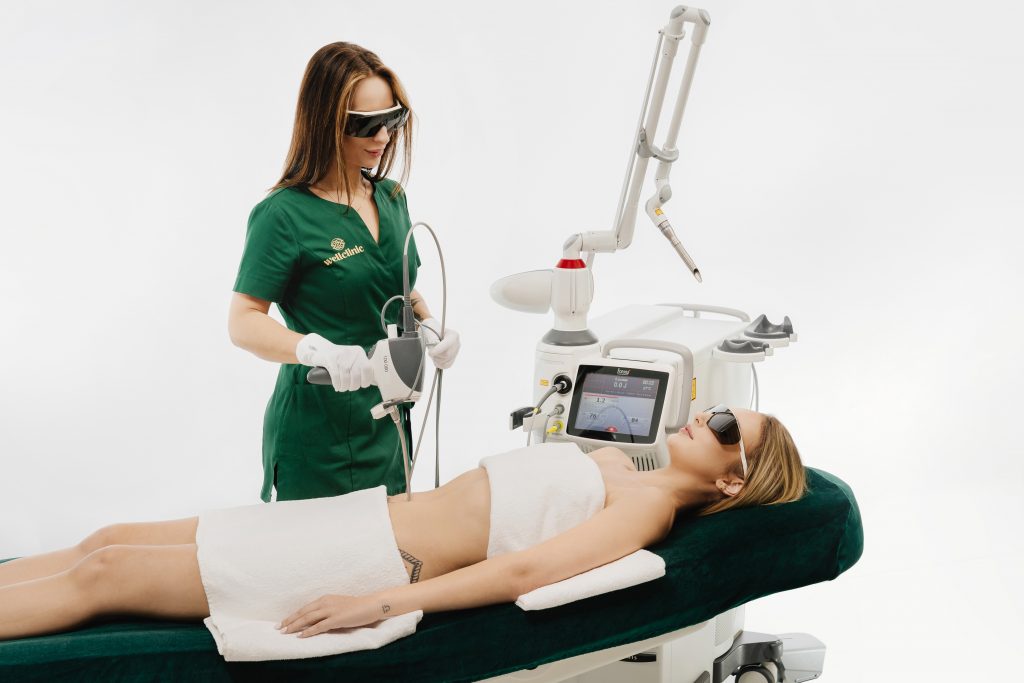
Laser fat reduction on the abdomen It uses light energy to exert a controlled effect on tissues in the abdominal region. The treatment utilises waves Nd:YAG i Er:YAG, which make it possible to influence both locally accumulated fat tissue, as well as the skin above it.
Laser energy It reaches specific layers of abdominal tissue, triggering a controlled reaction within them. In the case of adipose tissue, this leads to changes within adipocytes, i.e. the cells responsible for storing fat. At the same time, the laser’s action may affect the firmness and appearance of the abdominal skin.
The aim of the therapy is a reduction in localised abdominal fat and to improve the contours of this part of the figure. This is particularly important in the case of adipose tissue that is resistant to diet and physical activity, which, despite our best efforts, continues to linger around the abdomen.
After treatment has ended, the body continues to respond to the changes taking place in the tissues. The physiological processes occurring in the subsequent stages are significant for the gradual development of the fat-reduction effect and the appearance of the skin on the abdomen.
What happens to fat during laser lipolysis?
Adipocytes These are cells that store fat. They are found in adipose tissue and can increase in volume as they accumulate more energy. Their size affects the amount of adipose tissue located within the abdomen.
During laser lipolysis abdomen laser energy is directed towards a selected area. Its purpose is to influence adipose tissue and inducing controlled changes within it. Once treatment has finished, the body gradually responds to these changes. This process involves the natural mechanisms responsible for removal of cellular debris and the processing of substances released from the tissue.
In adipocytes, fat is stored mainly in the form of triglycerides. Following their rozłożenie, the following are formed, amongst others:. fatty acids and glycerol. These compounds can then be transported and utilised by the body in various metabolic processes.
If fatty acids will be used as energy source, and their metabolic processes result in the production of, amongst other things, carbon dioxide and water. Carbon dioxide is primarily eliminated via the lungs, whilst water can be utilised by the body or excreted naturally.
However, this does not mean that all the fat subjected to the treatment is automatically used as energy. Adipose tissue metabolism It is more złożony and depends, amongst other things, on the body’s energy requirements.
After laser fat reduction So the fat is not simply „flushed” out of the body. The changes taking place in the tissue trigger further biological processes, and the course of these processes also depends on individual characteristics of the body.
Visibility of the results of laser fat reduction
The appearance of the abdomen after treatment is influenced not only by fat reduction. The reaction of the skin and tissues to the energy applied is also significant.
The first changes to one’s physique may become noticeable relatively quickly. However, this does not mean that the body has already completed all the processes associated with the treatment. The outcome may also take shape in subsequent stages, whilst the tissues continue to respond to the earlier stimulation.
The rate of change varies from person to person. It depends, amongst other things, on the amount of body fat, the parameters of the treatment and the body’s response.
It is therefore worth assessing the final appearance of the abdomen by taking the whole process into account, rather than just what can be seen immediately after the procedure.
The importance of physical activity and hydration
Physical activity increases the body’s energy requirements. Depending on the intensity and duration of the exercise, and the availability of other energy sources, the body may draw more heavily on its fat reserves.
This does not, however, mean that exercise directly accelerates the removal of adipocytes after laser fat reduction.
Regular exercise helps, above all, to maintain a healthy weight and supports metabolic health. It is therefore worth staying physically active even after treatment.
It is also important that adequate hydration. Water plays a role in, amongst other things, metabolic processes and is essential for the proper functioning of the kidneys.
However, one should not expect that simply drinking more water will, in itself, speed up fat reduction. After treatment, it is simply a matter of ensuring you drink enough fluids and following the personalised advice given during your consultation.
Water containing Kłodawa salt and supplements to support treatment
Proper preparation for laser abdominal fat reduction It covers not only recommendations regarding the treatment itself. The body’s hydration status, diet and the supplements and preparations taken by the patient are also important. Before starting treatment, a specialist may provide personalised advice on how to prepare.
Proper hydration is one of the key elements in preparing the body for treatment. An adequate intake of fluids supports the body’s proper functioning and the smooth running of physiological processes.
If a specialist recommends this before treatment water with added Kłodawa salt, it should be regarded as part of an individualised preparation programme. This method of hydration may be recommended as part of the pre-treatment protocol; however, it should not be presented as a method which, in itself, enhances the effectiveness of the laser or accelerates fat reduction.
The most important thing remains adequate hydration and following the advice given during the consultation. Nor does this mean that drinking more water will automatically lead to better treatment outcomes. Above all, the body needs an adequate intake of fluids tailored to individual needs.
In preparation for laser fat reduction Supplementation may also play a role. Dietary supplements They can be used to supplement the daily diet. Their role may be to supplement specific dietary components, rather than to replace the treatment itself.
Why does the body play a role in the outcome of treatment?
The body does not respond to treatment in exactly the same way in every patient. These differences may be due, amongst other things, to body type, body fat percentage, skin condition and individual metabolic processes.
That is why, when planning laser lipolysis Both the characteristics of abdominal fat and the condition of the skin are taken into account.
This is particularly important when the aim is to simultaneously reduction of localised body fat and a more defined abdominal contour.
How can you maintain the results of losing belly fat?
After reducing localised body fat, it is still worth taking care of a stable body weight. The remaining adipocytes may increase in volume if, over a prolonged period, the body receives more energy than it needs. Therefore diet and physical activity they still play a part in the appearance of the stomach.
Regular exercise, a balanced diet and maintaining a stable body weight help to keep body-shaping effect.
Laser abdominal fat reduction - where does the fat go?
Belly fat does not simply disappear as soon as the treatment ends. Following laser treatment, the body gradually metabolises the substances associated with changes in adipose tissue, and the slimming effect may develop in subsequent stages.
This is important because laser abdominal fat reduction It is not merely a question of what happens during the procedure itself. What matters is also how the body reacts after the treatment and whether body weight remains stable.
If, despite following a diet and taking exercise Abdominal fat remains a problem, it is worth assessing whether reducing it locally would be an appropriate solution. The best way to decide how to approach this issue and what can realistically be expected is during a one-to-one a consultation with a cometologist.
Sources:
- PubMed „Efficacy and safety of long-pulse 1064 and 2940 nm lasers in non-invasive lipolysis and skin tightening”
https://pubmed.ncbi.nlm.nih.gov/31008550/ - PubMed „The Impact of the Number and Duration of Treatments with a 1064 nm Diode Laser on Adipocyte Apoptosis”
https://pubmed.ncbi.nlm.nih.gov/39512807/ - PubMed „Histopathological Analysis of Abdominal Skin and Fat Following In Vivo Hyperthermia-Induced Lipolysis”
https://pubmed.ncbi.nlm.nih.gov/39959417/ - PubMed „Low-level laser therapy for fat layer reduction: a comprehensive review”
https://pubmed.ncbi.nlm.nih.gov/23749426/ - PubMed „Non-invasive subcutaneous fat reduction: a review”
https://pubmed.ncbi.nlm.nih.gov/25664493/ - U.S. Food and Drug Administration (FDA) „Non-Invasive Body Contouring Technologies”
https://www.fda.gov/medical-devices/aesthetic-cosmetic-devices/non-invasive-body-contouring-technologies



 +48 600 100 177