
 Katarzyna Pawłowska
 05.10.2026
 Table of contents
You see your face every day. That’s why you might not notice for a long time that something has changed. Until one day you look in the mirror and see a heavier lower face, a less defined jawline and a face shape that no longer resembles the one you had a few years ago.
Wrinkles are not always the factor that most alters the appearance of the face. The loss of skin firmness and gradual changes in tissue volume also play a significant role. The contours begin to blur, the cheeks may lose their support, and the lower part of the face becomes more prominent.
However, you don’t need to change your facial features to improve their proportions. Facial modelling It allows you to correct selected areas, including the lower jaw, cheeks and chin. A properly planned correction can make the facial contours more defined and the proportions more harmonious.
It’s not about creating a new face. It’s about restoring its distinctiveness.
What does facial modelling involve?
Facial modelling It is also known as facial volumetry. It involves improving the shape of the lower jaw, chin and other areas of the face. In addition, volumetry helps to reduction of wrinkles and visually nourishes the complexion.
Facial modelling This is usually a non-invasive procedure based on the properties of hyaluronic acid. It involves injecting preparations containing a high concentration of this substance into the skin. As a result, the acid smooths the skin and tightens the complexion.
Facial contouring - what results can be achieved?
The shape of the face does not change solely as a result of the appearance of wrinkles. Over time, skin tone, tissue distribution and the volume of individual areas also change. As a result, the jawline may become less defined, the cheeks may lose some of their volume, and the proportions of the face may change.
Facial oval modelling It allows you to focus on the features that have the greatest impact on the appearance of the facial contour. Depending on your needs, the correction may involve the lower jaw, chin, cheeks or other areas where the proportions need improving.
The aim is not simply to increase volume. What matters is the correct distribution of the product and maintaining the right proportions between the different parts of the face. This ensures that the result looks natural and is tailored to the individual’s features.
Facial volumetrics It is carried out using hyaluronic acid-based preparations administered by injection. The final scope of the treatment should be determined during the consultation.

Modelling the lower jaw, chin and cheeks
Not every face requires the same kind of correction. For one person, the biggest difference may come from improving the jawline; for another, it may be a subtle reshaping of the chin or adding volume to the cheeks.
Modelling of the mandible
A well-defined jawline is very important for the appearance of the lower part of the face. Its contour may become less visible over time, partly due to changes in tissue volume and a loss of skin firmness.
Contouring this area can help to emphasise the contours and improve the proportions of the lower face. The extent of the correction should take into account the anatomy and the natural shape of the lower jaw.
Shaping the chin
The chin affects the proportions of the entire face, which is why its shape is important not only for the profile but also for the shape of the face. A minor adjustment can be used to improve the proportions between the chin, lips and lower jaw.
Shaping the chin It should not involve simply increasing its volume. It is important to ensure that its shape complements the other features of the face.
Cheek contouring
The cheeks are one of the areas where volume loss can occur over time. A change in their shape can affect the appearance of the central part of the face and the overall facial contour.
In this area, the following, amongst other things, is applied cheekbone volume. A carefully planned correction can accentuate the cheekbones and restore more harmonious facial proportions.
Facial contouring with hyaluronic acid
Hyaluronic acid It is a substance that occurs naturally in the body. It has the ability to bind water and, amongst other things, helps to maintain adequate tissue hydration. In aesthetic medicine, it is used in formulations designed for various applications.
In the case of volumetry, a suitably selected preparation can be used to shaping the contours of the face, jaw, chin or cheeks. The treatment helps to restore volume in specific areas and correct facial proportions.
However, this does not mean that everyone needs the same amount of the product. Too much volume can disrupt the natural proportions, which is why planning the procedure requires an assessment of the entire face, rather than just a single area.
How to model the oval of the face?
Facial contour modelling It should begin with an assessment of the cause of the problem. The approach differs depending on whether the issue is a loss of volume or whether the main problem is sagging skin.
During the consultation, the doctor assesses the proportions of the face, the condition of the skin, the distribution of tissues and the extent of volume loss. On this basis, they can determine which areas require correction and which method will be appropriate.
If the main issue is a loss of volume, one solution may be volumisation using hyaluronic acid. In the case of reduced skin firmness, however, the doctor may consider procedures aimed at firming the skin.
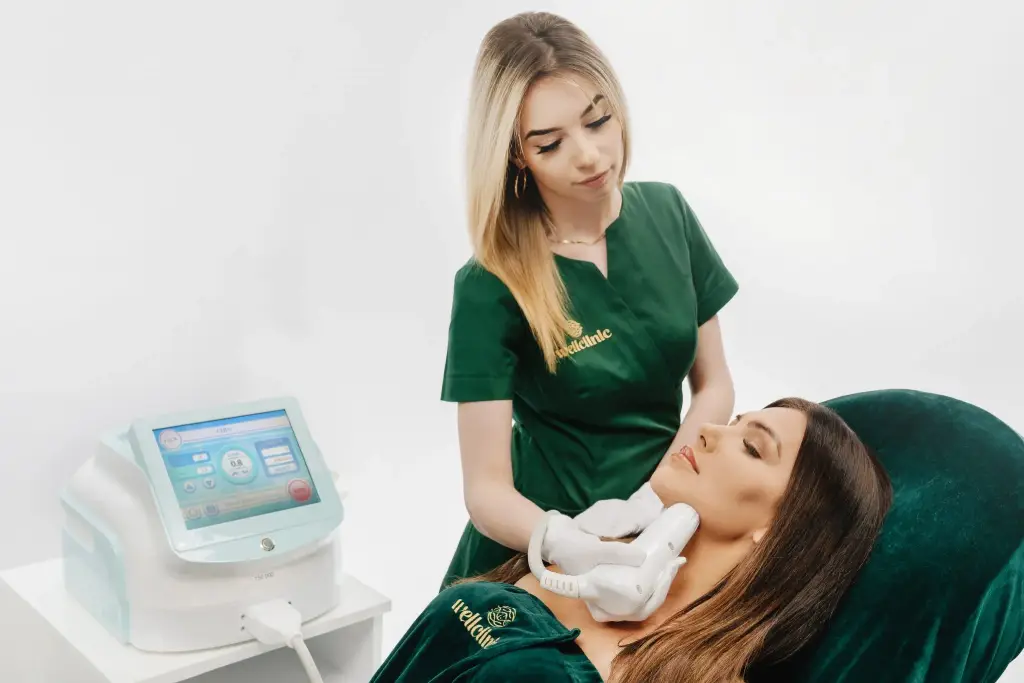
One option is 4D endolifting, which focuses on improving skin firmness and quality. Depending on the indications, treatments utilising HIFU or radiofrequency.
Not every method will be suitable for everyone. Therefore, the final treatment plan should be based on consultation and an assessment of individual needs.
Does facial contouring always require hyaluronic acid?
No. The choice of method depends on what is causing the change in the appearance of the face and what result the patient wishes to achieve.
If the main problem is a loss of volume, your doctor may consider using hyaluronic acid. If, on the other hand, the face has changed in appearance primarily due to a loss of skin tone, procedures aimed at improving skin firmness may be more appropriate.
The ageing process also involves a gradual reduction in production collagen i elastins. As a result, the skin becomes less supple and the facial contours may gradually lose their definition.
Therefore facial modelling It does not always mean adding volume. Sometimes the right approach is to improve skin firmness rather than increase its fullness.
When is it a good idea to opt for facial contouring?
Facial volumetrics It may be considered both by people who wish to improve their natural proportions and by patients whose facial contours have changed over time.
Reasons for seeking a consultation may include, amongst others:
- loss of volume in the cheeks,
- a less pronounced jawline,
- changing the proportions of the beard,
- loss of the oval’s definition,
- changes in tissue volume associated with the ageing process.
However, these symptoms do not always mean that a filler is required. During the consultation, the doctor can assess whether facial contouring with hyaluronic acid does it meet a genuine need, or would it be better to use a different procedure?.
The most important thing is to maintain the right proportions. After the treatment, your face should still look like your own - just with a more defined contour and well-balanced proportions.
Facial contouring at Wellclinic
If you notice that the contours of your face have become less defined, you don’t have to decide on a specific treatment straight away. The first step is to assess whether, what has actually changed in the appearance of the face.
During the consultation, a Wellclinic specialist analyses the proportions of the face, the condition of the skin and the distribution of tissue. On this basis, they can suggest a course of treatment tailored to your needs and the desired outcome.
Make an appointment for a consultation and have a chat with our specialist about the options for improving your facial contours. We carry out aesthetic medicine treatments at our clinics in Warsaw, Gdańsk and Cracow.
Sources:
- PubMed „Facial Ageing: A Review of Clinical and Pathophysiological Changes”
https://pubmed.ncbi.nlm.nih.gov/31380717/ - PubMed „Hyaluronic Acid Fillers: History and Overview”
https://pubmed.ncbi.nlm.nih.gov/30006283/ - PubMed „Hyaluronic Acid Fillers: Pathophysiology, Mechanisms of Action, and Clinical Applications”
https://pubmed.ncbi.nlm.nih.gov/30563815/ - PubMed „Anatomy of the Facial Fat Compartments”
https://pubmed.ncbi.nlm.nih.gov/24297898/ - American Academy of Dermatology, „Fillers: Overview”
https://www.aad.org/public/cosmetic/wrinkles/fillers - Cleveland Clinic „Dermal Fillers”
https://my.clevelandclinic.org/health/treatments/24291-dhttpsermal-fillers





 +48 600 100 177