
 Katarzyna Pawłowska

 01.10.2026
Table of contents
Acne may clear up, but its marks often remain for years. Indentations on the cheeks, an uneven skin texture and visible scars can affect the appearance of the face even after the inflammatory lesions have completely subsided. Treatment of acne scars requires a proper assessment of the problem. It is not only the depth of the scars that matters, but also their shape, structure and the condition of the surrounding tissues.
Creams and a daily skincare routine help to keep the skin in good condition, but they cannot, on their own, repair deep tissue damage. In such cases, treatments that stimulate skin regeneration and remodelling may be required.
Why do permanent scars form after acne?
Scars form when inflammation damages the deeper structures of the skin. The body initiates a healing process during which it rebuilds the damaged tissue. However, the newly formed collagen fibres do not always arrange themselves in the same way as in healthy skin. As a result, the skin’s surface may become uneven, and indentations or raised areas may appear where the lesions previously were.
It plays a significant role collagen, which is responsible for the skin’s strength and structure. Fibroblasts - cells that produce the components of the extracellular matrix - also play a part in the regeneration process. It is this network of proteins and other substances that provides support to the tissues and influences their mechanical properties.
If the regeneration process does not proceed correctly, the skin may lose some of its volume or be pulled down by fibrous strands located beneath its surface. This results in characteristic indentations, which are particularly visible when viewed under side lighting.
However, not every mark left by acne is a scar. Red and brown lesions may be post-inflammatory hyperpigmentation, which primarily affect skin tone. Scars, on the other hand, involve a change in the skin’s structure and require a different therapeutic approach.
Types of acne scars and the choice of treatment
The appearance of scars provides important information about which methods are likely to yield the best results. There are three main types of atrophic scars.
- Ice-pick scars - narrow, deep lesions resembling small puncture wounds. They can extend into the deeper layers of the skin, which is why treating them can be particularly challenging.
- Boxcar scars - depressions with distinct, often vertical edges. They vary in depth, and their appearance depends, amongst other things, on the extent of tissue loss.
- Rolling scars - broad, undulating irregularities that give the skin a rippled appearance. They are often caused by fibrous connections that pull the skin towards deeper structures.
In addition to atrophic scars, there are also hypertrophic scars i scarring, relating to excessive scar tissue growth. They require a different approach to acne scars.
A single person may have different types of scars at the same time. Therefore, treatment of acne scars should take into account their structure, rather than merely a general assessment of skin irregularities. Sometimes the best approach is to combine several methods.
Fibrous bands under the skin - the cause of persistent dimples
Some scars are associated with the presence of fibrous strands, which connect the superficial layers of the skin to the deeper tissues. These connections can pull the skin downwards, creating visible indentations.
In such cases, simply stimulating collagen production may not be enough. Improving the quality of the skin and freeing it from the mechanical pulling caused by fibrous strands are two distinct therapeutic objectives.
One of the methods used in appropriately selected cases is subcision, or scar subcision. The procedure involves the controlled release of fibrous connections beneath the scar. This is an invasive procedure and therefore requires medical assessment. It is not suitable for all types of lesions, and its use depends on the location of the scars, the structure of the tissues and the potential risk of complications.
A proper understanding of the mechanism behind the formation of the depression allows for better planning of treatment and helps to avoid methods that do not address the actual cause of the problem.
Microneedle radiofrequency treatment for acne scars
Micro-needle radiofrequency It combines micro-needling with radio-frequency energy. The energy delivered to selected layers of the skin induces a controlled thermal effect, which stimulates repair processes and tissue remodelling.
Over the coming weeks, the skin gradually reorganises its structures. This may lead to an improvement in the texture, firmness and appearance of atrophic scars. However, the result depends on their depth, type and the body’s individual response.
At Wellclinic, the following are used, amongst other things Exion technology. Its use in the treatment of scars requires an assessment of the indications and the selection of appropriate parameters to suit the condition of the skin.
Another option is skin microneedling, for example, using a device Dermapen. Controlled punctures stimulate local regenerative processes, including the activity of cells involved in tissue repair.
Both methods have their own indications and limitations. Not every scar responds to them in the same way, so before starting treatment, the skin’s structure should be assessed and any contraindications ruled out.
Laser treatment for acne scars - when should you consider laser therapy?
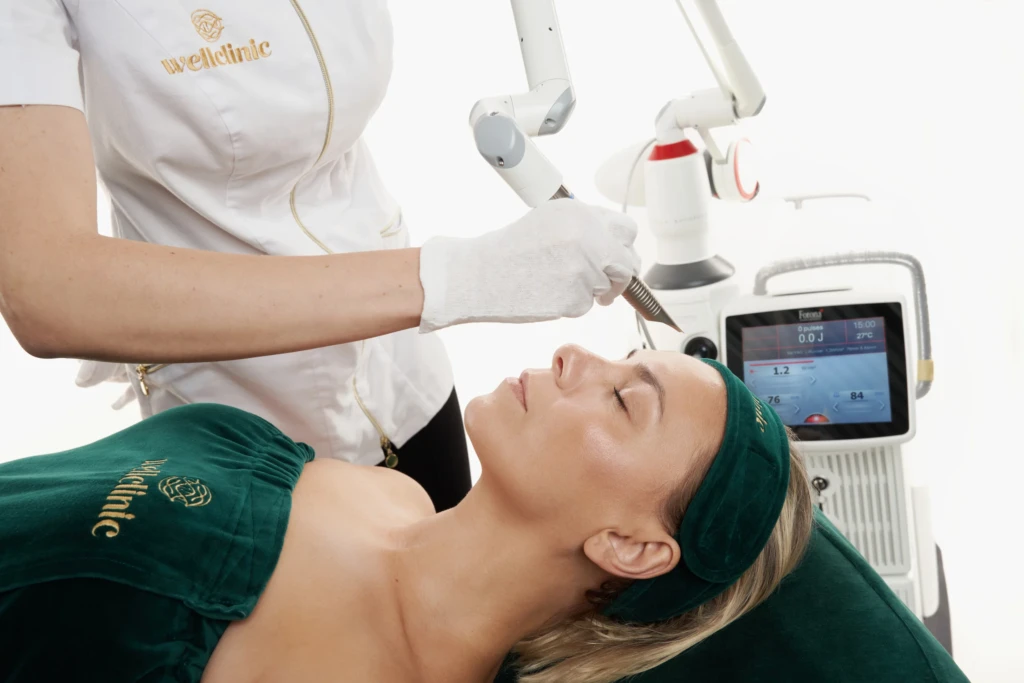
Laser therapy for acne scars It can help to regenerate the skin and improve its surface. Depending on the technology used, the laser energy acts on specific tissue structures, triggering repair processes.
One solution is fractional laser, which creates microscopic areas of controlled treatment. Between these areas, there are patches of skin that are not directly exposed to the laser, which aids the healing process.
Wellclinic offers a platform Fotona Dynamis SP Pro. Whether a particular treatment mode can be used depends on the type of scar, the condition of the skin and the specialist’s qualifications. The mere presence of scars does not mean that laser treatment will be the best option in every case.
Before laser therapy Consideration should be given to skin phototype, susceptibility to discolouration, any medication being taken and previous reactions to similar procedures. Particular caution is required for people at greater risk of pigmentation disorders.
After the treatment, redness, swelling or złuszczanie may occur. The recovery time depends on the method used and the individual’s skin response. It is important to take proper care of the skin and to follow the post-treatment instructions.
Why do the results of scar treatment appear gradually?
Skin remodelling is a biological process that takes time. Following a procedure designed to stimulate regeneration, fibroblasts contribute to the formation of components of the extracellular matrix, including collagen. New collagen fibres They must then mature and reorganise themselves within the tissue.
For this reason, the effects of the treatment are not always immediately apparent. The skin’s structure is assessed after a suitable recovery period, rather than solely immediately after the procedure.
The healing process is also influenced by general health, smoking, exposure to UV radiation and adherence to the specialist’s advice. These factors may play a role in recovery, although they do not, on their own, determine the final outcome.
How long does treatment for acne scars take?
Treatment of acne scars It often requires a series of treatments. The number of treatments depends on the type and depth of the lesions, the chosen method and the skin’s response. There is no single treatment plan that works for every patient.
The intervals between sessions are also important. The skin needs time to regenerate and rebuild itself, so having treatments more frequently does not necessarily mean better results.
The aim of the therapy is, first and foremost, reducing the appearance of acne scars, evening out skin texture and minimising the appearance of unevenness. The extent of possible improvement depends on individual circumstances. In the case of deep scars, it is not always possible to fully restore the skin’s original structure.
Skin care during scar treatment
Proper skincare supports regeneration and helps reduce the risk of irritation. The key is gentle cleansing, moisturising and daily sun protection.
SPF 50 sun cream is particularly important following procedures that increase the skin’s sensitivity to UV radiation. Exposure to the sun may contribute to the development or persistence of post-inflammatory hyperpigmentation.
Strong acids, retinoids and other zł-fattening ingredients should be used in accordance with a specialist’s recommendations. Following certain procedures, it may be necessary to temporarily adjust your skincare routine so as not to interfere with the healing process.
It is also worth avoiding extracting spots. Recurring inflammation and tissue damage increase the risk of further scarring.
Treatment of acne scars at Wellclinic
The choice of treatment should be based on a thorough assessment of the skin. During the consultation, the specialist analyses the type of scars, their depth, the current condition of the skin and the patient’s skincare routine to date. On this basis, it is possible to determine which methods are worth considering and whether it would be appropriate to combine several procedures.
Wellclinic offers technologies used to improve the skin’s structure, including Exion i Fotona Dynamis SP Pro. The choice of treatment depends on the indications, contraindications and individual needs.
If scars are still visible after acne treatment has finished, it is worth exploring ways to improve their appearance. Book a consultation at Wellclinic in Warsaw, Kraków or Gdańsk, to draw up a treatment plan tailored to the type of scars and the condition of your skin.
Sources:
1. PubMed - „Acne scars: pathogenesis, classification and treatment”
https://pubmed.ncbi.nlm.nih.gov/20981308/
2. PubMed - „Acne scarring: a classification system and review of treatment options”
https://pubmed.ncbi.nlm.nih.gov/11423843/
3. American Academy of Dermatology - „Acne scars: Consultation and treatment” https://www.aad.org/public/diseases/acne/derm-treat/scars/treatment
4. American Academy of Dermatology - „Acne scars: Signs and symptoms”
https://www.aad.org/public/diseases/acne/derm-treat/scars/symptoms
5. American Academy of Dermatology - „Acne scars: How to look after your skin after treatment”
https://www.aad.org/public/diseases/acne/derm-treat/scars/self-care
6. DermNet - „Acne scarring”
https://dermnetnz.org/topics/acne-scarring
7. DermNet - „Acne scars and how to get rid of them”
https://dermnetnz.org/topics/acne/acne-scars-how-to-get-rid-of-them
8. American Society for Dermatologic Surgery - „Acne Scars”
https://www.asds.net/skin-experts/skin-conditions/acne-scarring



 +48 600 100 177