What’s the worst thing you can do when you see „love handles” in the mirror? Decide that you just need to lose even more weight. You can restrict your food intake for months, increase the number of workouts and watch the weight drop. And yet, those folds of fat may still be visible. Then, instead of getting rid of the problem, you start battling those extra kilos – even though they may not be the cause at all.
Love handles on your back may remain after losing weight, even if you are slim and look after your figure. The body does not burn fat evenly, and localised deposits can be particularly resistant to diet and exercise. If you try to solve this problem solely by losing more weight, you may lose more kilograms, but you won’t necessarily achieve the desired appearance for your back.
Where do those love handles come from? Why isn’t exercise always enough? And what can you do when one part of your body simply won’t respond to a diet? We’ll find out for you where this problem comes from and what options are available modern body sculpting.
What exactly are the little butterflies on your back?
„Butterflies on my back” This is the colloquial name for the folds that appear on either side of the back. The term refers to their characteristic, symmetrical shape, which resembles the wings of a butterfly. They are most commonly seen around the shoulder blades, roughly at the level of a bra fastening. However, they can also appear in other parts of the back. They affect both women and men.
In most cases, they are caused by a localised build-up of fat. Sometimes the problem is also loose skin, which forms folds and becomes more noticeable when you move. „Butterflies” They are particularly noticeable when twisting the torso, bending over or wearing tight-fitting clothes.
Importantly, they do not necessarily have to be linked to being overweight. These folds can also occur in slim people. This is due, amongst other things, to the way the body stores fat – for some people, the back area is precisely where more fat accumulates.
Butterfly-shaped marks on the back – causes
Adipose tissue It is a natural component of the body. Its quantity and distribution depend, amongst other things, on genetics, age, gender, lifestyle and energy balance.
Excess body fat is most commonly associated with a long-term calorie surplus, that is, a situation in which the body takes in more energy than it needs. The level of daily physical activity is also a factor.
A sedentary lifestyle, a lack of exercise, poor eating habits and chronic stress can contribute to weight gain. In some people, excess body fat is particularly noticeable on the back.
It is worth remembering that Where fat is stored is partly determined by individual factors. In some people, excess weight will be most noticeable on the stomach, whilst in others it will be on the thighs, hips, bottom or back.
Butterflies in the stomach and hormones
In some cases, changes in body weight may be linked to hormonal imbalances or other health issues. If weight gain is sudden or accompanied by other symptoms, it is advisable to consult a doctor.
Depending on the situation, a specialist may recommend appropriate diagnostic tests, including hormone testing in women or hormone testing in men.
However, one should not assume that every roll of fat on the back is the result of hormonal problems. In the vast majority of cases, a number of factors influence the appearance of the figure at the same time.
Folds on the back – why do they form?
Folds on the back They can appear in various places – around the shoulder blades, on the sides of the torso, under the arms or where the bra sits.
Their visibility may increase as the overall amount of body fat increases. Body type, skin elasticity, muscle mass and the way the body is positioned whilst sitting or standing also play a role.
It is also worth bearing in mind that folds of skin do not always indicate excess fat alone. Their appearance may also be influenced by skin laxity and the natural folding of tissues.
How can I get rid of back fat?
If you want to reduce the amount of body fat on your back, a comprehensive approach is key. There is no exercise that burns fat exclusively from the back.
The key elements of the process are:
- a suitably balanced diet,
- regular physical activity,
- muscle-strengthening exercises,
- sufficient sleep and recovery,
- consistency in maintaining healthy habits.
What exercises can you do for the lats?
Back exercises do not burn fat in specific areas, but they can help to strengthen and build up the muscles in this part of the body, which affects the appearance and proportions of the figure.
A good approach is to combine cardio training with strength training.
Cardio
Cardio exercise increases energy expenditure and can form part of the process of reducing body fat. You don’t have to start with high-intensity workouts.
You can choose:
- a brisk walk,
- cycling,
- swimming,
- jogging,
- Cardio exercises at home.
Consistency is more important than a single, very intense training session. Even 20–30 minutes of exercise a few times a week can be a good start.
Strength exercises for the back
During your workout, it’s a good idea to include exercises that work the back muscles and the whole upper body. Examples include:
- dumbbell rowing,
- rowing on a rowing machine,
- pull-ups or easier versions of them,
- exercises with resistance bands,
- arm abduction,
- exercises to strengthen the postural muscles.
Strengthening your back muscles can improve their appearance and help maintain good posture.
Diet and butterflies in the stomach
Exercise alone may not be enough if your diet regularly leads to an energy surplus.
When cutting back, it is worth ensuring that a well-balanced diet, providing an adequate amount of protein, vegetables, whole grains, healthy fats and other essential nutrients.
If you need a personalised approach, it’s worth considering individual nutrition plan. However, it is not worth following very restrictive diets or expecting that a particular food will enable you to burn fat exclusively from your back.
How can I get rid of the rolls on my back?
If you want to reduce the appearance of love handles on your back, start with the basics: watch what you eat, increase your daily activity levels and introduce a regular strength training routine.
Don’t expect immediate results, though. Reducing body fat is a process that takes time and consistency.
If localised fat deposits persist despite a healthy diet and regular exercise, it is worth consulting a specialist to find out what body shaping methods may be appropriate in a particular case.
Is it possible to lose weight just from your back?
This is one of the most common questions about this issue. Unfortunately, we cannot tell the body which source of energy it should draw on first.
Exercises that target the back strengthen the muscles in that area, but do not cause localised fat burning. This is because the body does not select a specific area from which to draw fat during exercise.
Therefore, if your aim is to reduce the amount of fat on your back, it’s worth focusing on fat reduction.
Back fat – when diet and exercise aren’t enough?
In some people, despite weight loss, there are still areas where fat tissue is more stubborn. This may also apply to the back area.
In such a situation, you can find out what the options are body shaping. The choice of the appropriate method should always depend on the amount of body fat, the condition of the skin, the desired result and the individual’s state of health.
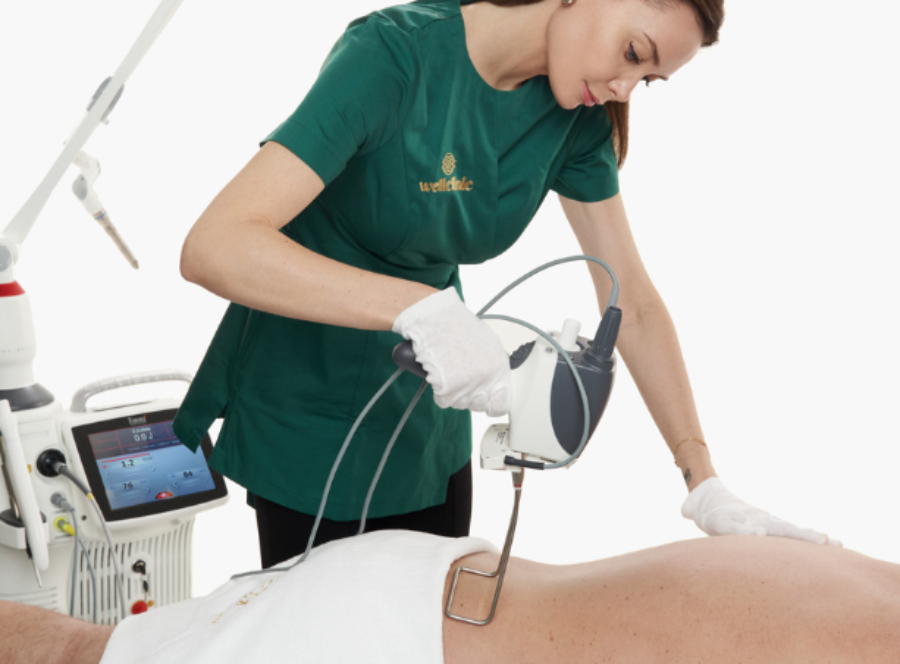
Laser liposuction for back fat and sagging skin
One of the methods used to reduce localised fat deposits is laser liposuction.
It utilises the action of a laser to simultaneously affect adipose tissue and skin. The procedure may be considered in cases of localised fat deposits accompanied by sagging or loss of skin firmness. This is particularly important when the problem concerns not only excess body fat, but also the appearance of the skin on the back.
Depending on individual needs, the treatment may help to body contouring, improving skin firmness and appearance. TightSculpting technology It can be used on various areas of the body; however, the scope and parameters of the treatment should be tailored to the individual.
What can you do if the fat on your back just won’t go away?
You might lose a few more kilograms and still see the same folds on your back when you look in the mirror. If, despite dieting and regular exercise, localised fat deposits are still throwing off your body’s proportions, losing more weight may not be the answer. The body does not choose where to burn fat, which is why the problem of one stubborn area may persist even when you are at a healthy weight.
The following remain the basis a well-balanced diet, regular physical activity and strength training. Exercise can strengthen the back muscles and improve your figure, but it does not allow for localised fat burning. If the problem is small, stubborn deposits of body fat, it is worth assessing during a consultation whether the following method would be a suitable solution: laser body shaping.
It is crucial to identify the problem correctly. Whether laser liposuction Whether this is the right solution depends on an individual assessment carried out during the consultation. The specialist analyses the amount and distribution of body fat, the condition of the skin and the expected outcome, and can then recommend a tailored course of treatment.
Don’t waste any more months trying to lose weight in an area that can’t be changed through diet or exercise alone. Book a consultation and find out which body-contouring options are right for you. We carry out these treatments at Wellclinic clinics in Warsaw, Gdańsk and Cracow.
Sources:
- National Institute of Diabetes and Digestive and Kidney Diseases (NIDDK)
„Factors Affecting Weight & Health”
https://www.niddk.nih.gov/health-information/weight-management/adult-overweight-obesity/factors-affecting-weight-health - PubMed (National Library of Medicine)
„Genomics of body fat distribution”
https://pubmed.ncbi.nlm.nih.gov/34238772/ - World Health Organisation (WHO)
„Physical activity”
https://www.who.int/europe/news-room/fact-sheets/item/physical-activity - PubMed (National Library of Medicine)
„Regional fat mobilisation and type of exercise in sedentary, pre-menopausal, overweight and obese women”
https://pubmed.ncbi.nlm.nih.gov/23836493/ - Endocrine Society
„Obesity”
https://www.endocrine.org/patient-engagement/endocrine-library/obesity - FDA (U.S. Food and Drug Administration)
„Non-Invasive Body Contouring Technologies”
https://www.fda.gov/medical-devices/aesthetic-cosmetic-devices/non-invasive-body-contouring-technologies