
 Katarzyna Pawłowska
 18.09.2026
 Table of contents
Face shape It doesn’t change overnight. At first, the jawline isn’t as defined as it used to be. The cheeks seem heavier, the skin loses its firmness, and the first fine lines appear at the corners of the mouth. Later on, there are marionette lines and an increasingly less defined contour of the lower part of the face.
And that’s when many people start looking for a way to facelift without surgery.
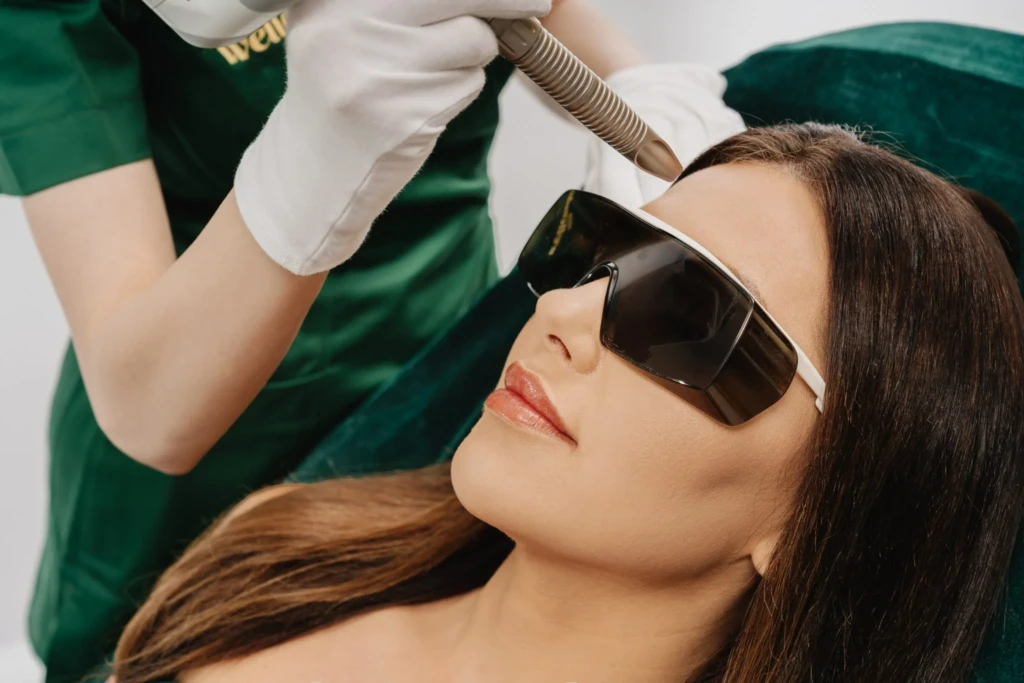
One option is laser facelift. It does not work like a surgical facelift and does not mechanically reposition the tissues. It uses laser energy to target the skin in a controlled manner and stimulate the processes involved in its remodelling.
What happens to the shape of the face as we get older?
A change in facial contours is not just a skin problem.
Over time, both the quantity and quality decline collagen and elastins, and the skin loses some of its elasticity. The distribution and volume of facial tissues also change. As a result, the jawline may become less defined, the cheeks begin to sag slightly, and the lower part of the face appears heavier.
That is why a cream or moisturising alone is not always enough when there is a noticeable skin flaccidity.
Improving the shape of the face is not just about smoothing out wrinkles. Skin firmness, texture, elasticity and the appearance of the facial contours are also important.

Laser facial contouring - how does it work?
Laser facelift This term refers to treatments that use laser energy to exert a controlled effect on tissues and stimulate skin regeneration.
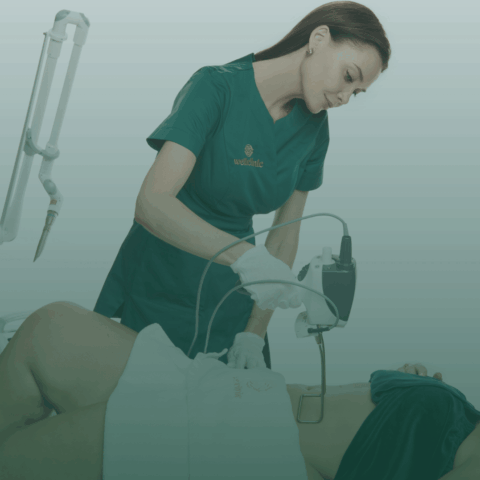
One of the technologies used in this type of therapy is Fotona 4D. It utilises two wavelengths - E4 at 2940 nm and Nd at 1064 nm - and four operating modes, enabling it to target different areas and layers of tissue.
It’s not about mechanically „tightening” the skin.
Laser energy It causes controlled heating of the tissues. Under appropriately selected conditions, this can stimulate collagen remodelling and influence the properties of the skin. Studies on therapies utilising a combination of different wavelengths indicate changes in the skin’s structure and an improvement in selected parameters associated with ageing.
The effect is therefore thought to result from the remodelling and improvement in the quality of the tissues, rather than from their surgical repositioning.
The jawline and marionette lines - where can you see a change in the face’s contour?
It is the lower part of the face that often reveals a loss of firmness first.
Laser facelift It improves skin firmness and makes the contours appear more defined. However, the effect depends on the cause of the change in facial contours.
If the main issue is skin laxity, laser therapy may be one of the solutions. If there is significant tissue sagging or a marked loss of volume, simply improving the quality of the skin may not be enough.
A laser is not a substitute for a surgical facelift. It works differently.
Puppet lines and loss of skin firmness
The puppet’s strings These are the lines that run from the corners of the mouth towards the chin. Over time, they can become increasingly noticeable, particularly as the skin loses its firmness and the lower part of the face begins to sag.
That is why simply treating the surface of the skin does not always solve the problem.
Laser treatment can be one component of a therapy aimed at improving skin tone and texture. In studies concerning Endolift technology an improvement in depth and surface area was observed nasolabial wrinkles and a line of puppets, as well as parameters relating to the density, thickness and elasticity of the skin.
The effects of laser facelifts
The result depends on the condition of the skin, the degree of sagging and the treatment protocol used.
With the right treatment, it is possible to aim for:
- improving skin firmness and elasticity,
- a better appearance face shape,
- smoothing out fine lines,
- improvement in skin structure,
- to reduce the visibility of selected furrows,
- to stimulate processes associated with collagen remodelling.
Not everything happens straight away.
Skin renewal is a gradual process, so the improvement may become increasingly noticeable over the coming weeks. This is important if you want a result that doesn’t suddenly alter your facial features.
When should you consider a laser facelift?
Not every change in the shape of the face requires the same treatment. Laser facelift may be considered, amongst other things, when:
- the skin begins to lose its firmness,
- the jawline is less defined,
- the cheeks begin to sag slightly,
- the first lines of the puppet begin to appear,
- the face looks less tense,
- There are visible signs of ageing, but there isn’t a great deal of excess skin.
In cases of more advanced tissue sagging, a different course of treatment or a combination of several methods may be required.
That is why it is not worth choosing a treatment simply because it is called a „non-surgical facelift”. First, you need to find out what is actually causing the change in the face’s contours.
How many sessions are needed to improve the shape of the face?
There is no single figure that suits everyone.
Factors such as age, skin condition, the degree of sagging, the area being treated and the parameters used are all important. Information on the Fotona 4D often refers to a course of several sessions carried out at intervals of a few weeks, but the exact treatment plan should be tailored to the individual.
It is also worth bearing in mind that the skin needs time to regenerate. Therefore, the results should be assessed not only immediately after the treatment, but also after the time required for the regenerative processes to take place.
How I felt and my recovery
The sensations experienced depend on the protocol used, the parameters and individual sensitivity.
You may feel warmth or discomfort during the treatment. In the case of protocols Fotona 4D The manufacturer highlights the non-invasive nature of the treatment and the short recovery time.
However, it is pointless to promise that everyone will experience exactly the same thing. Comfort depends on the individual patient and how the treatment is carried out.
A natural look without altering the facial features
Not everyone wants a dramatic lifting effect. Often, it’s about something simpler: making the jawline more defined again, making the skin look firmer, and ensuring the face doesn’t look tired.
The oval is supposed to look better. Therefore, when planning treatment, it is worth taking into account not only the laxity of the skin itself, but also the facial proportions, tissue volume and the patient’s expectations.
Laser facial contouring at Wellclinic
Over time, the contours of the face may become less defined and the skin may lose its firmness. However, this does not always mean that a surgical facelift is necessary. In many cases, the contours of the face can be improved using carefully selected laser treatments.
Before starting treatment, it is worth finding out exactly what is causing the changes to the contours of the face. The main cause may be a loss of skin firmness and elasticity, but changes in tissue volume and the natural shifting of tissues as we age also play a significant role.
At Wellclinic laser facial contouring It is tailored to each individual using Fotona 4D technology. During the consultation, a specialist assesses the condition of the skin, its firmness and the appearance of the facial contours, and discusses the expected results with the patient. This enables the treatment to be tailored to the skin’s current needs.
If you notice that the contours of your face are no longer as defined as they used to be, it’s worth starting with a consultation rather than looking for the strongest treatment available. A well-chosen treatment should address a specific skin concern.
Would you like to check whether laser face lift Will it be right for you? Book an appointment a consultation at Wellclinic and, together with a specialist, choose a solution tailored to your skin.
- Fotona „Fotona 4D® - Non-surgical facelift"
https://www.fotona.com/en/treatments/2305/fotona-4d/ - Fotona „Aesthetic Lasers"
https://www.fotona.com/en/aesthetics/ - PubMed „Laser resurfacing and fractional photothermolysis: clinical applications and outcomes"
https://pubmed.ncbi.nlm.nih.gov/ - PubMed „Photorejuvenation of the skin using a 1064-nm Nd:YAG laser"
https://pubmed.ncbi.nlm.nih.gov/ - PubMed „Non-ablative laser resurfacing for skin rejuvenation"
https://pubmed.ncbi.nlm.nih.gov/ - American Academy of Dermatology „Laser resurfacing"
https://www.aad.org/public/cosmetic/younger-looking/laser-resurfacing - PubMed „Laser skin resurfacing: a review"
https://pubmed.ncbi.nlm.nih.gov/


 +48 600 100 177