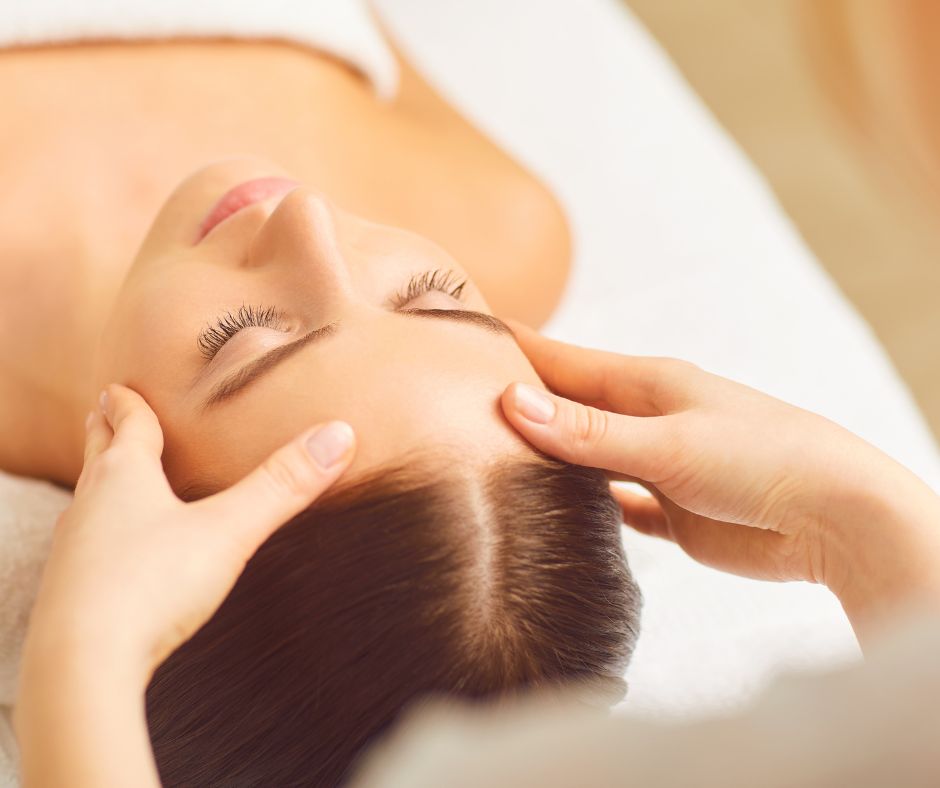
Japanese skincare For years, it has been associated with consistency, gentleness and a strong focus on skin health. One of its key elements is facial massage, which combines manual techniques, pressure on specific points and work on the muscles of the face, neck and nape. Japanese facial massage It can be a pleasant way to relax tense muscles and temporarily improve the appearance of the skin.
However, it should not be regarded as a substitute for aesthetic medicine treatments. Massage does not permanently remove wrinkles or halt the ageing process. It can, however, make the face look more rested and the skin appear better supplied with blood. Relaxing tense facial muscles can also improve the appearance and comfort of the face.
Japanese facial massage – what does it involve?
Japanese facial massage It is not limited to the face alone. Depending on the technique, the treatment may also be applied to the neck, nape of the neck, décolletage and, at times, the scalp. Techniques used include stroking, rubbing, kneading, gentle pressure and acupressure.
A massage can be performed at different speeds and with varying degrees of intensity. Initially, the movements are usually gentler, whilst later stages may involve more vigorous work on the tissues. It is important to adjust the pressure applied to suit the sensitivity of the skin and your current state of health.
One of the less obvious aspects of this type of massage is the work carried out on the neck and jaw area. Muscle tension in these areas can contribute to discomfort in the face and temples. Relaxing these structures can therefore produce benefits that go beyond simply feeling relaxed.
Japanese facial massage and Kobido
One of the best-known Japanese facial massage techniques is Kobido. This is a traditional massage originating from Japan, which combines various manual techniques, including pressure, rubbing, kneading and rapid movements performed on the surface of the skin. Depending on the stage of the massage, the therapist may apply varying degrees of pressure, moving from gentle, relaxing movements to more vigorous stimulation of the tissues. The massage covers not only the face but also the neck and nape, allowing tension to be addressed across a wider area.
A characteristic feature of Kobido is the variation in pace and pressure. Gentler movements are primarily intended to relax and prepare the tissues, whilst more dynamic techniques increase the intensity of manual stimulation. It is also important to focus on the jaw, temples, forehead and cheeks during the massage, as these areas often accumulate tension linked, amongst other things, to facial expressions and everyday stress.
Kobido massage is sometimes referred to as natural facelift, although this term should not be taken literally. The improvement in facial contours may be primarily due to manual manipulation of the tissues, a reduction in muscle tension, and a temporary improvement in microcirculation and fluid drainage. However, it is not equivalent to a surgical facelift or a procedure that results in a permanent lifting of the skin.
The effects of Japanese facial massage
Manual tissue stimulation causes a temporary increase in blood flow in the area being massaged. As a result, the skin may appear more radiant and refreshed immediately after the treatment. Gentle drainage techniques can also help to remove excess tissue fluid, which in some cases can reduce morning puffiness.
Facial massage It also affects muscle tension. This is particularly true of the jaw, forehead and temples, where many people unconsciously hold tension. Regular manual work can help to relax these areas.
However, it is important to distinguish between the short-term improvement in appearance and actual skin remodelling. Massage does not stimulate the tissues to the same extent as procedures using laser or radiofrequency energy, and its effects should not be considered comparable to those of aesthetic medicine treatments.
The benefits of Japanese facial massage
Immediately after a massage, the face may look more rested, and the skin may appear better supplied with blood and more radiant. Some people also notice a visible reduction in swelling.
Japanese facelift However, it is not a surgical facelift. The term refers primarily to the visual effect achieved through manual manipulation of the tissues and muscle tone. It does not involve a permanent lifting of the skin or the removal of wrinkles.
If your main concerns are deep-set wrinkles, loss of firmness or noticeable sagging of the skin, it is also worth considering treatments aimed at tissue remodelling. At Wellclinic, we offer, amongst other things, treatments in the field of facial rejuvenation.
Japanese facial massage and wrinkles
Is A Japanese facial massage can reduce wrinkles? No. However, it can temporarily improve the appearance of the skin and reduce the visibility of certain wrinkles caused by muscle tension or skin dehydration.
In the case of expression lines, the underlying mechanism is more complex. They are caused, amongst other things, by the repeated contraction of specific facial muscles. Massage alone does not eliminate this mechanism.
If the aim is to achieve a more noticeable reduction in the signs of ageing, treatments involving laser therapy or other skin-stimulating technologies may be considered. The choice of treatment should be based on an assessment of the skin’s condition, the biological age of the tissues and the desired outcome.
Acupressure and working with facial muscle tension
A distinctive feature of some Japanese massage techniques is acupressure, which involves applying pressure to specific points. In the practice of facial massage, this technique can be used primarily as part of a manual approach to managing tension and promoting relaxation.
It is interesting to note that during a massage, the therapist often works not only on the areas where tension is felt. The area around the neck, jaw and temples can play a role in the overall sensation of tension in the head. For this reason, a good massage should not be limited solely to running one’s hands over the cheeks.
Japanese facial massage and lymphatic drainage
One of the reasons why the face may appear slimmer after a massage is the effect that gentle manual techniques have on the flow of fluids in the tissues. However, this does not mean that body fat is reduced.
The slimming effect may be particularly noticeable in the morning, when there is slight swelling in the face. A massage can improve the appearance of the facial contours at such times, but the result is temporary.
Drainage should therefore not be equated with facial contouring in the sense of tissue remodelling. These are two different mechanisms.
Who is the Japanese facial massage intended for?
Japanese facial massage It may be a good choice for people who want to combine skincare with relaxation and work on muscle tension. It is particularly effective when the face looks tired and tension in the jaw, forehead or neck is clearly noticeable.
However, there is no single method that suits everyone. In the case of mature skin with a noticeable loss of firmness, the effects of massage may be insufficient if the aim is genuine tissue remodelling.
In such a situation, other methods may be considered facial rejuvenation, selected during a consultation to address a specific problem.
Contraindications for Japanese facial massage
Massage should not be performed in cases of active skin inflammation, severe acne, cold sores or damage to the epidermis. Caution is also required following aesthetic medicine treatments, when the tissues need time to regenerate.
An infection or inflammation in the mouth may also be a contraindication. In the case of chronic conditions, if you are taking medication that affects blood clotting, or if you have any other concerns regarding the safety of the massage, it is advisable to consult a specialist beforehand.
Particular attention should be paid to the current condition of the skin. Even a gentle massage is not advisable if it is likely to further irritate or aggravate an existing problem.
Japanese facial massage versus laser treatments
Massage and laser therapy address slightly different needs. Japanese facial massage It focuses primarily on manual work with tissues, relaxation and a temporary improvement in the skin’s appearance. Laser treatments, on the other hand, can affect deeper skin structures and be used, amongst other things, to stimulate remodelling processes.
At Wellclinic, the following procedures are carried out, amongst others: 4D endolifting, i.e. a procedure using the Fotona platform.
In the case of laser treatments, it is essential to select the appropriate parameters for the skin type and the aim of the treatment. Therefore, a pre-treatment assessment should be carried out before the procedure.
Japanese facial massage – a treatment or part of a skincare routine?
It is best to treat Japanese facial massage as a form of regular skincare and manual exercise, rather than as an alternative to professional aesthetic medicine treatments. Its strength lies in combining relaxation with a temporary improvement in the skin’s appearance and a reduction in muscle tension.
If you’re keen on facial rejuvenation and if you want to improve your skin’s firmness, reduce the appearance of wrinkles or restore a more defined facial contour, it is worth considering methods other than massage. Book a consultation at Wellclinic, so that a specialist can assess the condition of your skin and select a treatment suited to its needs and the desired result.
Sources:
- PubMed „Comparative Effects of Facial Roller and Gua Sha Massage on Facial Contour, Muscle Tone, and Skin Elasticity: A Randomised Controlled Trial”
https://pubmed.ncbi.nlm.nih.gov/40439289/ - PubMed „Efficacy of Conservative Techniques for Mechanical Facial Rejuvenation: A Systematic Review”
https://pubmed.ncbi.nlm.nih.gov/41322034/ - Wiley Online Library „Comparative Effects of Facial Roller and Gua Sha Massage on Facial Contour, Muscle Tone, and Skin Elasticity: A Randomised Controlled Trial”
https://onlinelibrary.wiley.com/doi/10.1111/jocd.70236 - PubMed „Short- and long-term effects of using a facial massage roller on blood flow and vascular reactivity in the facial skin”
https://pubmed.ncbi.nlm.nih.gov/30477852/ - Wiley Online Library „Effectiveness of manual therapy applied to craniomandibular structures in temporomandibular disorders: A systematic review”
https://onlinelibrary.wiley.com/doi/full/10.1111/joor.13299 - Archives of Allied Health Sciences „A pilot study on the immediate effects of modified facial massage on blood flow, temperature and the elasticity of facial skin”
https://he01.tci-thaijo.org/index.php/ams/article/view/66216