
Rapid weight loss does not always result merely in a smaller clothes size. Sometimes the appearance of the skin changes as well. When the kilograms disappear in a short space of time, the fatty tissue that previously supported the skin gradually shrinks. The skin, however, needs more time to adapt to the new volume of the tissues. That is why, after intensive weight reduction it may become less firm, and the contours of the face and figure may look different.
This problem can be observed, amongst other things, during pharmacological treatments to aid weight loss, such as Ozempic or Mounjaro. This does not mean that the medicines themselves cause sagging skin. What is important, above all, is the rate and extent of weight loss.
Changes may be particularly noticeable on the face, neck, arms, stomach or thighs. In some people, the skin gradually adapts to the new body shape over time, whilst in others the loss of firmness remains more noticeable.
That is why it is worth looking after the condition of your skin whilst you are losing weight, rather than waiting until sagging becomes a noticeable problem. The sooner you start looking after your skin, the more you can do to help maintain its firmness and quality throughout the whole process.
The biological mechanism – why the skin loses its firmness
Leather is based on collagen, elastin and the subcutaneous tissue, which together determine its structure and firmness. During rapid weight loss, adipose tissue is lost more quickly than the skin’s supporting fibres.
There is a loss of internal tissue support. The skin cannot keep pace with the changing volume of the body. As a result, its density and ability to contract gradually decrease, which is clinically evident as a loss of firmness and changes to the contours of the face and figure.
Ozempic, Mounjaro, skin firmness and the importance of collagen
Collagen is responsible for the skin’s strength and structure. It is synthesised in fibroblasts and depends on metabolic factors such as vitamin C, hydration and the body’s biochemical balance.
During weight-loss treatments, the rate of weight loss outpaces the rate of collagen remodelling. The skin does not have sufficient time to rebuild its supportive structure at a rate that keeps pace with the changes in volume.
That is precisely why, in the context of Ozempic, Mounjaro, skin firmness It is important to take action in parallel, rather than intervening only once the reduction has been completed.
Timing is of clinical importance in this process. The later skin support is provided, the greater the risk of the laxity becoming permanent.
Preventing loss of skin firmness during weight loss
Maintaining the quality of the skin requires an approach that runs parallel to the weight-loss process. This means working on both the metabolic and structural levels of the skin, rather than focusing solely on surface-level care.
Antioxidant support, hydration and the stimulation of fibroblasts responsible for collagen production are all important.
The absence of such an approach leads to a situation where the rate of change in body shape exceeds the skin’s ability to adapt.
Treatments to support skin firmness whilst taking Ozempic and Mounjaro
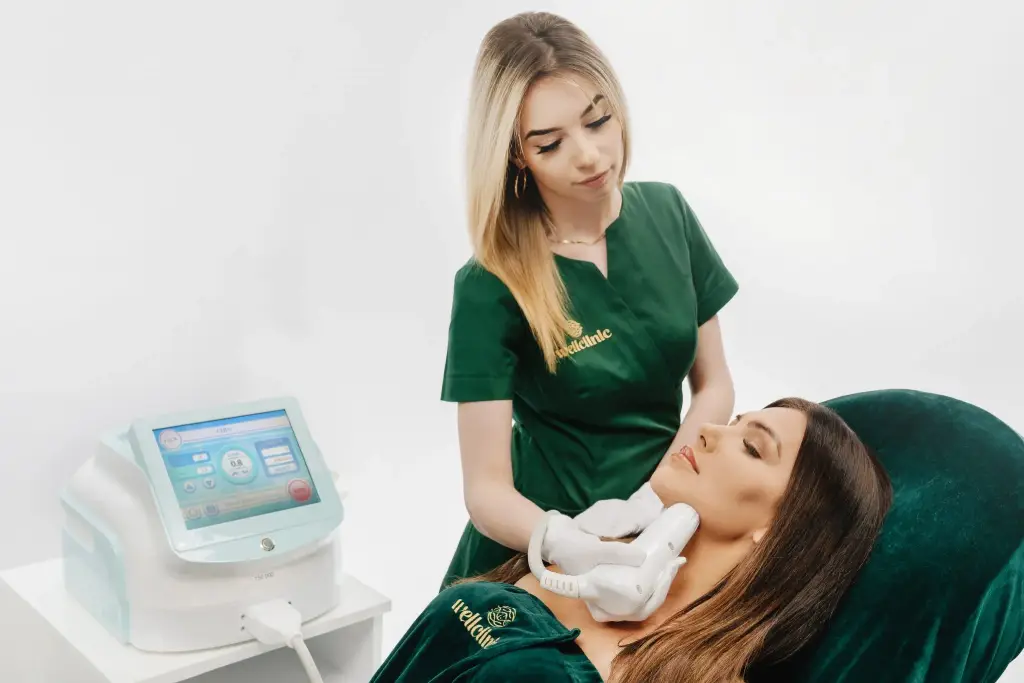
Aesthetic medicine It utilises technologies that do not replace the skin’s biological processes, but rather activate and regulate them. In the context of weight loss, it is important to act on several levels simultaneously – from the deep layers of the dermis to the structure of collagen and elastin, which are responsible for the skin’s firmness and mechanical resilience.
During therapy Tight Sculpting™ Laser and thermal energy are utilised, acting at various tissue levels – from the skin’s surface to its deeper layers. In practice, this means simultaneous body contouring and stimulation of skin tightening, which is particularly important when there is a rapid loss of subcutaneous volume. The skin is stimulated to reorganise itself, rather than merely undergoing a superficial improvement in appearance.
Technology HIFU II It acts deeper, in the layers responsible for the structural support of tissues. Concentrated ultrasound energy causes localised thermal stimulation, which initiates the process of neocollagenesis. As a result, the skin gradually increases in density and firmness, and these changes occur in a time-controlled manner, in line with the natural cycle of tissue remodelling.
Nucleofill tissue stimulators They work at a cellular level, stimulating fibroblasts to produce more collagen and elastin. Unlike traditional dermal fillers, they do not add volume but improve the quality and density of the skin from within. This is important in situations where the problem is not a lack of volume per se, but a loss of supportive structure.
Mesotherapy It supports the skin’s metabolism. It delivers active ingredients directly to the dermis, which improves the conditions for regeneration and collagen synthesis. In practice, this results in better hydration, nourishment and the skin’s ability to respond to stimulating factors.
The effects of all these methods are not immediate, because skin firmness It is not a superficial factor, but the result of a restructuring of deep tissue structures. This process requires time, consistency and the correct sequence of steps, particularly when the skin is adapting to rapid weight loss.
Ozempic and Mounjaro: skin firmness – key findings
Loss skin firmness During treatment with Ozempic and Mounjaro, this is a natural consequence of changes in body volume. It is not a random occurrence, but a predictable response by the body to rapid weight loss.
The timing of when support begins is of the utmost importance. The skin adapts over time, which is why proactive measures are more effective than intervening after the fact.
Rapid weight loss during treatment with medicines such as Ozempic or Mounjaro leads to changes in the structure of soft tissues. The most noticeable effect is on the skin, which loses some of its natural support following a reduction in body fat.
As a result, there is a decline skin firmness, particularly in the face, neck, arms and abdomen. This is a biologically predictable effect and is primarily due to the rate of weight loss, rather than the treatment itself.
Find out how to prevent a loss of skin firmness whilst taking Ozempic or Mounjaro, and which treatments at Wellclinic support skin regeneration. Make an appointment for a consultation – Our beauty therapists will put together a personalised treatment plan, tailored to your skin and the results you’re hoping to achieve. We carry out regenerative treatments at our clinics in Warsaw, Gdansk i Krakow.
Sources:
- PubMed „Weight Loss and Skin Changes: A Review”
https://pubmed.ncbi.nlm.nih.gov/36910322/ - PubMed „The Impact of Weight Loss on the Skin: A Systematic Review”
https://pubmed.ncbi.nlm.nih.gov/37401318/ - PubMed „Skin Changes Following Bariatric Surgery”
https://pubmed.ncbi.nlm.nih.gov/30274055/ - PubMed „The effect of weight loss on facial ageing: a systematic review”
https://pubmed.ncbi.nlm.nih.gov/31945351/ - American Academy of Dermatology: „Skin care and weight loss”
https://www.aad.org/public/everyday-care/skin-care-basics/dry/skin-care-weight-loss - Cleveland Clinic: „Ozempic Face: What It Is and How to Treat It”
https://health.clevelandclinic.org/ozempic-face