Cellulite can appear even when you’re doing everything „by the book”. A slim figure, a healthy diet, regular exercise - and yet, on your thighs, bottom or tummy, there are bumps and dimples that are becoming increasingly hard to ignore. Where does cellulite come from, given that I lead a healthy lifestyle? This is a question many women ask themselves, especially as the characteristic indentations become increasingly visible over time.
That is precisely why cellulite It is one of the most common cosmetic skin problems. It is estimated that it affects as many as 80-90% women, regardless of age, body weight or level of physical activity. It is therefore not a problem exclusive to people who are overweight. Cellulite can also occur in slim, active women.
Importantly, cellulite It is not merely „uneven skin” that can be effectively concealed with make-up. Its appearance is determined by changes occurring deeper down, within the subcutaneous tissue. These include, amongst other things, the distribution of fat cells, microcirculation, lymph flow and the structure of collagen fibres.
Therefore permanent removal of cellulite requires a comprehensive approach, focused not only on the appearance of the skin’s surface, but also on improving the structure of the subcutaneous tissue, microcirculation and the quality of collagen fibres.
What is cellulite?
Cellulite 1TP4 is a disorder of the subcutaneous tissue in which fat cells they begin to arrange themselves unevenly and form clusters that put pressure on the surrounding structures. At the same time, there is slowing of microcirculation and obstruction of lymphatic drainage, which further emphasises the visibility of the changes.
In practice, this means that the skin is no longer smooth and even. Instead, unevenness, thickening and characteristic indentations appear, which may vary depending on muscle tension, body position or the body’s level of hydration.
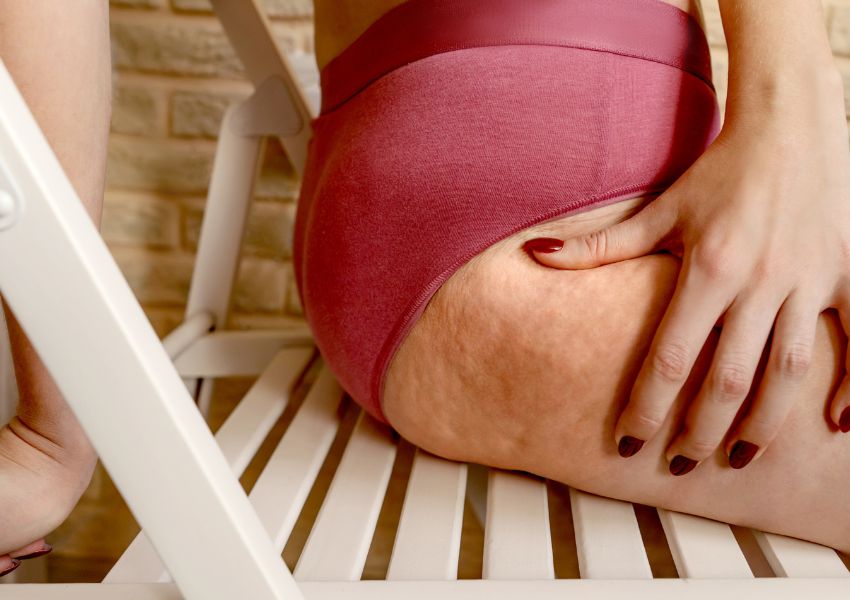
Most often cellulite occurs in thighs, buttocks, stomach and arms. These are areas where fat tends to accumulate more easily and where circulatory problems are more likely to occur. Over time, the changes may affect an increasingly larger area of skin and become more noticeable.
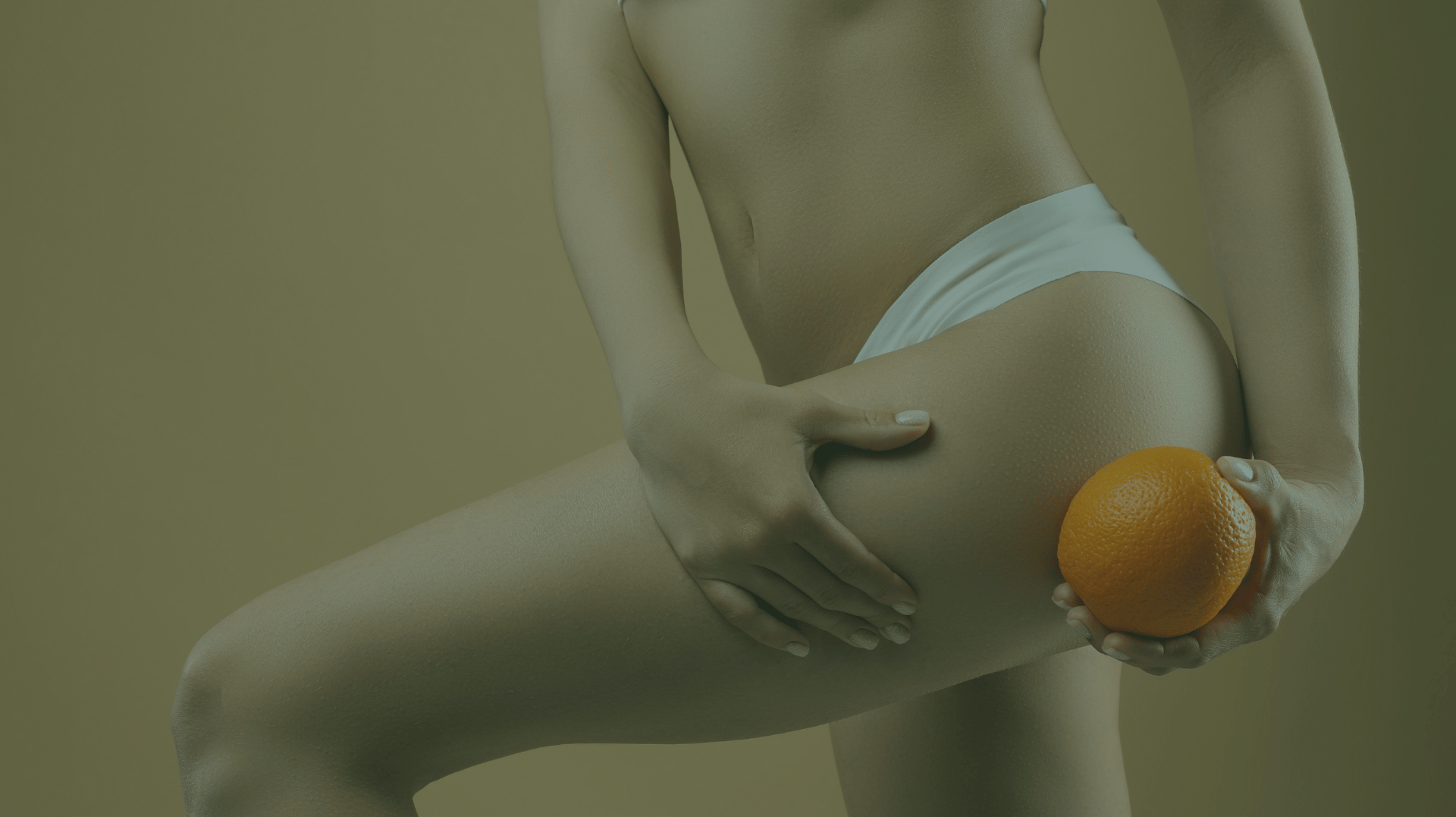
One of the most characteristic symptoms is the so-called. „orange peel”, i.e. an irregular skin surface resembling delicate ripples. In more advanced cases, the lesions are visible without the need to press on the skin.
What does cellulite look like on the skin?
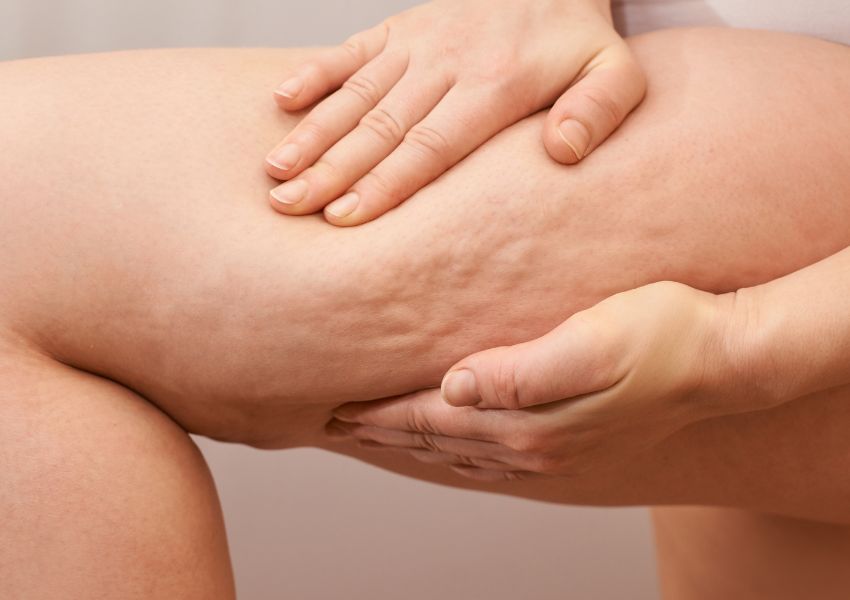
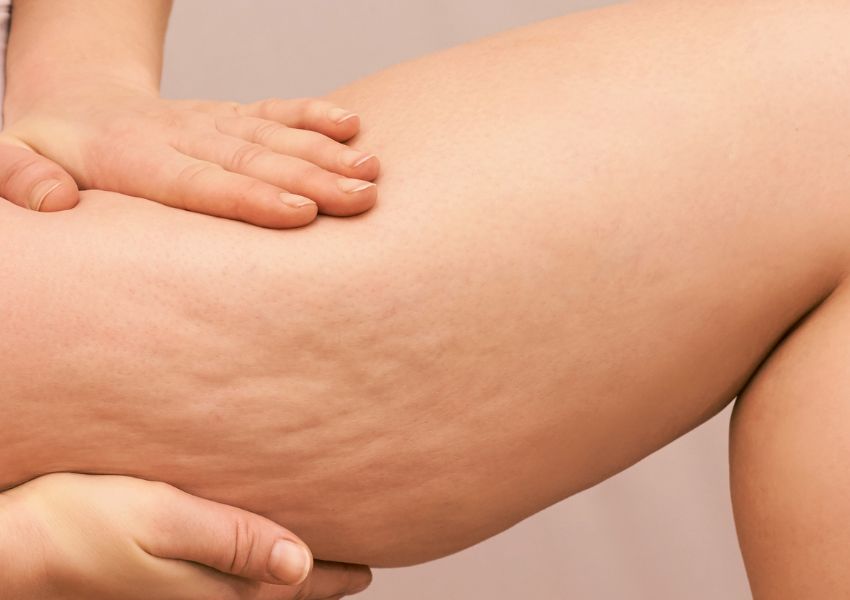
At an early stage cellulite It can be difficult to spot. The changes mainly become visible when pressure is applied to the skin or under certain lighting conditions, such as side lighting. At this stage, many people are not yet aware that it is there.
Over time, however, the structure of the skin begins to change gradually. Irregularities become more pronounced, and the skin’s surface loses its smoothness. In some areas, subtle indentations appear, which may develop into more noticeable deformities over time.
In the intermediate form cellulite It is already noticeable without applying pressure. The skin begins to react to muscle tension, and any unevenness becomes more pronounced during movement. There may also be a sensation of a „compacted” tissue structure when touched.
In advanced cases cellulite It is constantly visible, regardless of body position. The skin loses its elasticity and its surface becomes noticeably wrinkled. In such cases, the changes are not only aesthetic but also structural.
How can you recognise cellulite?
Recognition cellulite It is not difficult, as the changes are both visual and tactile. The first thing you notice is the unevenness of the skin’s surface, which resembles subtle indentations and raised areas.
Another sign is a change in the skin’s elasticity. The affected areas cellulite They may be less elastic and more „stiff” compared to healthy tissue. In some cases, the changes can be felt even without looking at the skin.
It is also worth noting that cellulite It can take various forms. The most common types are water cellulite, adipose cellulitey and fibrous cellulite. Each one has a slightly different base and may look different on the skin, but the common factor remains uneven surface texture skins.
The causes of cellulite and ways to reduce it
Where does cellulite come from? There is no single cause for its development. Its appearance is influenced by, amongst other things, the structure of the subcutaneous tissue, the distribution of fat cells, microcirculation and the condition of the collagen fibres. For this reason, cellulite can occur in both overweight women and slim, active people.
If skin irregularities are visible and pose an aesthetic concern, their nature and severity can be assessed during a consultation, and an appropriate course of treatment selected. One of the available methods is Unison therapy, which combines monopolar radio waves with focused acoustic waves. The treatment acts on the skin and subcutaneous tissue, helping to improve skin firmness, elasticity and microcirculation.
Make an appointment for a consultation, to discuss the condition of your skin and the treatment options available in your specific case. At Wellclinic, cellulite reduction treatments are carried out in Warsaw, Gdańsk and Cracow.
Sources:
- PubMed „Comparative Analysis of Cellulite Treatment Methods: A Systematic Review"
https://pubmed.ncbi.nlm.nih.gov/39547984/ - PubMed „Do electrophysical agents work for the treatment of cellulite? A systematic review of clinical trials"
https://pubmed.ncbi.nlm.nih.gov/38695965/ - PubMed „Therapeutic approaches to cellulite"
https://pubmed.ncbi.nlm.nih.gov/26566570/ - PubMed „Unipolar radiofrequency treatment to improve the appearance of cellulite"
https://pubmed.ncbi.nlm.nih.gov/18788033/ - PubMed „Extracorporeal shockwave therapy: mechanisms of action and physiological aspects in the treatment of cellulite, body contouring and localised fat - A systematic review"
https://pubmed.ncbi.nlm.nih.gov/28590827/ - American Academy of Dermatology (AAD) „Cellulite treatments: What really works?"
https://www.aad.org/public/cosmetic/fat-removal/cellulite-treatments-what-really-works - American Academy of Dermatology (AAD) „Cellulite and fat removal"
https://www.aad.org/public/cosmetic/fat-removal