
 Katarzyna Pawłowska
 06.10.2026
 Table of contents
Your hair doesn’t start falling out on the day you notice it on your pillow. The process usually begins much earlier.
At first, the hair may become thinner, less dense and weaker. The parting begins to look wider, the scalp becomes more visible, and the hairstyle loses its volume. In men, the first sign may be receding hairline or thinning at the crown of the head. In women, the problem often presents as a gradual reduction in hair density.
There may be many causes. Factors such as genetic predisposition, hormones, age, chronic stress, nutrient deficiencies, scalp conditions and certain systemic diseases all play a role.
That is why treatment for hair loss should not begin with the question: „What can I do to make my hair grow?”. First, you need to establish, Why does hair fall out, and what condition are the hair follicles in?.
Exosomes for hair – what exactly are they?
Exosomes These are small extracellular vesicles released by cells. They are one of the components of intercellular communication. They can transport, amongst other things, proteins, lipids and RNA molecules, conveying information that influences the functioning of other cells.
It was precisely this mechanism that meant that exosomes for hair have become a focus of interest for researchers working on tissue regeneration and the problem of hair loss.
In the context of the scalp, what matters is their potential impact on the cellular environment surrounding the hair follicles. It is not, therefore, a simple mechanism whereby a substance reaches the hair root and the hair begins to grow. The biology of the hair is far more complex.
Hair follicle goes through specific growth phases. The most important phase from the point of view of hair growth is the anagen, i.e. active growth. Next comes the phase catagen, associated with the gradual cessation of hair follicle activity, and telogen – the resting phase. An imbalance between these phases can lead to increased hair loss.
Therefore, any method designed to promote healthy hair should also be assessed in the light of this, what happens inside the hair follicle itself and in the surrounding area.
How do exosomes affect the hair?
The mechanism by which exosomes function is primarily linked to intercellular communication. The molecules they contain can influence the processes taking place in recipient cells; for this reason, their potential applications are being investigated, including in tissue regeneration and the modulation of cellular processes.
In the case of exosomes on the scalp Interest is focused on their potential impact on the environment of the hair follicles, regenerative processes and intercellular communication.
This is important because hair follicle It does not function in isolation from the surrounding tissue. Its function is influenced by the entire skin microenvironment.
Research into the use of exosomes in hair treatment is still ongoing. The preliminary results are promising, but this does not mean that exosomes are a solution for every type of hair loss, nor that a specific number of new hairs can be guaranteed.
In medicine, it is therefore worth distinguishing between the potential of technology versus the promise of results.
Exosomes for androgenetic alopecia
Androgenetic alopecia It is one of the most common types of hair loss in both women and men. Its defining characteristic is the gradual miniaturisation of the hair follicles.
In practice, this means that subsequent hairs growing from a given follicle may become progressively finer, shorter and less visible. Over time, they become almost invisible. It is therefore not merely a problem of „excessive hair loss”. Equally important is the process of the hair follicle’s activity and size gradually diminishing.
In people predisposed to androgenetic alopecia, one of the key factors is the sensitivity of the hair follicles to aandrogens, in particular dihydrotestosterone (DHT).
That is precisely why exosomes for androgenetic alopecia are an interesting area of research. Their potential regenerative effects and impact on the follicular microenvironment may support treatment, but they should not be regarded as a substitute for diagnosis or for all recognised methods of treating androgenetic alopecia.
The earlier the problem is identified, the more important it is to halt its progression and preserve existing hair.
Exosomes for hair loss – first the cause, then the treatment
Not all hair loss is caused by androgenetic alopecia.
Hair loss can also occur following a period of severe stress, infection, rapid weight loss, hormonal changes or nutritional deficiencies. In such situations, the problem may be temporary, and correctly identifying the cause is more important than rushing to try yet another method of stimulating the scalp.
An example is telogenetic alopecia. During this process, a larger number of hairs simultaneously enter the resting phase and subsequently fall out. Patients often only notice the problem several weeks or months after the triggering factor.
Therefore exosomes for hair loss should be regarded as part of a personalised treatment plan, rather than a one-size-fits-all solution for every type of hair loss.
Well Hair Restoration – laser and exosomes
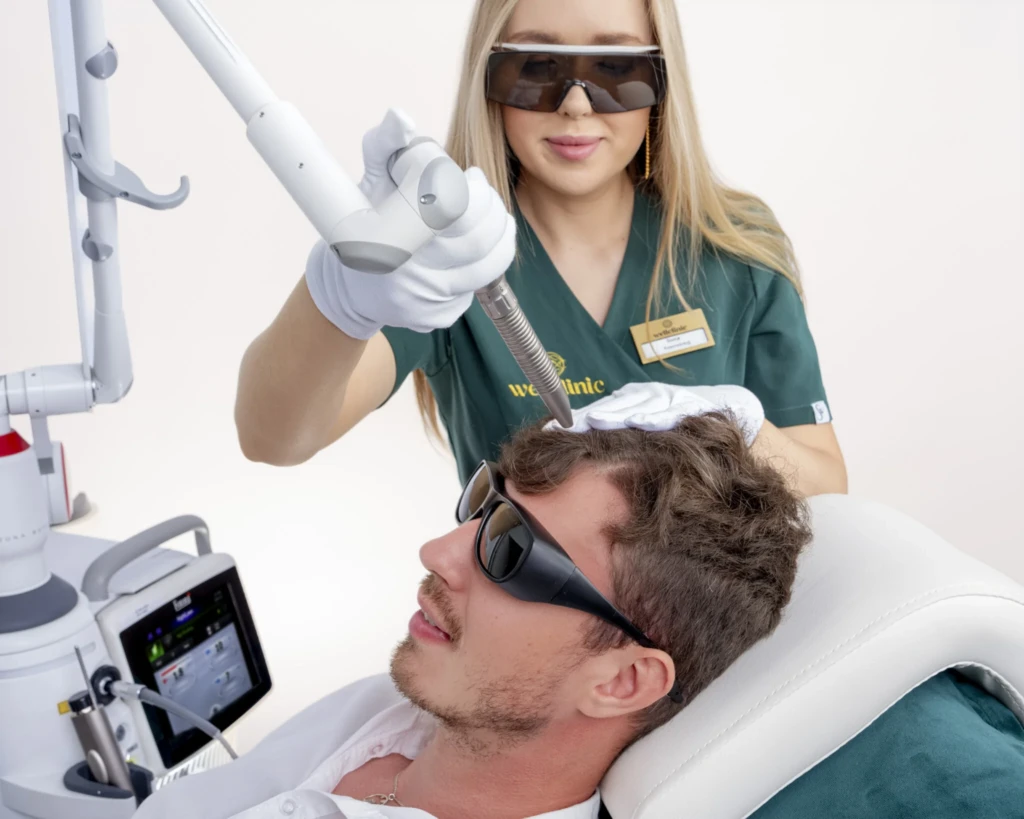
At Wellclinic Well Hair Restoration treatment combines the action of a laser Fotona Dynamis SP Pro using a preparation containing exosomes.
The idea behind this combination is to have a comprehensive effect on the scalp – using laser energy and ingredients employed in regenerative therapies.
Laser stimulation of the scalp affects the processes taking place in tissues, whilst exosomes are used because of their potential in the field of mobile communications.
However, this does not mean that combining the two technologies automatically produces better results for every patient. The final outcome depends on the cause of the problem, the condition of the hair follicles, the stage of the condition and the individual’s response.
For those who…gCould exosomes be suitable for hair?
Therapy It may be considered for people who are experiencing gradual hair thinning, a reduction in hair density or a deterioration in hair condition. It may also be considered as part of the management of people with certain types of alopecia.
However, this does not mean that every patient will be a suitable candidate.
Among other things, the following are important:
- the type and cause of hair loss,
- the duration of the problem,
- degree of thinning,
- the condition of the hair follicles,
- condition of the scalp,
- the presence of skin diseases or inflammation,
- previous treatments,
- general state of health.
If hair follicle is irreversibly damaged; stimulating the scalp alone will not restore its function. This is one of the reasons why it is not advisable to delay diagnosis for too long.
What changes can be expected following exosome therapy?
The results of treatment should be assessed realistically. The aim should not be to promise spectacular changes in a short space of time, but rather to improve parameters that can actually be observed: the condition of the scalp, the quality of the hair, its thickness, density and the extent of thinning.
In the case of the effects of exosomes on hair may depend on the initial condition of the hair follicles and the cause of the problem. A person with intact but weakened hair follicles may have completely different prospects to a patient with advanced, long-standing hair loss.
It is also important to bear in mind that an improvement in the appearance of your hair does not always mean that a large number of new hairs will grow. Sometimes the first change may be an improvement in the quality and thickness of your hair, with an increase in visual density only following later.
This is precisely why the results of hair treatments are best assessed over the long term and on the basis of comparable photographic records.
Exosomes for hair – when can you see the results?
Hair grows slowly, and its biological cycle is considerably longer than a few weeks. For this reason, the effectiveness of a treatment should not be judged solely on the basis of what happens immediately after it has been carried out.
It is also important that hair growth cycle length and the stage the bursa was at when treatment began.
Only such a comparison makes it possible to minimise the influence of factors that may visually increase or decrease the perceived density of the hair.
Exosomes for hair – safety of the treatment
Safety depends not only on the concept of the treatment itself, but also on the quality and origin of the preparation used, the method of its preparation, the storage conditions and the administration procedure.
It is therefore advisable, before starting treatment, to know exactly which preparation is being used, where it comes from and what its indications are.
It is also important to rule out situations where the problem primarily requires a dermatological diagnosis or treatment of the underlying cause.
Exosomes should not be seen as a way of circumventing diagnosis.
If hair loss is sudden, very severe, accompanied by inflammation, itching or scalp pain, or if distinct patches of baldness appear, further diagnostic tests may be necessary.
Exosomes versus other treatments for hair loss
There is rarely a single, universal solution to the problem of hair loss.
Depending on the diagnosis, various strategies are employed – ranging from causal and pharmacological treatment to methods that support the health of the scalp and hair follicles.
Exosomes are distinguished primarily by a mechanism related to intercellular communication. However, they are not equivalent to all available treatments.
Therefore, comparing methods solely on the basis of „which technology is best” may lead to erroneous conclusions. A far more important question is, which method addresses a specific problem in a specific patient.
Exosomes in hair therapy – an area that is still being researched
Applications of exosomes Tissue regeneration is an area under intensive research. In the case of hair, particular interest is focused on the possibility of utilising its properties to modulate the processes taking place in the microenvironment of the hair follicle.
This is an area which may, in the future, find wider application in regenerative therapies. At the same time, the current state of knowledge calls for caution when making promises regarding the outcomes.
In the case of new medical technologies, it is particularly important to have well-designed clinical trials, sufficiently large patient cohorts, a long follow-up period and the ability to compare results consistently.
Therefore exosomes for hair It is worth viewing this as an emerging field of treatment, rather than as a miracle cure for hair loss.
Hair treatment begins with a proper diagnosis
Hair loss is not a single problem and does not have a single cause. In one person, it may be due to genetic predisposition and the progressive miniaturisation of hair follicles; in another, it may result from a temporary disruption to the growth cycle. Yet another case may require an investigation into hormonal, metabolic, dermatological or deficiency-related causes.
That is why the mere fact that „hair is falling out” is not enough to choose a treatment.
Exosomes for hair They represent an interesting avenue for the development of regenerative therapies, given their role in intercellular communication and their potential impact on the follicular environment.
The most important thing is to find the answer to the question, Why has my hair started to thin – and what can be done before the problem gets any worse?.
Don’t just guess why your hair is falling out. Find out what’s happening at the root. If you notice excessive hair loss, thinning, a reduction in hair density or a deterioration in the condition of the scalp, book a consultation. A team of specialists will assess the condition of your hair and scalp and select a treatment tailored to the actual cause of the problem.
Sources:
- PubMed „Exosomes and Hair Regeneration: A Systematic Review of Clinical Evidence Across Different Types of Alopecia and Exosome Sources”
https://pubmed.ncbi.nlm.nih.gov/40955427/ - PubMed „Exosomes for Treating Hair Loss: A Review of Clinical Studies”
https://pubmed.ncbi.nlm.nih.gov/39447204/ - PubMed „Exosomes in Hair Regeneration”
https://pubmed.ncbi.nlm.nih.gov/35441799/ - PubMed „Exosome-driven treatments for hair regrowth in androgenetic alopecia”
https://pubmed.ncbi.nlm.nih.gov/42377704/ - PubMed „Androgenetic alopecia”
https://pubmed.ncbi.nlm.nih.gov/40276450/ - PubMed „Telogen Effluvium: a review of the science and current obstacles”
https://pubmed.ncbi.nlm.nih.gov/37996318/




 +48 600 100 177