
 Katarzyna Pawłowska
 12.05.2026
 Table of contents
After 60 years of age some signs of ageing they may turn up sooner than you expect. Wrinkles Wrinkles become deeper, the skin loses its firmness, regenerates more slowly, and it can become increasingly difficult to maintain its natural moisture levels. This is the point at which your current skincare routine may not always deliver the same results as before.
How to make your face look younger after the age of 60, when do creams stop being enough? It is not about stopping the clock or completely erasing the signs of ageing. The aim may be to improve the skin’s quality, hydration, firmness and appearance, whilst maintaining the face’s natural proportions.
There are many possibilities – from a carefully selected home care after professional facial treatments. Different methods address different issues, which is why it is not only age that matters, but above all the current condition of the skin and the type of changes we wish to correct.
What can actually improve the appearance of the skin after the age of 60, And what is just an empty promise? Let’s take a look at the methods that can be used as part of a comprehensive approach to mature skin.
Skin condition after 60 years of age
After sixty, natural regenerative processes slow down and the synthesis of collagen and elastin decreases significantly. As a result, the skin loses its flexibility, becomes thinner and more susceptible to skin dehydration. Deeper furrows and facial wrinkles appear and the face loses its former oval.
Ageing does not just affect the surface of the skin alone. There is a decline in activity fibroblasts, that is, the cells responsible for collagen regeneration. Slowed microcirculation can affect the processes of tissue nourishment and oxygenation. Deeper facial structures also change – there is a loss of body fat and remodelling of the bone support, which affects the proportions and oval of the face.
Increasing attention is also being paid to skin microbiome, which loses its diversity with age. An imbalance in the microflora can increase skin sensitivity, exacerbate dryness and promote inflammation, which accelerates the ageing process.
Signs of ageing can also include hyperpigmentation and uneven skin texture. Nevertheless, the right care for mature skin and well-chosen treatments can improve the condition of the skin, restoring its healthy appearance and radiance.
How to rejuvenate the face in old age?
Although the skin ageing process is inevitable, there are effective ways to slow it down. Of key importance is the right care for mature skin, providing restorative ingredients the hydrolipidic barrier and regular humidification.
In practice, however, hydration alone is not enough. The skin after 60 years of age also requires regenerative stimuli that stimulate fibroblasty to work and support natural regeneration processes. Therefore, individually tailored anti-aging therapies, that do not mask the problem, but stimulate the skin to rebuild from within.
Worth combining home care with professional cosmetic and medical treatments, which act on different levels of the skin - from the epidermis to the deep layers. This makes it possible to improve skin firmness, structure and density, and not just a temporary smoothing.
Home remedies for rejuvenation in women 60+
Daily skincare is key to keeping skin in good condition after 60. It is worth focusing on restoring the skin barrier, as its weakening leads to faster moisture loss and greater sensitivity.
The following also play a particularly important role in the care of mature skin retinol, which is one of the best-researched anti-ageing ingredients. Retinol stimulates cell renewal, promotes the reconstruction of collagen fibres and improves skin texture. Wrinkles become shallower and the skin regains greater firmness and elasticity.
In caring for the skin, it is important to avoid over-aggression - over-intensive 1TP4Exfoliation or frequent use of irritating ingredients can weaken the skin instead of strengthening it. Mature skin responds better to ingredients such as ceramides, shea butter, peptides, hyaluronic acid and lipid substances that promote regeneration and reduce the feeling of dryness. Support also plays an increasingly important role the skin microbiome, which influences its resilience and balance.
It is also essential to sun protection - exposure to UV radiation accelerates the ageing process not only through wrinkles, but also through degradation collagen and the formation of discolouration.
It is worth noting the process glycation, which is the damage done to collagen fibres by excess sugar in the diet, resulting in a loss of skin firmness.
How to firm up facial skin after 60?
Modern technologies make it possible to effectively firm facial skin and support its natural regeneration. Many methods work not only on the surface, but also in the deeper layers of the skin, stimulating the production of collagen and elastin.
Facial treatments for 60-year-olds increasingly focus not on rejuvenation, but on improving the skin quality. It makes the face look younger but still natural.
Recommended treatments include micro-needle radiofrequency, tissue stimulators and laser therapy, which promote skin recovery and improve skin texture. In the event of volume loss, the use of volumetrics, which restores facial proportions without the effect of artificiality.
Also of increasing importance are treatments to improve microcirculation i tissue drainage, because well-circulated skin regenerates more quickly and regains a healthy colour.
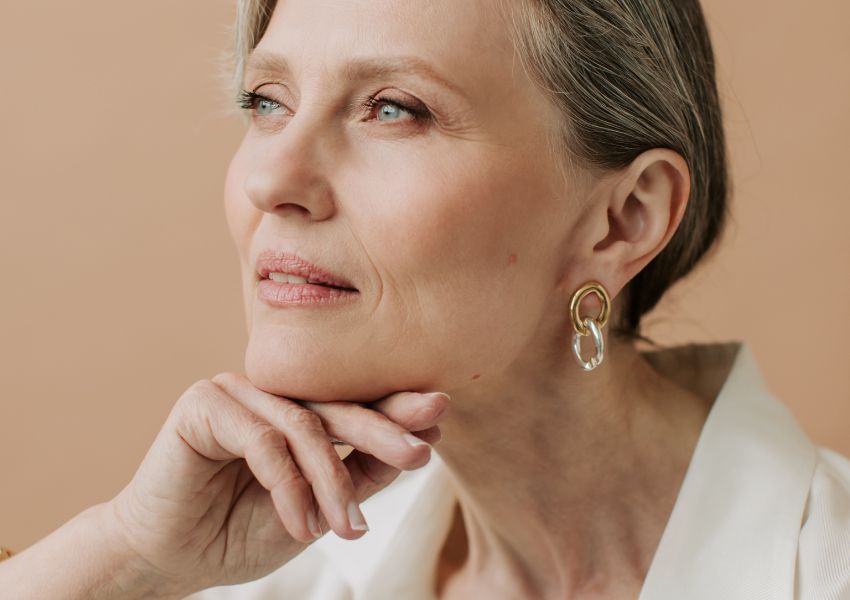
Best facial rejuvenation treatments for 60-year-olds
There are no universal aesthetic medicine treatments for a 60-year-old woman that would be best for every woman. The skin at this age ages in a multidimensional and individual way. The ageing process includes not only the appearance of wrinkles, but above all the gradual loss of skin quality, its densities, flexibility and natural tissue volumes. There is also a weakening of collagen-elastin scaffolding, slowing down the regenerative processes and changes in the deeper layers that affect the oval face and proportions.
For this reason, effective action anti-aging should not be based on a single aesthetic medicine treatment, but on a a holistic, considered approach, which takes into account the different mechanisms of skin ageing. The best aesthetic and biological results are obtained by combined strategy, which uses several methods that work on different levels of the skin. Each technology has a different function and addresses a different problem, so their synergistic action allows a more natural and harmonious effect to be achieved.
Micro-needle radiofrequency
Micro-needle radiofrequency is one of the key treatments in this approach, as it combines micro-damage to the skin with controlled tissue heating, which intensively stimulates fibroblasts to produce new collagen and elastin. As a result, the skin gradually becomes tighter, denser and elastic, and its structure is being restructured in real terms.
Tissue stimulators and skin regeneration
Tissue stimulators do not work like classic fillers - they trigger the skin's natural regenerative processes. Their purpose is to improve long-term skin quality by stimulating its cells to work more intensively.
As a result, the skin becomes more compact, better hydrated and more resistant to further ageing processes. The effects are not immediate, but build up gradually, ensuring that the look remains natural and unforced.
Laser therapy to improve skin texture
Laser therapy is another important element of rejuvenation therapy, as it allows it to act simultaneously on the surface of the skin and its deeper layers. Depending on the type of laser, it is possible to improve skin tone, reduce discolourations, to smooth out fine lines and wrinkles and even out her structure.
After a series of laser treatments, the skin becomes more uniform, brighter and visually younger, as it regains a better ability to reflect light, which is important for the perception of age. Laser therapy can also be used to close rodilated capillaries and reductions erythema, which often intensify with age and make the skin look tired and irritated.
The laser action also stimulates skin regeneration processes and stimulates the fibroblasts for production kolagen. It is improving voltage, skin elasticity and overall quality. The face regains a fresher, more radiant and rested appearance without the effect of artificially exaggerated features.
Laser vessel sealing
Laser vessel sealing is one of the most effective treatments for people over the age of 60, whose skin becomes thinner, more fragile and prone to the formation of dilated capillaries and erythema. Visible „spider veins” most commonly appear on the cheeks, nose and chin, causing uneven skin tone and giving the face a tired look.
The treatment involves the use of laser energy, which acts selectively on the blood vessels, leading to their shrinkage and gradual closure without damaging the surrounding tissues. As a result, the skin becomes more uniform and the complexion gains a calmer and healthier appearance.
Hyaluronic acid and improved skin hydration
Hyaluronic acid is an important part of comprehensive rejuvenation, as it improves the skin hydration and smooths wrinkles. As we age, its natural levels decrease, leading to dryness, loss of flexibility and deepening of furrows.
The right formulations help restore the skin's water binding capacity, making it more firm, smooth and radiant.
A good complement to the therapy is mesotherapy, which delivers active substances directly to the skin's deeper layers. This treatment, carried out using hyaluronic acid, vitamins and peptides, supports hydration, improves skin tension and stimulates its natural regeneration.
This makes the skin in 60-year-old women more radiant, supple and more responsive to other rejuvenating treatments.
Volumetrics and facial oval reconstruction
One of the key problems of adulthood is loss of facial oval. With age, there is a gradual reduction in the amount of subcutaneous adipose tissue in the cheek and temple area, and weakening of the skin's support structures. Tissues begin to move under the influence of gravity.
The effect is a drooping of the cheeks, a deepening of the nasolabial furrows, loss of clear jawline and a less harmonious facial contour.
In such cases, the following applies facial volumetrics, This is the reconstruction of lost structures in strategic areas such as the cheeks, temples or jawline. The treatment restores the face to its proper proportions and improve its structural support.
The aim is not to change the facial features, but to subtly restore the volume lost in the ageing process. Properly performed facial modelling achieves a harmonious rejuvenation effect without altering facial expressions or individual beauty characteristics.
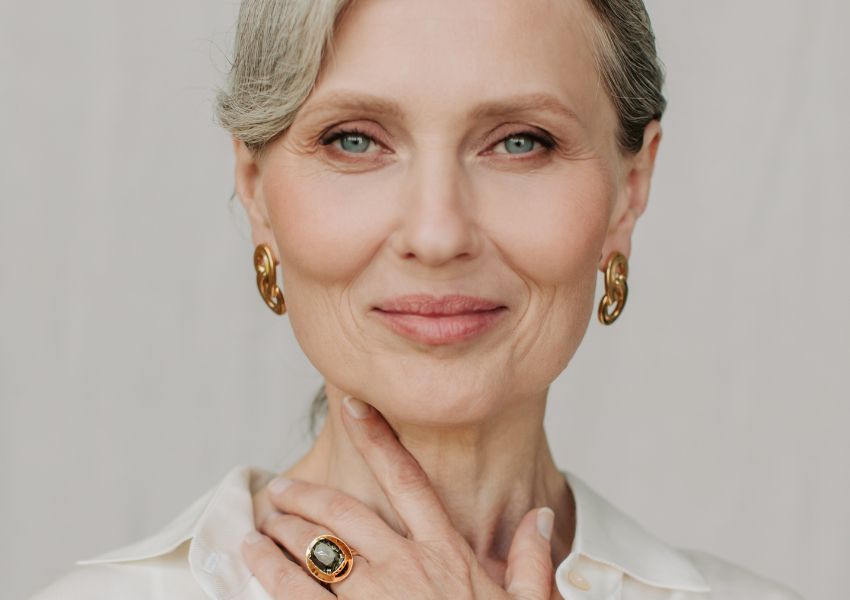
Neck treatments for a 60-year-old woman
Neck treatments for people over 60 are primarily aimed at improving the skin tensions, a reduction in its flaccidity and alignment skin structures. The skin in this area ages faster than on the face because it is thinner and has less sebaceous glands, which promotes dryness and the formation of horizontal wrinkles and so-called „the rings of Venus".
Various methods are used in aesthetic medicine to improve the skin of the neck, such as laser therapy, micro-needle radiofrequency, tissue stimulators or mesotherapy. These treatments stimulate natural regenerative processes, support the production of collagen and improve skin hydration, making it firmer and smoother.
Biostimulation as a modern approach to improving appearance
The contemporary approach to aesthetic medicine is increasingly focused on biostimulation, i.e. stimulating the skin to regenerate itself rather than mechanically „repairing” it. This approach is more physiological and long-term, as it activates the body's natural repair processes.
As a result, the skin not only looks younger, but actually improves its structure from within. Such rejuvenation is more harmonious, does not alter the facial features in an unnatural way and preserves the individual character of the face, which is particularly important in the 60+ age group.
What facial treatments for a 60-year-old?
How can you make your face look younger after the age of 60 without altering its natural features? There is no single treatment that can address all the signs of ageing. Wrinkles, loss of firmness, dryness, reduced skin elasticity and changes to the facial contour each require a different approach.
Therefore, when it comes to mature skin, it is not only the choice of a specific treatment that matters, but above all a proper assessment of its condition. Facial treatments They may be aimed, amongst other things, at improving skin firmness and quality, moisturising the skin, stimulating regenerative processes or correcting specific signs of ageing.
During consultation A specialist can assess the condition of the skin, the extent of the changes and the patient’s expectations, and then discuss the available treatment options. The choice of treatments should take into account the individual needs of the skin, its condition and the desired outcome.
FAQ - treatments and skin care after 60 years of age
Are aesthetic medicine treatments after the age of 60 safe?
Yes, provided they are carried out after prior consultation and matching the therapy to the skin condition. It is crucial that contraindications are ruled out and the intensity is individually adjusted aesthetic medicine treatments, because mature skin is more sensitive and slower to regenerate.
Is it still possible to achieve a natural rejuvenation effect at this age?
Yes, however, the aim is not to „turn back the clock” but to improve the skin quality. Modern therapies focus on restoring density, improved tone and evening out texture, so the face looks fresh but still natural.
How often should aesthetic treatments be performed after the age of 60?
The frequency depends on the type of therapy. Stimulating treatments is usually performed in series and then switched to a maintenance regimen. In many cases, periodic follow-up visits and single booster treatments are sufficient.
Can different methods of rejuvenation be combined?
Yes, and it is often even recommended. Combining different technologies allows you to work on different layers of the skin - from the epidermis to the deep tissues - which gives more comprehensive and lasting results than a single treatment.
What are the most common mistakes in mature skin care?
The most common mistakes are over-aggressive 1TP4Leaching, the use of multiple strong ingredients at the same time and a lack of regularity. It can also be a problem to skip sun protection, which is crucial in slowing down the skin ageing.
Does lifestyle affect the effects of treatments?
Yes, a very big one. Even the best-suited therapies will not be fully effective without adequate hydration, sleep and a supportive diet mature skin. Factors such as stress, smoking or excess sugar can significantly undermine the effects of the treatments.
After how long do you see the results of rejuvenation treatments?
Depending on the method - some of the effects appear gradually, as many therapies work by stimulating the skin's natural regenerative processes. The most lasting results are visible after a few weeks or after completing the entire series rejuvenation treatments.
Sources:
- PubMed „Skin anti-ageing strategies”
https://pmc.ncbi.nlm.nih.gov/articles/PMC3583892/ - PubMed „The Effectiveness of Injectable Hyaluronic Acid in Improving Facial Skin Quality: A Systematic Review”
https://pubmed.ncbi.nlm.nih.gov/37038447/ - PubMed „Radiofrequency Microneedling for Facial Rejuvenation: A Systematic Review”
https://pubmed.ncbi.nlm.nih.gov/41947517/ - Harvard Health „Skin care for ageing skin: Minimising age spots, wrinkles and under-eye bags”
https://www.health.harvard.edu/healthy-aging-and-longevity/skin-care-for-aging-skin-minimizing-age-spots-wrinkles-and-undereye-bags - American Academy of Dermatology „How to look after your skin in your 60s and 70s”
https://www.aad.org/public/everyday-care/skin-care-basics/care/skin-care-in-your-60s-and-70s - American Society of Plastic Surgeons „What are the best non-surgical treatments for mature skin?”
https://www.plasticsurgery.org/news/articles/national-mature-womens-day-what-are-the-best-nonsurgical-procedures-for-mature-skin


 +48 600 100 177