
 Katarzyna Pawłowska
 14.10.2026
 Table of contents
Itching, redness, dry skin and recurring skin lesions can have various causes. One of these is atopic dermatitis (AD) – a chronic inflammatory condition that can affect both children and adults. Its symptoms can be troublesome, particularly when the itching makes it difficult to sleep and the irritation keeps returning despite the use of skincare products.
However, not every itchy rash is atopic dermatitis. Similar symptoms may also accompany urticaria, and the lesions on the face are sometimes mistaken for acne. How can you recognise the tell-tale signs, what might make skin problems worse, and when should you consult a dermatologist?
What is atopic dermatitis?
Atopic dermatitis It is a chronic, inflammatory skin condition associated, amongst other things, with a disruption of the skin’s protective barrier and an abnormal immune response. The skin loses water more quickly than a normally functioning epidermis, causing it to become dry, sensitive and more susceptible to irritants.
AZS It often begins in childhood, but may also persist into adulthood. In some people, symptoms do not appear until later in life. The course of the condition varies – periods of exacerbation alternate with periods when the symptoms are less noticeable.
For development atopic dermatitis Genetic predisposition, the functioning of the immune system and environmental factors all play a role. Some patients also suffer from other atopic conditions, such as asthma or allergic rhinitis.
It is worth emphasising that Atopic dermatitis is not a contagious disease. You cannot catch it through touch, contact with someone who is ill, or by sharing the same objects.
What are the symptoms of atopic dermatitis?
The most distinctive a symptom of atopic dermatitis is itchy skin, which is often accompanied by dryness and irritation. Scratching provides temporary relief, but can further damage the skin and exacerbate the inflammation.
Typical symptoms include:
- Dry skin – rough, tight and prone to irritation.
- Redness and inflammation – visible as patches or lumps; on darker skin, the lesions may also take on brown, purple or greyish hues.
- Skin flaking – particularly in areas that are very dry.
- Cracks and scratches – they may appear as a result of intense scratching.
- Recurrent skin lesions – symptoms may subside and then flare up again.
- Thickening of the skin – in areas that are constantly exposed to scratching.
Itching It can be particularly troublesome in the evening and at night. For some people, it affects the quality of their sleep, their concentration and their general well-being.
However, itchiness and dryness alone are not sufficient to diagnose atopic dermatitis. Similar symptoms may also occur in other skin conditions, so if in doubt, it is advisable to consult a doctor.
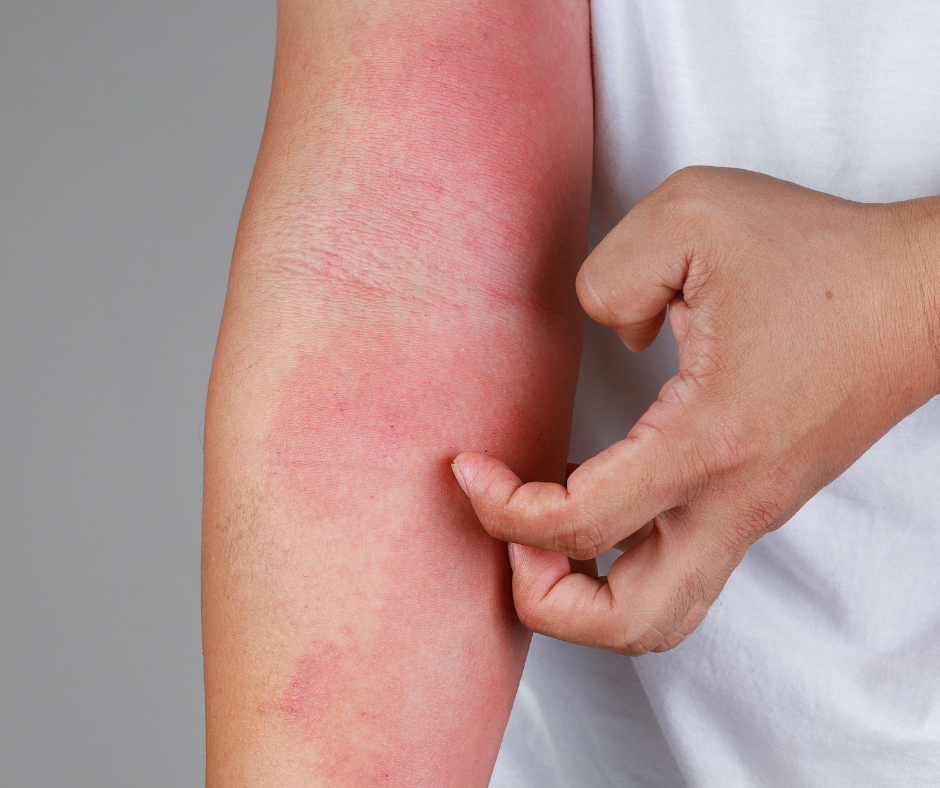
Where does atopic dermatitis most commonly occur?
The location of the lesions depends, amongst other things, on the patient’s age and the course of the disease.
In infants AZS It often affects the cheeks, scalp and limbs. In older children and adults, lesions frequently appear in the elbow and knee creases, on the neck, palms and wrists.
In adults, the condition can also affect the face and eyelids. Lesions on the hands can be particularly troublesome, as frequent contact with water, detergents and cleaning products can further weaken the skin’s protective barrier.
The lesions do not occur in the same places in every patient. Their location is one of the factors taken into account during diagnosis.
What causes atopic dermatitis?
There is no single cause of atopic dermatitis. The disease develops as a result of the interaction of genetic, immunological and environmental factors.
A weakened skin barrier plays an important role. Healthy skin limits water loss and protects the body from external factors. In atopic dermatitis, this function is impaired, which contributes to dryness, irritation and the development of inflammation.
Symptoms may be exacerbated by, amongst other things:
- dry air and low humidity;
- hot baths and excessive sweating;
- detergents and cosmetics containing irritants;
- stress and lack of sleep;
- rough fabrics that make the itching worse;
- certain allergens or other individual triggers.
Not all of these factors will be a problem for every patient. Rather than cutting out a whole host of products and ingredients from your daily life, it is worth noting the situations in which your symptoms actually worsen.
Atopic dermatitis versus hives and acne – how can you tell them apart?
An itchy rash, redness or papules may look similar, but they do not always have the same cause. Atopic dermatitis, urticaria and acne They differ in the appearance of the lesions, their duration and the mechanism by which they develop.
Atopic dermatitis – dryness and chronic itching
In atopic dermatitis, the skin is usually dry, rough and irritated. Red or discoloured patches, flaking, cracks and scratch marks may appear.
The following are characteristic recurrent lesions and persistent itching. Symptoms usually last for several days or longer, and their severity may vary over time.
Hives – raised welts that disappear quickly
Urticaria It most commonly presents as sudden-onset, raised and itchy blisters. These may resemble the marks left by contact with stinging nettles, vary in size and appear on various parts of the body.
The most important indicator is how long a single lesion lasts. A typical urticarial wheal disappears without a trace within 24 hours, although new lesions may appear in other places during that time.
Unlike atopic dermatitis, urticaria does not usually cause chronic flaking or dryness of the skin within the welts themselves. It may be linked, amongst other things, to infections, medicines, certain foods or physical factors. However, it is not always possible to identify the cause.
If hives are accompanied by swelling of the tongue or throat, difficulty breathing or problems swallowing, immediate medical attention is required.
Acne – blackheads, papules and pustules
Acne most commonly appears on the face, back, chest and shoulders. It is characterised by open blackheads, resembling black dots, and closed blackheads, appearing as small, pale lumps.
Red papules and pustules containing pus may also occur, and in more severe cases, deep and painful nodules. These lesions develop as a result of, amongst other things, blocked hair follicles, excessive sebum production and inflammation.
Various methods are used to treat acne, chosen according to the type and severity of the lesions. One option is laser treatments for acne, which may support treatment in certain cases. Depending on the type of device and the parameters used, the laser can target inflammation, bacteria associated with the development of acne, or sebum production. However, not every technology works in the same way, and laser treatments are not a substitute for standard dermatological treatment. In the case of active inflammatory lesions, a tendency towards hyperpigmentation or scarring, it is advisable to consult a dermatologist before deciding on treatment.
Laser treatment of acne It may also be considered as part of a broader treatment plan, particularly when existing methods have not produced the expected results. The choice of appropriate technology should take into account the condition of the skin, the phototype and any possible contraindications.
Unlike atopic dermatitis, acne does not usually cause widespread, dry and itchy skin. However, some anti-acne treatments can cause dryness and irritation, which further complicates skincare.
The key differences between atopic dermatitis, hives and acne
| Feature | Atopic dermatitis | Urticaria | Acne |
|---|---|---|---|
| Appearance of the changes | Dry, irritated, and sometimes flaky patches | Raised, itchy blisters | Blackheads, papules, pustules |
| Itching | Often strong | Often strong | It is not usually the main symptom |
| Duration of a single change | Usually a few days or longer | A typical blister takes up to 24 hours | Usually days or weeks |
| Typical locations | Elbows and knees, hands, neck, face | Any part of the body | Face, back, chest |
| A distinctive feature | Dryness and recurrent inflammation | The rapid appearance and disappearance of blisters | Blackheads and lesions associated with hair follicles |
The differences outlined above are for guidance only. It is not always possible to make a definitive diagnosis based solely on the appearance of the skin. Atopic dermatitis may also occur alongside other skin conditions.
How should you look after skin affected by atopic dermatitis?
Proper skincare helps to reduce dryness, support the skin’s protective barrier and alleviate discomfort. However, it is not a substitute for medical treatment if there is active inflammation.
1. Use emollients regularly
Emollients These are products that soften the skin and help to reduce water loss. They may come in the form of creams, lotions, ointments or emulsions.
It is best to choose products designed for dry and sensitive skin, free from fragrances, which can further irritate the skin. It is advisable to use emollients every day, even when symptoms are less severe.
There is no single product that suits everyone. What matters is the product’s composition, how well your skin tolerates it, and how regularly you use it.
2. Avoid over-drying
Long, hot baths and harsh cleansing products can make dry skin worse. A better option is to take shorter baths in lukewarm water and use gentle cleansing products.
After washing, it is a good idea to gently pat the skin dry with a towel, without rubbing too hard, and then apply an emollient.
3. Introduce new cosmetics carefully
In the case of atopic dermatitis, an extensive skincare routine is not always beneficial. It is advisable to choose products with simple formulations and introduce them one at a time, whilst monitoring the skin’s reaction.
If a cosmetic product causes a burning sensation, increased itching or redness, you should stop using it. If the symptoms persist, it is advisable to consult a doctor.
4. Limit your exposure to irritants
In the case of atopic dermatitis of the hands, it may help to limit contact with detergents and to wear protective gloves when cleaning. It is also a good idea to choose soft clothing that does not aggravate the itching, and to avoid overheating.
How should atopic dermatitis be treated?
Treatment of atopic dermatitis It depends on the severity of the symptoms, the patient’s age, the location of the lesions and the response to previous treatment.
The key is to use emollients regularly. During flare-ups, your doctor may recommend topical anti-inflammatory medicines, such as corticosteroids or calcineurin inhibitors. In certain cases, phototherapy or systemic treatment may also be used.
You should not choose medication yourself based solely on the appearance of the rash. The symptoms of atopic dermatitis may resemble those of other conditions, and taking the wrong course of action may delay a correct diagnosis.
A dermatology consultation is particularly important when:
- itching makes it difficult to sleep or carry out daily activities;
- the lesions are extensive or recur frequently;
- the skin cracks, hurts or starts to ooze;
- the treatment received so far has not led to any improvement;
- signs of a possible infection are appearing.
Rapidly spreading, painful lesions, a fever or numerous blisters require urgent medical assessment.
Can atopic dermatitis be cured?
Atopic dermatitis is a chronic condition, and its course can vary over the years. In some children, the symptoms subside over time, whilst in others they persist into adulthood.
There is no single method that guarantees a permanent cure for all patients. However, it is possible to effectively manage symptoms, reduce flare-ups and improve quality of life.
It is very important to combine regular self-care, avoiding known factors that exacerbate symptoms, and treatment tailored to the stage of the disease.
The aim of the treatment is not only to improve the appearance of the skin, but above all to reduce itching, restore the skin’s protective barrier and prevent further flare-ups.
Atopic dermatitis and cosmetic treatments
People with atopic dermatitis should approach cosmetic treatments with caution. Skin with a compromised protective barrier may react more strongly to active ingredients, friction, temperature and other stimuli.
During a flare-up of the condition, where there is active inflammation, cracks or weeping lesions, treatments carried out on the affected skin should be avoided. In such cases, a consultation with a dermatologist should be prioritised.
Even during a period of improvement, the choice of treatment should take into account the current condition of the skin and its tolerance. Not every treatment intended for sensitive skin will be suitable for someone with AZS.
Before the treatment, it is advisable to inform the specialist of any medical conditions, any medication you are taking and any previous reactions to cosmetic products.
Atopic dermatitis – when should you see a dermatologist?
Recurrent itching, dryness and irritation can significantly affect your day-to-day life. If you are unsure whether these symptoms indicate atopic dermatitis, hives or acne, it’s not worth limiting yourself to testing cosmetics on your own.
A dermatologist will assess the appearance and location of the lesions, how long they have been present, and any accompanying symptoms. On this basis, they can make a diagnosis and determine the appropriate course of treatment.
An accurate diagnosis helps to avoid unnecessary trial and error with skincare and enables you to start the appropriate treatment sooner.
Sources:
- American Academy of Dermatology (AAD), „Clinical guideline on atopic dermatitis„. https://www.aad.org/member/clinical-quality/guidelines/atopic-dermatitis
- Sidbury R. et al., „Guidelines for the management of atopic dermatitis in adults using topical therapies”, Journal of the American Academy of Dermatology, 2023. https://pubmed.ncbi.nlm.nih.gov/36641009/
- National Health Service (NHS), „Atopic eczema.”
https://www.nhs.uk/conditions/atopic-eczema/ - National Health Service (NHS), „Hives.”
https://www.nhs.uk/conditions/hives/ - American Academy of Dermatology (AAD), „Acne: Overview.”
https://www.aad.org/public/diseases/acne/really-acne/overview - Chu D. K. et al., „Guidelines on atopic dermatitis (eczema): 2023 American Academy of Allergy, Asthma and Immunology/American College of Allergy, Asthma and Immunology Joint Task Force on Practice Parameters”, Annals of Allergy, Asthma & Immunology, 2024. https://pubmed.ncbi.nlm.nih.gov/38108679/


 +48 600 100 177